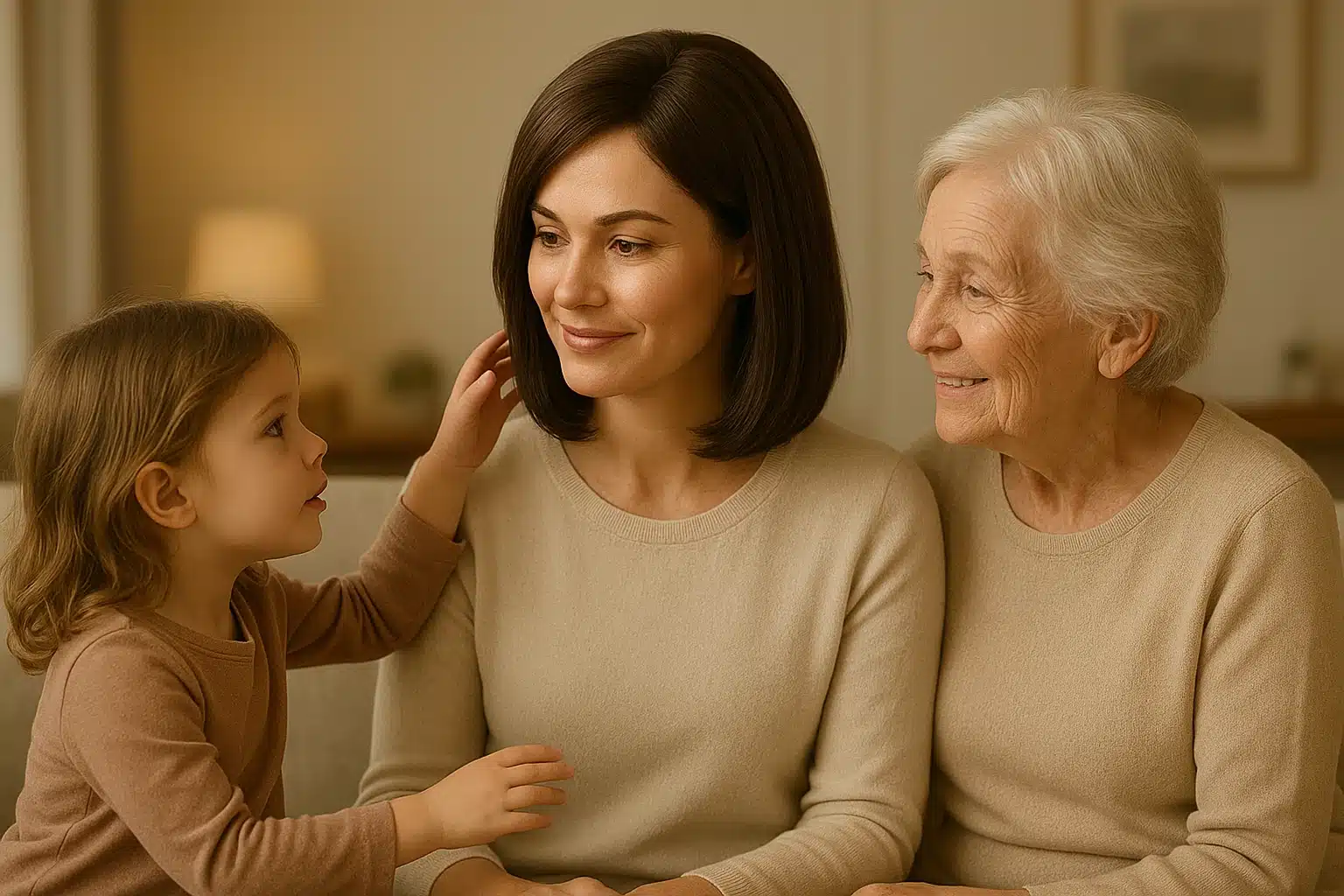
Walking into a room with a new hairstyle is often celebrated as a moment of personal reinvention. However, for those navigating hair loss due to medical conditions or genetics, the decision to wear a wig is more than a style choice—it is a journey of identity. While we often focus on how strangers might perceive us, the most delicate interactions usually happen within our own homes. Navigating wigs and social confidence when interacting with the world begins with the people closest to you: the inquisitive grandchild pulling at your hem or the elderly parent who remembers the heavy, awkward hairpieces of the past.
This guide isn’t about convincing your family to like your wig; it is about fostering understanding. By bridging the gap between your personal choice and their level of comprehension, you transform a potential source of anxiety into an opportunity for connection. Whether you are speaking to a four-year-old or an eighty-four-year-old, the goal remains the same: to normalize your experience and establish that your identity remains unchanged, regardless of what you are wearing.
The “Sandwich” Challenge: Bridging the Generational Gap
Many wig wearers find themselves in the “sandwich generation”—simultaneously caring for young children and aging parents. This unique position requires you to be a linguistic chameleon. You cannot explain alopecia or chemotherapy to a toddler the same way you explain it to a senior, yet both conversations are vital for your peace of mind.
The mistake many make is avoiding the topic entirely. Silence breeds mystery, and mystery often breeds fear. By taking control of the narrative, you remove the stigma. You are teaching your children empathy and helping your elderly relatives understand modern solutions to age-old challenges.
Part 1: Explaining Your Wig to Children
Children are naturally observant and refreshingly honest. They notice changes immediately, but they rarely judge unless they are taught to. When introducing your wig to a child, your energy dictates their reaction. If you are calm and matter-of-fact, they will be too.
The “Special Hat” Analogy (Toddlers to Age 3)
For very young children, abstract concepts like “hair loss” or “autoimmune awareness” are confusing. They deal in the tangible.
- The Concept: Frame the wig as an accessory, similar to items they already understand.
- The Script: “You know how you put on shoes to go outside or a coat when it’s cold? Mommy wears this special hair sometimes because it makes her feel happy and ready for the day. It’s just like a special hat that looks like hair.”
- The “Aha” Moment: Once they categorize the wig as “clothing” rather than a body part, the confusion usually vanishes.
The Curiosity Phase (Ages 4-7)
At this age, children are tactile learners. Their primary questions are often practical: “Does it hurt?” or “Can I take it off?”
- The Strategy: Demystify the object. If you are comfortable, let them touch the wig while it is on a stand. Show them the inside cap.
- The Script: “My natural hair is taking a long rest right now. So, I wear this hair instead. It’s soft, right? It doesn’t hurt at all—it’s actually very comfortable.”
Social Scripts for Pre-Teens (Ages 8-12)
Older children are less concerned with the mechanics and more concerned with social implications. They worry about being different or what their friends might say.
- The Strategy: Equip them with a script. They need to know what to say if a peer asks about your hair.
- The Script: “If your friends ask, you can just tell them, ‘My mom wears a wig because her hair is thinning, and she likes this style.’ It’s no big deal.”
Part 2: Discussing Wigs with Elderly Family Members
Talking to the older generation presents a completely different set of challenges. Their hesitation often stems from protection; they may associate wigs with the stigma or poor quality of decades past.
Debunking the “1970s Wig” Myth
If your mother or grandmother expresses concern about your wig looking “fake” or being “uncomfortable,” remember that her reference point is likely from 40 or 50 years ago. In previous eras, wigs were often heavy, hot, and notoriously obvious.
- The Education: Explain that technology has revolutionized the industry. Modern caps are breathable, and the fiber technology has advanced to the point where even the best human hair wigs are virtually indistinguishable from biological hair.
- The Script: “I know wigs used to be heavy and scratchy, but they aren’t like that anymore. This one is light, it lets my scalp breathe, and it looks just like my real hair used to. It actually helps me feel more like myself, not less.”
Navigating Cognitive Decline
If you are interacting with a family member suffering from dementia or memory loss, complex explanations may cause distress.
- The Strategy: Focus on the emotion, not the logic. If they ask why your hair looks different, you don’t need to explain the medical history every time.
- The Script: “I just had it done at the salon! Do you like the color?”
- The Goal: Validation and comfort are more important than factual precision in these moments.
Scenario-Based Scripts for Difficult Conversations
Sometimes, the hardest part is the opening sentence. Here are three approaches based on your specific situation:
Scenario A: Chemotherapy or Medical Hair Loss
- To Family: “As part of my treatment, I’m going to lose my hair for a while. I’ve chosen a wig that makes me feel confident so I can focus on getting better rather than worrying about how I look. I’m happy to answer any questions you have.”
Scenario B: Alopecia or Thinning Hair
- To Family: “You might have noticed my hair has been changing. I’ve decided to start wearing hair that gives me the volume I used to have. It’s a positive choice for me, and I’m really enjoying how it looks.”
Scenario C: Aesthetic Choice
- To Family: “I love the freedom of changing my style without damaging my natural hair. Wearing wigs lets me express different sides of my personality, just like changing my outfit.”
Frequently Asked Questions
Q: What if my child wants to pull on the wig?
A: This is a common fear. Establish boundaries early. Teach them that just like glasses or jewelry, the wig is delicate. “We touch with gentle hands only,” is a good mantra.
Q: My elderly parent insists I don’t need a wig and should “just be natural.” How do I respond?
A: Acknowledge their sentiment but stand firm in your comfort. “I appreciate that you think I’m beautiful either way, but wearing this makes me feel more comfortable and confident right now. It helps me go about my day without self-consciousness.”
Q: How do I explain wig maintenance to family members who are curious?
A: Treat it like any other high-quality garment. Explain that just like a silk blouse requires dry cleaning, your hair requires specific care. You can mention that you use best wig care products designed specifically to keep the fiber soft and the cap clean, which helps them understand it’s a hygienic and managed process.
Moving Forward with Confidence
The transition to wearing hair is a physical one, but the journey of explaining it is emotional. By breaking the news gently, debunking old myths, and keeping the lines of communication open, you normalize the experience for your entire household.
Remember, your family takes their cues from you. If you treat your wig with shame, they will perceive it as a secret. If you treat it with dignity—as a tool that enhances your life and restores your confidence—they will likely follow suit, becoming not just observers of your journey, but your biggest supporters.