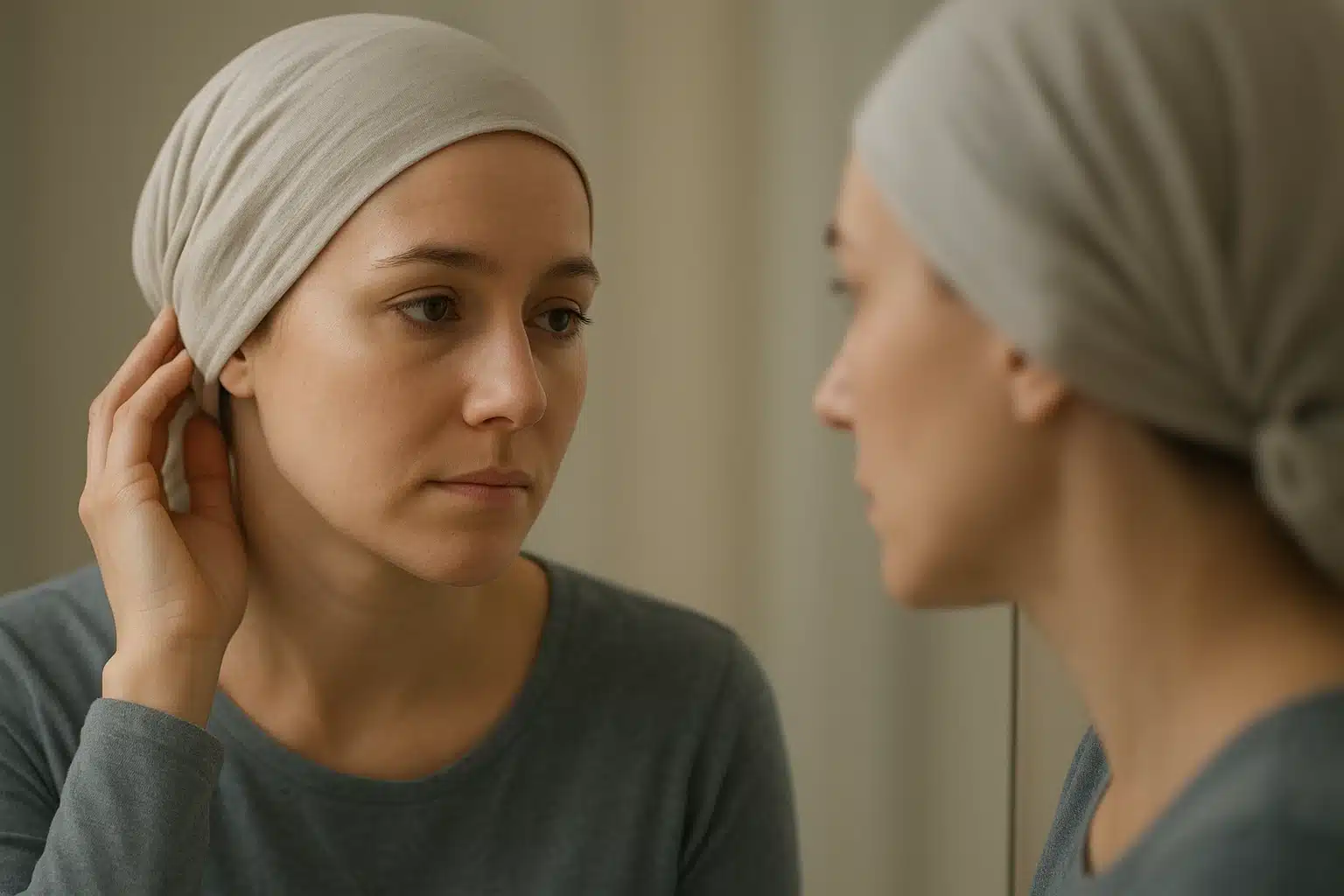
When you receive a severe medical diagnosis, your world stops. In the span of a single doctor’s appointment, your priorities violently shift toward survival, treatments, and navigating a frightening new reality. Yet, for many patients facing chronic illness or major medical interventions, a silent, secondary fear almost immediately whispers in the back of their minds: “Am I going to lose my hair? How will my body change?”
Almost as quickly as those questions arise, a crushing wave of shame follows. When you are quite literally fighting for your health, mourning your physical appearance can feel incredibly superficial. You might ask yourself why you care about your reflection when you should just be grateful to be alive. This internal battle is incredibly common, and navigating the emotional landscape of hair loss and physical changes requires immense self-compassion. Caring about how you look during a health crisis isn’t a sign of vanity; it is a fundamental human drive to preserve your identity.
The Quiet Conflict: Understanding “Double-Guilt”
If you are feeling torn between focusing on your health and grieving your appearance, you are experiencing what psychologists often refer to as “Double-Guilt.”
First, there is the overarching guilt and grief of being sick—the burden it places on your life, your family, and your finances. Second, there is the acute guilt of caring about how that sickness makes you look. Well-meaning friends, family, and even medical professionals often inadvertently compound this shame with dismissive remarks like, “It’s just hair, it will grow back,” or “At least the treatment is working.”
While these comments are usually meant to be encouraging, they profoundly invalidate your very real sense of loss. Survival focus and identity focus are not mutually exclusive; they are parallel tracks of your healing journey. It is entirely possible—and completely normal—to be deeply grateful for life-saving medicine while simultaneously being devastated by what that medicine does to your body.
Deconstructing the Myth of “Vanity”
To free yourself from this guilt, it helps to dismantle the word “vanity” itself. In our modern culture, the concept of vanity has been weaponized, often equated with self-absorption, superficiality, and an obsession with superiority over others.
But wanting to look like yourself during a medical crisis is not vanity. It is identity preservation.
When we look in the mirror and see a reflection we no longer recognize, it creates a profound psychological disconnect. Clinical studies documenting the psychology of hair loss and bodily changes reveal that preserving one’s appearance is an active defense mechanism against depression, social anxiety, and a diminished sense of self-worth.
The Science of “Enclothed Cognition”
This concept is backed by a psychological framework known as “enclothed cognition.” This theory suggests that the clothes we wear, the cosmetics we use, and the way we present our hair actually change our neurochemistry and psychological processes. Treating your appearance needs isn’t a cosmetic luxury; it acts as a clinical intervention. Maintaining your physical identity can actually lower cortisol (the stress hormone) levels, boosting your emotional resilience and supporting your immune system when you need it most.
The Sociology of the “Sick Role” and Reclaiming Privacy
Why does losing your hair or experiencing visible physical changes feel so deeply violating? Sociologist Talcott Parsons coined a concept called the “sick role.” When your illness becomes physically visible to the outside world, you are forcefully thrust into this public sick role, stripping you of your privacy and autonomy.
Suddenly, the grocery store cashier gives you a pitying look. Acquaintances ask intrusive medical questions. Your visible hair loss broadcasts a private health battle to the public without your permission.
Taking steps to preserve your appearance is a powerful tool to control your own narrative. It allows you to decide when, where, and to whom you disclose your illness. It provides a protective shield, allowing you to go about your day simply as you, rather than as “the patient.”
Navigating the Emotional Storm: Finding Comfort in Words
During the hardest days of your health journey, the emotional burden can feel too heavy to carry alone. Many people naturally seek out validation, searching for quotes with chronic illness themes or feeling guilt quotes just to know someone else understands their pain.
If you are currently combating self-blame, let these validating truths serve as a comforting pause point:
- It is okay to not be okay. You do not have to perform toxic positivity for the comfort of others.
- It is okay to be sad. Grieving the loss of your hair, your energy, or your previous physical self is a necessary step in processing your diagnosis.
- Your appearance concerns are valid. Recognizing the shift in your reflection is a natural byproduct of your awareness, not a sign of selfishness.
Practical Coping Strategies: Moving from Guilt to Self-Advocacy
Moving from passive validation to active self-advocacy is a crucial step in your emotional recovery. Here are actionable ways to reclaim your autonomy:
1. The “Micro-Identity” Technique
When major parts of your appearance are out of your control, find small, manageable ways to express your personal style. This could be wearing a beautifully patterned, soft headwrap, applying a bold lip color on days you feel washed out, or choosing comfortable clothing that makes you feel vibrant.
2. Boundary-Setting Scripts
You have the right to protect your peace. When someone minimizes your appearance concerns, you can use respectful but firm scripts to set boundaries:
- “I know you’re trying to help by focusing on the positive, but losing my hair is really painful for me, and I just need to be sad about it right now.”
- “I am grateful the treatment is working, but my hair is a big part of my identity. It’s okay for me to grieve both things at once.”
3. Financial Self-Compassion
Many patients feel selfish spending money on appearance-related items when medical bills are piling up. It is vital to reframe this: investing in a high-quality cranial prosthesis (medical wig), cold caps, or comfortable headwear is not a frivolous luxury. It is an essential investment in your mental health, emotional stability, and quality of life.
Your Identity Preservation Checklist
On days when cognitive exhaustion sets in and your energy is low, use this simple checklist to ground yourself and validate your experience.
I acknowledge that my appearance concerns are real and valid. I will practice 5 minutes of mindful self-compassion when looking in the mirror. I give myself permission to seek cosmetic and cranial support without shame. I reclaim my right to choose who gets to see my illness and when.
Frequently Asked Questions (FAQ)
Is it normal to care about my hair when I have a serious illness?
Absolutely. Caring about your hair and appearance is deeply tied to your sense of self and continuity. It is a normal, psychological survival instinct to want to recognize the person looking back at you in the mirror.
How do I explain my appearance needs to my healthcare team without feeling silly?
Doctors are trained to treat the disease, but the best healthcare providers treat the whole patient. You can simply say: “I understand we are focusing on my physical healing, but the cosmetic side effects are heavily impacting my mental health. Can we discuss options like scalp cooling, or can you provide a prescription for a cranial prosthesis?”
What does it mean to be “in vain” when you are seriously ill?
True vanity implies excessive pride or a desire to be superior to others. When you are ill, wanting to maintain your appearance is the exact opposite of vanity—it is a modest desire to simply remain yourself and avoid the intrusive gaze of the public.
Next Steps on Your Journey
Overcoming the guilt of prioritizing your appearance doesn’t happen overnight. It requires unlearning decades of societal messaging that tells us caring about our looks is superficial. As you continue to navigate your health challenges, remember to extend the same profound grace to yourself that you would offer to a loved one in your position.
Take things one day at a time, allow yourself to feel the full spectrum of your emotions, and know that taking steps to preserve your personal identity is one of the bravest forms of self-care you can practice.