There is nothing quite like the feeling of slipping on a brand-new wig. The texture is flawlessly smooth, the movement is incredibly natural, and the confidence it brings is undeniable. But if you wear wigs regularly, you know the frustration that often follows a few weeks later: the hair at the nape of your neck begins to feel crunchy, tangles become a daily battle, and that beautiful, fluid movement starts to look stiff. If you’ve ever wondered why your alternative hair seems to degrade so quickly, you are not alone, and more importantly, you are not to blame.
The secret to a long-lasting, beautiful wig lies in understanding exactly what the hair is made of and how it responds to its environment. A crucial part of preventing this damage is understanding the structural foundation of your piece. Exploring the anatomy of a perfect wig, mastering hairline density and texture reveals how the density and ventilation of a unit directly dictate how friction is distributed across the hair fibers. When you combine this structural knowledge with a little bit of material science, you unlock the ability to not just maintain your wig, but completely restore its original glory. Let’s explore the true causes of wig wear and tear, and how the experts keep alternative hair looking flawless.
The “Nape Crisis” and the Science of Friction Frizz
If you look closely at a worn wig, 90% of the damage typically starts in one specific place: the nape of the neck. We call this the “Nape Crisis.” This area is ground zero for friction. Every time you turn your head, the fibers rub against your collar, your skin, and your sweat.
When beginners see this damage on a synthetic wig, they often describe the hair as “dry.” But here is the first major “aha moment” of wig care: synthetic hair cannot be dry because it cannot hold moisture.
What you are actually seeing is called friction frizz, which is a form of mechanical deformation. Think of a synthetic fiber like a perfectly smooth, microscopic plastic ribbon. When that ribbon rubs against your heavy winter coat all day, the friction stretches the plastic beyond its elastic limit. It creates microscopic crinkles and bends along the hair shaft. Because the fibers are no longer smooth, they snag on one another like microscopic velcro, leading to severe tangling.
Understanding that synthetic frizz is a physical shape problem rather than a hydration problem completely changes how we must treat it.
The Fabric Softener Trap: Why Popular DIY Hacks Fail
If you search the internet for ways to fix a frizzy synthetic wig, you will inevitably stumble across the infamous “fabric softener trick.” Community forums and social media are full of tutorials claiming that soaking your wig in laundry softener will magically restore it.
While it might feel softer on day one, a week later, the wig usually feels sticky and tangles worse than before. Why?
Fabric softeners are formulated with cationic surfactants designed to coat highly porous organic materials, like cotton t-shirts. Synthetic wig fibers are non-porous plastics. When you apply fabric softener to a wig, it leaves behind a gummy chemical film on the outside of the fiber. This film acts as an electrostatic magnet, attracting dust, dirt, and your skin’s natural sebum. This buildup dramatically increases friction, accelerating the destruction of the fiber.
The Professional Alternative: Instead of laundry products, expert stylists rely on silicone-based professional restorers (look for ingredients like dimethicone or cyclomethicone). Silicone provides a micro-fine, non-sticky slip that reduces friction without acting as a dirt magnet.
Identifying Your Fiber: The Crucial First Step
Before applying any restoration technique, you must identify your wig’s fiber. Treating a synthetic wig like human hair (using heavy moisturizing oils) or a human hair wig like synthetic (using high heat without heat protectant) is the fastest way to ruin your investment.
- Traditional Synthetic: Holds its style perfectly after washing. Cannot tolerate dry heat (like curling irons).
- Heat-Friendly Synthetic: Requires heat to change or smooth the style. Tends to experience friction frizz faster than traditional synthetic but can be smoothed out with specialized heat tools.
- 100% Human Hair: Behaves just like biological hair. Requires constant hydration and styling after every wash.
The Restoration Protocols: Step-by-Step Texture Recovery
Once you know your fiber, you can apply the correct scientific protocol to reverse the damage.
Protocol A: Traditional Synthetic (The Steaming Method)
Traditional synthetic fibers (usually made of modacrylic or acrylic) have what scientists call a low Glass Transition Temperature. If you touch a dry flat iron to them, the thermal energy transfers too fast, melting the plastic instantly.
To restore a frizzy traditional synthetic wig, professionals use wet heat (steam). Steam at 212°F distributes heat evenly and gently.
- Secure the wig to a canvas block head using T-pins.
- Gently detangle with a wide-tooth comb, starting from the bottom and working your way up.
- Hold a handheld garment steamer a few inches from the frizzy sections.
- As the steam hits the hair, use your wide-tooth comb to gently pull the fibers straight. The steam relaxes the polymer bonds just enough to smooth out those microscopic crinkles without melting the hair.
Protocol B: Heat-Friendly Synthetic (Precise Thermal Realignment)
Unlike traditional synthetics, heat-friendly synthetics actually need dry heat to smooth out friction frizz.
- Pin the wig securely to your block head.
- Section the hair into small, manageable pieces.
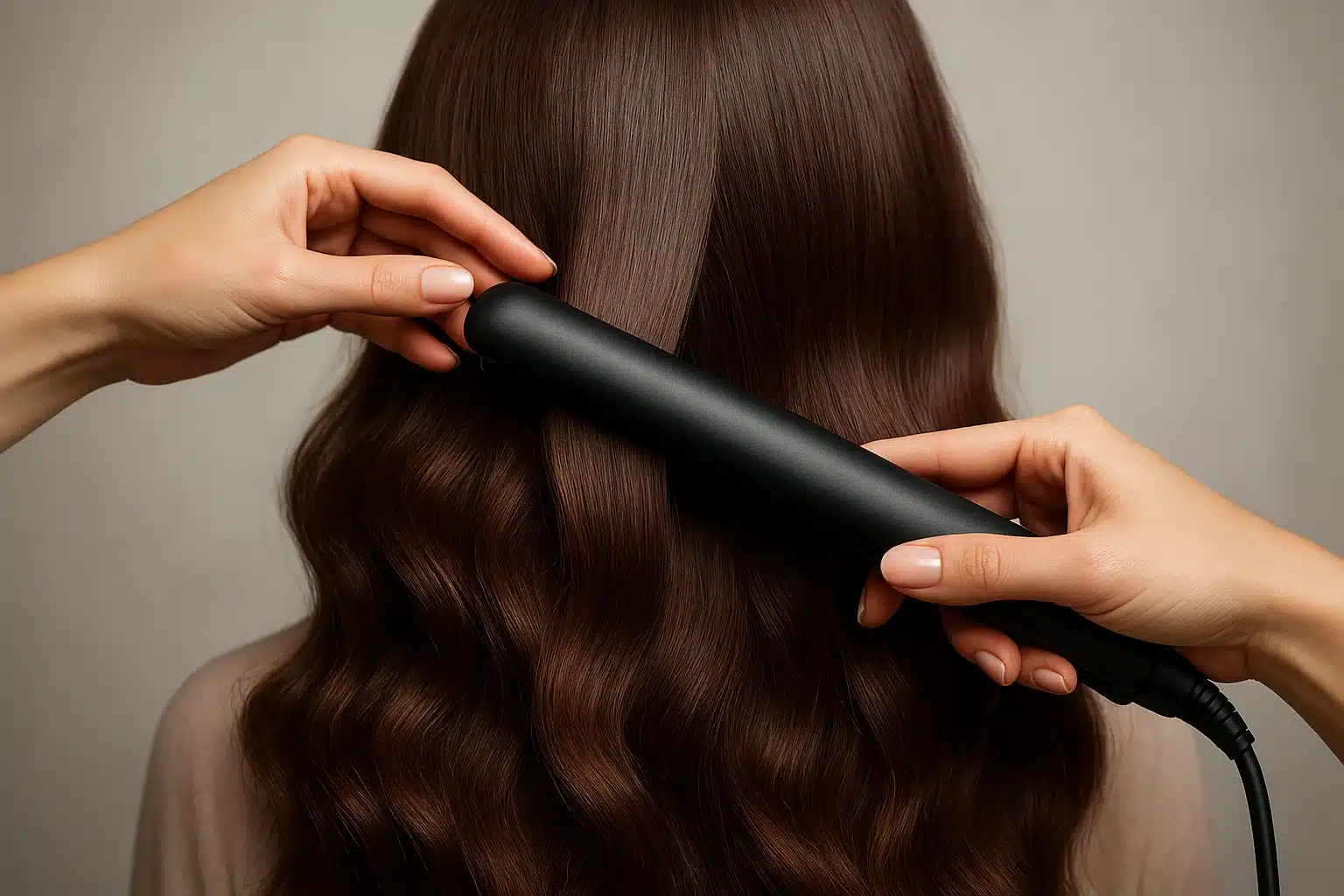
- Using a temperature-controlled flat iron set strictly between 270°F and 280°F, slowly pass the iron over the frizzy sections while following closely with a fine-tooth heat-resistant comb. The controlled heat realigns the stretched polymers, making the fiber smooth and straight again.
Protocol C: Human Hair (Deep Hydration & Cuticle Sealing)
Because human hair wigs do not receive natural oils from a scalp, their cuticles can easily dry out and lift, causing friction and tangling.
- Wash with a sulfate-free, deeply hydrating shampoo.
- Apply an intensive moisture masque, avoiding the hand-tied knots at the base of the wig (which can loosen if conditioned).
- Rinse with cool water to seal the hair cuticle, and always apply a salon-grade heat protectant before blow-drying or styling.
Advanced Styling: The “Shock Cooling” Principle for Perfect Curls
One of the most common complaints among intermediate wig wearers is: “I tried to curl my heat-friendly synthetic wig, but the curls fell flat immediately!”
This happens because synthetic fibers are polymers. When you apply heat with a curling wand, you are relaxing the molecular bonds, making the plastic malleable. However, the new shape is only locked in when the fiber cools completely.
If you release a hot curl from the wand and let it drop, gravity will stretch the warm, soft polymers right back into a straight line.
The Solution: The “Pin & Cool” Method.When you curl a section of synthetic hair, remove the wand, but keep the hair gathered in its coiled shape. Pin the coil directly to the wig block using a metal duckbill clip. Leave it pinned until the hair is completely cool to the touch (this is the “shock cooling” phase). Once you unpin it, the curl memory will be permanently locked in until you apply heat to it again.
Curling Kinky Straight Wigs
For textured or kinky-straight synthetic units, you want to preserve that beautiful natural volume while adding a wave. Use lower heat, larger sections of hair, and always use the Pin & Cool method. Be gentle when combing out the cooled curls; use your fingers or a wide-tooth comb rather than a brush to keep the textured crimp intact.
The Ultimate Wig Thermal Guardrail Guide
To prevent irreversible damage, keep this temperature cheat sheet handy when styling your alternative hair:
| Fiber Type | Safe Heat Tools | Maximum Temperature Limit | Notes |
|---|---|---|---|
| Traditional Synthetic | Handheld Steamers ONLY | 212°F (Steam) | Never use dry flat irons, curling wands, or hot blow dryers. |
| Heat-Friendly Synthetic | Flat irons, Curling Wands | 270°F – 280°F | Must use the “Pin & Cool” method to lock in styles. |
| Human Hair | All Professional Salon Tools | Up to 350°F | Always use a high-quality thermal protectant spray. |
Frequently Asked Questions (FAQ)
How do I fix a frizzy tangled wig?
Start by gently detangling from the ends upward with a wide-tooth comb. Identify your fiber type: if it is traditional synthetic, use a handheld steamer to relax the frizz. If it is heat-friendly synthetic, use a flat iron on a low setting (270°F) to smooth the fibers.
Why is my synthetic wig dry and crunchy at the nape?
Your wig isn’t dry; it is experiencing “friction frizz” (mechanical deformation). The constant rubbing against your neck and collar has stretched the plastic fibers beyond their elastic limit, causing microscopic crimping that tangles easily.
Can you curl a straight synthetic wig?
Yes, if it is a heat-friendly synthetic wig. You can use a curling wand at a safe temperature (around 270°F). If it is a traditional synthetic wig, you cannot use a curling wand, but you can set the hair in plastic rollers and use wet steam to change the style.
How do I curl a straight wig without melting it?
Ensure your curling iron has an exact digital temperature control, never exceeding 280°F for heat-friendly synthetics. To ensure the curl stays, remember to use the “Pin & Cool” method, clipping the curl in place until it is entirely cold.
Next Steps for Your Hair Journey
Mastering wig care doesn’t happen overnight, but understanding the science behind the strands puts you miles ahead of the curve. By ditching the fabric softener, respecting the thermal guardrails of your specific fiber, and utilizing professional techniques like steaming and shock-cooling, you can dramatically extend the lifespan of your beautiful wigs.
As you continue your alternative hair journey, remember that high-quality care starts with high-quality knowledge. Take a closer look at your current wig collection, identify your fibers, and treat your units to a restorative spa day. When you understand the anatomy and material of your hairpieces, keeping them flawlessly smooth becomes less of a chore, and more of an art form.