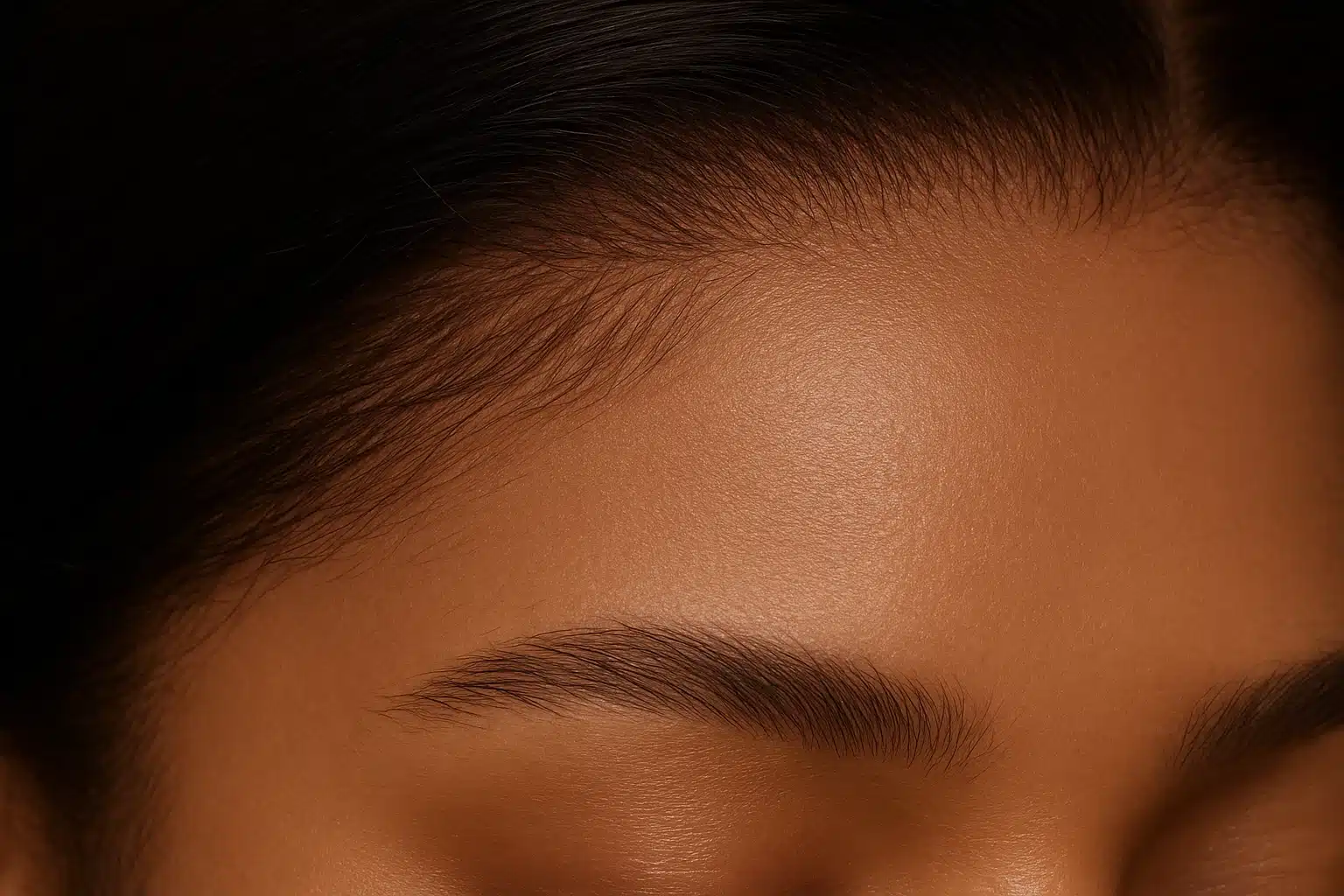
We’ve all had that moment in front of the mirror. You’ve found a style you absolutely love—the volume is perfect, the color is radiant—but you find yourself leaning in closer, scrutinizing the forehead. You’re looking for that tell-tale sign that separates a good hair day from a great wig: the realism of the hairline.
For anyone new to the world of alternative hair, the terminology can feel like a foreign language. You hear about “ventilation,” “bleached knots,” and “plucking,” but knowing what these terms mean is different from understanding why they matter to your look. The secret to a wig that looks like it’s growing directly from your scalp lies in microscopic details. These techniques are central to What Really Makes a Premium Wig? A Deep Dive into Patented Technologies, and understanding them is the first step toward wearing your hair with total confidence.
The Anatomy of a “Black Dot”
To understand why bleaching is necessary, we first need to look at how a high-quality wig is constructed. In premium lace front and monofilament wigs, individual hair strands are hand-tied to a sheer mesh base. Think of it like a microscopic latch-hook rug.
When a dark hair strand is tied onto the lace, the knot itself creates a tiny, visible dark spot. While a single knot is barely noticeable, thousands of them along a hairline can create a “dotted” effect that disrupts the illusion of skin.
Single vs. Double Knots
Not all knots are created equal.
- Single Knots: These are typically used right at the very edge of the hairline. They are smaller, harder to see, and easier to bleach.
- Double Knots: These are used further back in the wig cap to provide durability and prevent shedding. They are larger and more visible, but essential for the longevity of the piece.
The Magic of Bleached Knots
Bleaching knots is exactly what it sounds like—a chemical process used to lighten the pigment of the knot where it secures to the lace.
When done correctly, the bleach lightens the dark knot to a shade that closely resembles the lace or your scalp tone. This removes the visual “anchor” of the hair strand. Instead of seeing a black dot against your skin, the hair appears to grow seamlessly out of the follicle.
The Delicate Balance: Realism vs. Durability
If bleached knots look so much better, why aren’t all knots bleached white? It comes down to structural integrity. Bleach is a harsh chemical that can weaken the hair.
- The Sweet Spot: High-quality manufacturing involves bleaching the knots just enough to hide them (often to a light brown or blonde hue), but not so much that the hair snaps off at the root.
- The Trade-off: A wig with heavily bleached knots offers the ultimate “scalp illusion” but requires gentler care to prevent shedding over time.
Tapered Hairlines: Avoiding the “Wall of Hair”
While knots determine how the hair attaches, the hairline shape determines how it lays.
One of the biggest giveaways of a lower-quality wig is a hairline that is too dense, too straight, and too abrupt. This is often called the “helmet” or “wall of hair” effect. Natural human hair doesn’t start at 100% density right at the forehead. It grows in a gradient—fine, wispy hairs at the front that gradually thicken as you move back toward the crown.
What is a Pre-Plucked or Tapered Hairline?
A tapered hairline mimics this natural growth pattern.
- Gradient Density: The hair at the very edge is sparse, allowing you to see the scalp (or lace) through it.
- Irregular Shape: A natural hairline isn’t a perfect semicircle. It has slight dips and peaks.
- Baby Hairs: Fine, shorter hairs are often included to soften the transition between the forehead and the wig.
Beginner Beware: Common Pitfalls in Pursuit of Perfection
Many enthusiasts attempt to customize their wigs at home to achieve this look. While DIY customization is popular, it comes with risks that can ruin a premium piece.
The “Hot Roots” Effect (Over-Bleaching)
If bleach is left on the knots too long, or if the mixture is too runny, it can seep up the hair shaft. This turns the roots orange or brassy—a phenomenon known as “hot roots.”
- The Fix: If you encounter a wig with slightly brassy roots, you don’t always need to dye it. A root touch-up spray or a brow mascara in the correct shade can mask the orange tone instantly.
The Over-Plucked Hairline
In an attempt to thin out a hairline, it is easy to go too far. Over-plucking can tear the delicate lace grid or create bald patches that are impossible to hide.
- The Lesson: It is always better to buy a wig that is “pre-plucked” by a manufacturer with precise quality control standards than to attempt aggressive plucking on your own without training.
The Smart Buyer’s Inspection Checklist
You don’t need to be a stylist to spot quality. Whether you are browsing online or looking at a piece in person, use this checklist to assess the realism of the wig front:
- Check the Transition: Does the hairline look like a solid line, or does it fade in gradually?
- Inspect the Knots: Zoom in on the photos. Can you see distinct black dots at the very edge, or are they diffuse and lighter in color?
- Look for Baby Hairs: Are there shorter, wispier hairs along the perimeter to soften the edge?
- Lace Color: Does the lace appear transparent or tinted? Transparent lace is easier to blend with makeup to match your specific skin tone.
Frequently Asked Questions
Do blonde wigs need bleached knots?
Generally, no. Since the hair is already light, the knots are naturally invisible against the lace. Bleached knots are primarily a concern for darker hair colors (brunettes, black, and dark reds).
Can I bleach the knots on a synthetic wig?
No! You cannot bleach synthetic fiber. Bleach works by lifting pigment from a natural hair shaft. Applying bleach to synthetic fiber will ruin the fiber and potentially melt the lace. For synthetic wigs, look for features like “monofilament caps” which simulate the scalp without needing bleach.
How do I hide knots if I don’t want to bleach them?
If you are nervous about chemically processing your wig, you can use makeup. Apply a small amount of powder foundation that matches your scalp color to the underside of the lace. This helps camouflage the dark knots from the inside out.
Will a wig with bleached knots shed more?
It is possible. Because the bleaching process opens the cuticle of the hair at the tie-point, the knot is slightly more fragile. However, with proper care—using a wide-tooth comb and avoiding pulling on the lace—a high-quality wig with bleached knots will last a long time.
[]
Understanding the mechanics of your wig empowers you to make better choices. By looking for tapered hairlines and properly processed knots, you move beyond simply “wearing a wig” to embracing a style that feels authentically you. Whether you choose a premium synthetic piece or a human hair investment, the devil—and the beauty—is truly in the details.