There is a specific moment of hesitation every wig wearer knows well. You’re standing in front of the mirror, holding a curling iron, looking at your beautiful new hairpiece. You want to add a soft wave or sweep the bangs away from your face, but your hand hovers. The fear of melting or ruining your investment is real, and frankly, it’s valid. Traditional synthetic wigs were never designed to meet heat, and for years, the rule was strict: keep away from the oven, the fireplace, and certainly the curling wand.
But technology has evolved. Ellen Wille’s High Definition (HD) heat-friendly synthetic fibers have changed the landscape, offering the freedom to customize your look just like biological hair—if you follow the rules of physics. Before you plug in your styling tools, it is crucial to verify that your specific wig model is indeed heat-friendly. You can consult Your Complete Guide to Ellen Wille Wigs: Finding Your Perfect Style to confirm your fiber type and ensure you are starting on a safe foundation. Once you are ready, mastering the art of heat styling is less about luck and more about understanding the unique science of synthetic fiber.
The Science of HD Fiber: It’s Not Just Plastic
To style safely, you have to shift your mindset from “drying” hair to “molding” fiber. Biological hair relies on breaking hydrogen bonds (usually with water and heat) and reforming them as they dry. Synthetic HD fiber works differently—it operates on the principle of thermoplasticity.
Think of the fiber less like human hair and more like wax or glass. When you apply heat, the fiber softens and becomes pliable. However—and this is the most critical concept to learn—the style does not set while the fiber is hot. It sets only when it cools down. This phenomenon is known as the “Thermodynamic Transition.”
If you heat a curl and immediately let it drop while it’s still warm, gravity will pull the softened fiber straight before it has a chance to lock into the new shape. Understanding this “cool-to-set” requirement is the secret to styles that last.
The Essential Toolkit for Heat Styling
You cannot use the same tools on synthetic fiber that you use on biological hair without risking damage. Standard styling tools often lack the precise temperature controls required for synthetic fibers.
The Temperature “Sweet Spot”
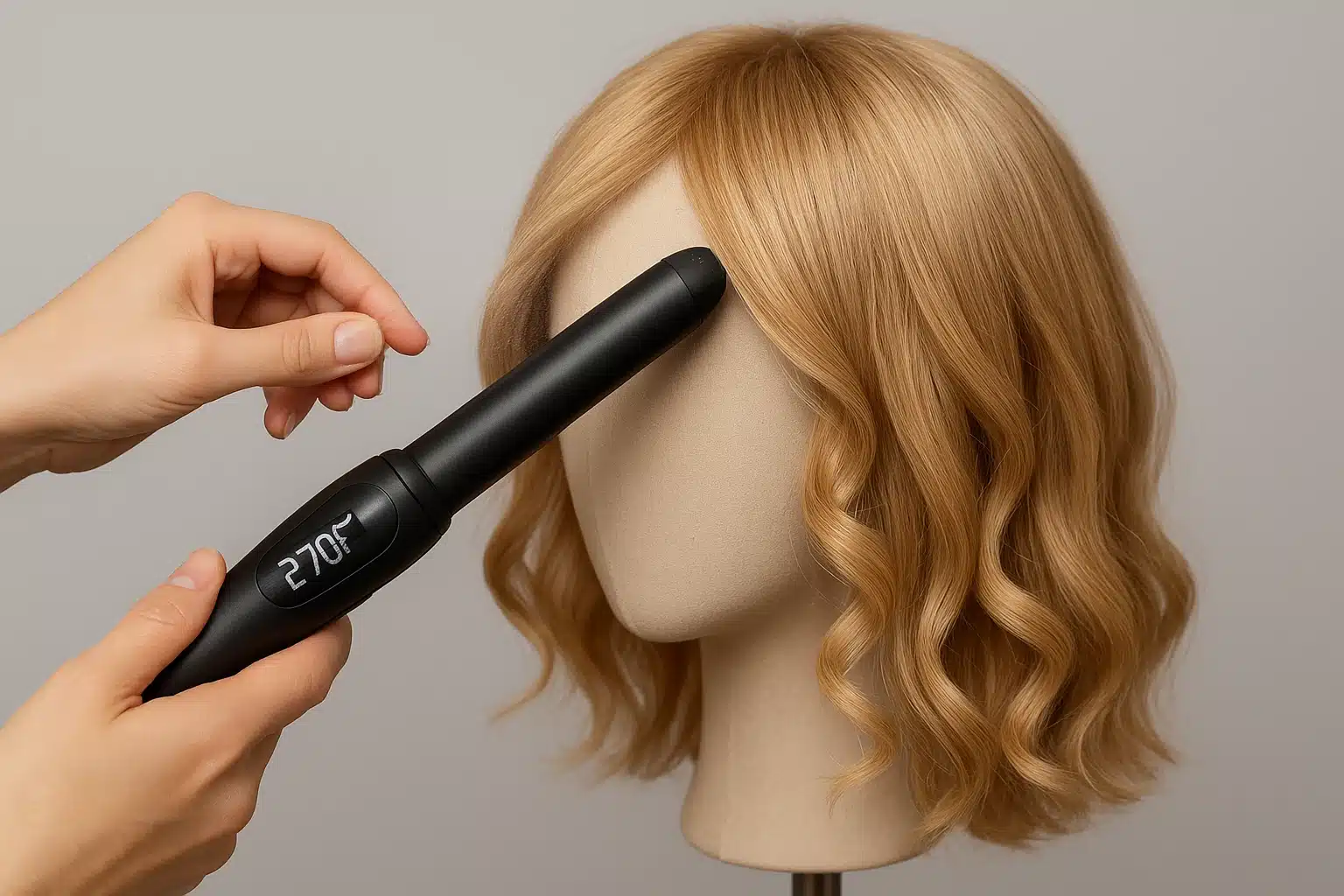
The golden rule for Ellen Wille heat-friendly wigs is to stay within the 260°F to 280°F (approx. 125°C – 140°C) range.
- Below 240°F: The heat may not be sufficient to soften the fiber enough to reshape it.
- Above 280°F: You risk compromising the integrity of the fiber, leading to singeing, melting, or permanent frizz.
Recommended Tools
- Digital Temperature Control Iron: Avoid irons with “Low/Med/High” dials. You need a tool with a digital display to ensure you never accidentally cross the 300°F danger zone.
- Ceramic Plates/Barrels: Ceramic distributes heat evenly. Metal tools often have “hot spots” that can scorch fibers instantly.
- Wide-Tooth Comb: Essential for detangling without stretching the heated fiber.
- Clips: These are non-negotiable for the cooling phase.
- Water Spray Bottle: A fine mist sprayer is your heat protectant.
The “Damp-Heat-Cool” Protocol: A Step-by-Step Masterclass
The most common mistake beginners make is styling dry fiber. We recommend the “Damp-Heat-Cool” framework to ensure longevity and safety.
Phase 1: Preparation & The Water Buffer
Before applying any heat, gently detangle the wig using your wide-tooth comb, starting from the ends and working your way up. Once detangled, section the hair.
Here is the professional secret: Mist each section with water before applying heat. Water acts as a conductive buffer. It helps distribute the heat evenly through the fiber preventing the “singe point,” and allows the fiber to become pliable at lower temperatures. You aren’t boiling the hair; you are creating a safe environment for the fiber to transition.
Phase 2: Heat Application
Apply your heat tool (set to 260°F – 280°F) to the damp section. Move the tool continuously; never let it sit in one spot for more than a second or two.
- For Straightening: Use a flat iron and follow the comb method. Run a fine-tooth heat-resistant comb through the hair, following immediately with the flat iron. This tension creates a sleek, smooth texture.
- For Curling: Wrap the hair around the barrel. Hold for 5–10 seconds to allow the heat to penetrate the fiber.
Phase 3: The “Clip & Cool” (The Aha Moment)
This is where 90% of styling failures happen. When you remove the curling iron, do not let the curl drop.
While the curl is still hot, catch it in your hand. Compress it back toward the base and pin it against the wig cap using a metal clip. The fiber must remain in this curled shape until it is completely cool to the touch.
Why? Because the fiber has “style memory.” Whatever shape the fiber is in when it returns to room temperature is the shape it will hold until heat is applied again. If you let it cool while it’s hanging down, you are teaching it to be straight. If you let it cool while pinned up, you are teaching it to be curly.
Troubleshooting: Fixing the “Crunchy” Ends
Over time, you may notice the ends of your wig feeling rough, frizzy, or “crunchy.” This is often mistaken for heat damage, but it is usually friction frizz—caused by the fiber rubbing against clothing or skin.
The beauty of heat-friendly fiber is that heat can actually fix this.
- Mist the frizzy ends with water.
- Set your flat iron to the safe zone (260°F – 280°F).
- Slowly run the iron through small sections of the ends.
The heat and tension will smooth the microscopic imperfections in the fiber, essentially “healing” the frizz and returning the wig to a silky texture.
Frequently Asked Questions
Can I use regular hairspray on my heat-friendly wig?
It is best to avoid standard drugstore hairsprays. They often contain alcohols and lacquers that can dry out synthetic fiber and leave a white, flaky residue that is difficult to wash out. Stick to water-soluble styling products specifically formulated for synthetic hair.
Is the style permanent?
The style is “permanent” in the sense that humidity and rain won’t ruin it (unlike biological hair). However, it is not permanent in the sense that you can’t change it. The style will stay locked in until you apply heat again to reshape it.
How often should I heat style my wig?
While the fiber is designed to withstand heat, excessive styling can shorten the lifespan of the wig. We recommend restyling only when necessary, such as after washing or when you want to change your look significantly. For daily maintenance, a little water and a wide-tooth comb usually suffice.
Can I use a blow dryer?
Generally, air drying is safest for synthetic wigs. However, if you must use a blow dryer, use the “cool” or “warm” setting—never hot—and keep the nozzle moving constantly to avoid concentrating heat on one area, which can damage the cap construction or the fiber.
Continuing Your Education
Mastering heat styling opens up a new world of possibilities for your wig wearing experience. It transforms a static accessory into a dynamic part of your personal style. Remember, the key is patience: low heat, water buffers, and allowing the fiber to cool completely. By treating the fiber with respect and understanding its scientific properties, you can keep your Ellen Wille wig looking salon-fresh for months to come.