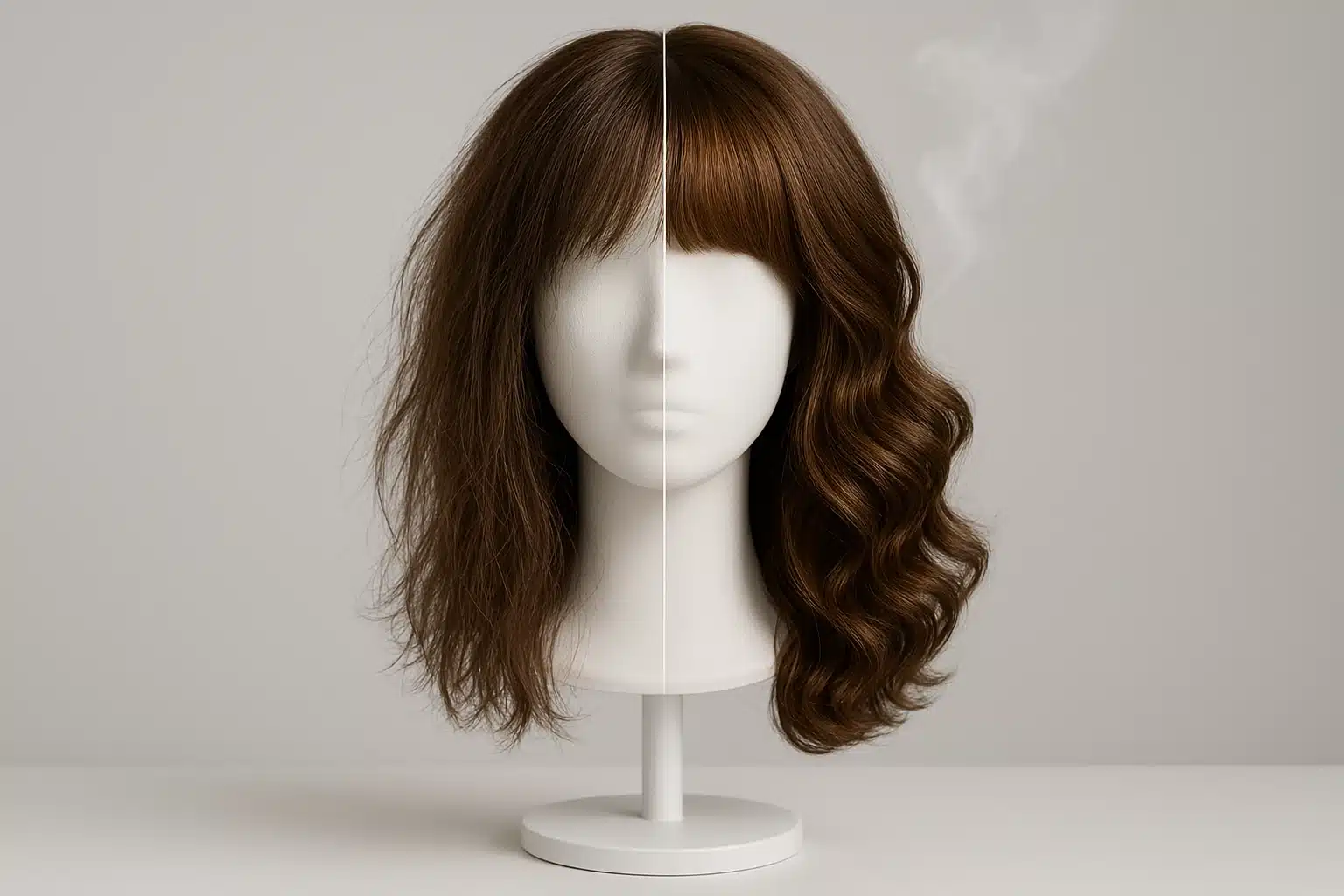
We have all experienced that specific moment of disappointment: you reach for your favorite wig—the one that has made you feel confident and beautiful for months—only to find that it looks… tired. The curls that once bounced with vigor are now hanging limp, or the sleek bob that framed your face perfectly has developed a rebellious frizz at the nape.
It is a common misconception that once a synthetic wig loses its shape, it has reached the end of its lifespan. However, often what you are witnessing isn’t the death of the fiber, but rather a molecular “relaxation.” Before you resign yourself to purchasing a replacement, it is helpful to understand the engineering behind your piece. As detailed in Your Authoritative Guide to Rene of Paris Wigs, these fibers are marvels of modern polymer science, designed with a specific “style memory” that can, with the right knowledge, be rebooted.
Understanding Fiber Fatigue vs. Style Memory
To understand how to fix your wig, you first need to understand what is happening inside the strand. Rene of Paris wigs are primarily crafted from high-quality Kanekalon and polyester blends. Unlike rene of paris human hair wigs, which behave like your biological hair and respond to conditioning treatments, synthetic fibers are thermoplastics.
When a synthetic wig is manufactured, it is baked at a specific temperature to “lock in” its style—whether that is a tight curl or a bone-straight fall. This is known as “Style Memory.” Over time, exposure to body heat, friction from collars, and environmental factors cause the polymer chains within the fiber to relax. We call this Fiber Fatigue.
The fiber hasn’t broken; it has simply forgotten its shape. The secret to restoration lies in the Glass Transition Temperature (Tg). This is the scientific “sweet spot”—usually between 180°F and 212°F (80°C–100°C)—where the solid plastic fiber softens just enough to be malleable without melting. By carefully manipulating the fiber at this temperature, we can “reset” the memory.
The Diagnosis: Is it Surface Frizz or Structural Fatigue?
Before applying heat or product, look closely at the hair fibers to identify the specific issue.
- Friction Frizz: This typically appears at the nape of the neck. It looks like the ends are singed or crimped. This is caused by the mechanical rubbing of the fiber against clothing, creating heat that distorts the fiber’s surface.
- Structural Fatigue (Limpness): This is when the overall shape has collapsed. The curls are elongated, or the volume at the root has flattened. This indicates the molecular bonds have relaxed too much.
Phase 1: The Cold Refresh (For Minor Dryness)
If your wig is relatively new but looking a bit lackluster, you likely do not need a full thermal reset. You simply need to reduce static and re-align the cuticles.
The 12-Inch RuleRene of Paris experts emphasize a crucial technique often overlooked: distance. When using a maintenance spray, such as the Revive Liquid Enhancement, it must be sprayed from at least 12 inches away.
- Why? Spraying too close causes the product to bead up on the plastic fiber rather than coating it evenly. This leads to “clumping” and makes the wig look greasy and heavy, accelerating fiber fatigue.
Phase 2: The Thermal Reset (For Limp Styles)
This is the advanced technique that separates the experts from the novices. To revive a wig that competitors might claim is “beyond help,” we utilize the power of steam.
Why Steam?Dry heat (like a curling iron) can be dangerous for standard synthetic wigs because it is difficult to control the temperature fluctuation. Steam, however, creates a moist heat environment that acts as a plasticizer. It penetrates the core of the Kanekalon fiber, lowering the resistance to reshaping and allowing you to reset the style safely.
The Steaming Protocol
- Pin and Prep: Secure your wig to a canvas block head. Comb through gently with a wide-tooth comb to remove tangles.
- Directional Mapping: Identify the original curl pattern. Rene of Paris styles are specific—look at whether the curl twists clockwise or counter-clockwise.
- The Steam Application: Using a handheld clothes steamer, apply steam to the section you are styling. Keep the steam moving and never let the nozzle touch the fiber directly.
- The “Re-Clocking”: While the fiber is warm and moist (in that Tg sweet spot), use your fingers to twist the curl back into its original direction. Pin it in place with a clip.
- The Cool Down: This is the most critical step. Style memory is locked during the cooling phase, not the heating phase. You must let the fiber cool completely in its new shape before removing the clip.
Phase 3: Structural Repair (Combatting Nape Frizz)
For that troublesome friction frizz at the nape, steam alone may not smooth out the crimping. You may need to use a “low-heat” smoothing method.
- The Sizzle Test: Before applying any heated tool (even a steamer) to a wig, test a tiny, hidden strand at the nape. If the fiber sizzles or curls up immediately, the heat is too high.
- The Smooth Out: Apply steam to the frizzy ends and immediately run a fine-tooth comb through them. The tension of the comb combined with the moist heat helps pull the “kinks” out of the polymer chain.
Frequently Asked Questions
Can I use a regular curling iron to restyle my wig?
For standard synthetic wigs, the answer is generally no. Most curling irons operate at temperatures exceeding 250°F, which will instantly melt the fibers. Unless you have a specific “Heat-Friendly” synthetic wig (which has a higher heat tolerance), steam is the safest and most effective method for restoration.
How often should I perform a “Thermal Reset”?
You should not need to do this often. A full steam reset is recommended only when the style has significantly dropped—typically every 4 to 6 months depending on wear frequency. Over-steaming can eventually dry out the fibers.
My wig has a “permanent” part. Can I change it?
Rene of Paris wigs often feature monofilament parts that allow for multidirectional styling, but the base structure usually favors one direction. You can alter the part using the steam method: apply steam to the root area, redirect the hair, and hold it flat with a styling comb until it is completely cool.
Is it true that synthetic wigs only last 6 months?
This is a general industry guideline, but with proper “Fiber Fatigue” management, many wearers extend the life of their pieces to 9 or even 12 months. The “6-month” rule usually assumes the wearer is not actively resetting the fiber’s memory.
Moving Forward in Your Journey
Understanding the science of your wig transforms it from a disposable accessory into a long-term investment. By mastering the variables of heat, moisture, and tension, you can maintain that “out of the box” beauty for much longer than you thought possible.
Restoring a wig is a skill that takes patience, but the result—a revitalized style that looks and feels fresh—is worth the effort. If you are noticing signs of wear, try these techniques before assuming your wig has retired. You might be surprised by how much life is left in those fibers.