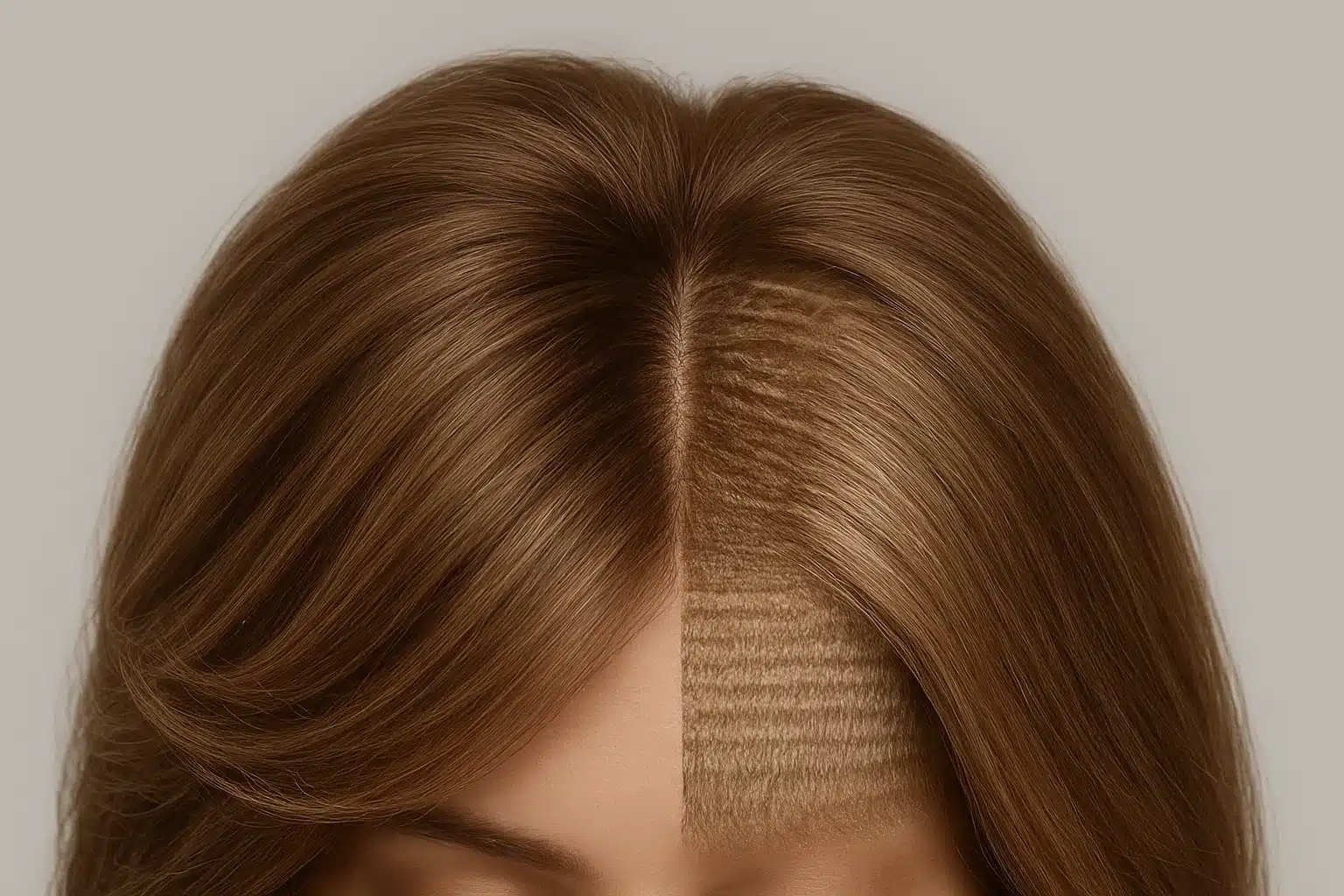
Have you ever experienced the “unboxing panic”? It’s a common scenario for many first-time wig wearers: you open a beautiful new style, run your fingers through the fibers, and suddenly stop. At the root, underneath the sleek lengths, you find short, crimped, fuzzy hairs. Your first instinct might be to think you’ve received a defective unit or a wig that has been matted during shipping.
However, in the world of high-quality alternative hair, those crimped fibers are not a flaw—they are a deliberate architectural feat known as permatease. Understanding this feature is the key to unlocking styles that hold their shape all day without hairspray or backcombing. For those looking to understand the full scope of these designs, our authoritative guide to Rene of Paris wigs details how different collections utilize this construction to achieve everything from medical-grade naturalism to high-fashion volume.
The Architecture of Volume: The “Structural Nest”
To understand why Rene of Paris (RoP) utilizes permatease, we have to look at the physics of hair. Natural hair has a follicle that holds it upright. When hair is hand-tied onto a wig cap, it tends to lay flat against the head. While this is excellent for sleek, low-density looks, it poses a challenge for styles that require lift, body, or that “salon-blowout” silhouette.
Think of permatease as the “structural nest” of the wig. Just as a stylist might tease or backcomb biological hair at the root to create a cushion for the top layer to rest on, RoP engineers permanent teasing into the cap construction. These short, crimped fibers act as a scaffold. They physically push the longer, smooth fibers up and away from the scalp.
Without this internal structure, the gravity of the synthetic fiber would cause high-volume styles—like the popular Noriko collection—to collapse flat against the head within hours.
The Physics of the “Long Unit”
This structural necessity becomes even more critical with length. If you wear an extra-long wig (20 inches or more), the weight of the fiber (often exceeding 260 grams) pulls heavily downward. Without a reinforced “nest” at the crown, the wig would look bottom-heavy—flat at the top and wide at the bottom. The permatease counterbalances this weight, ensuring the silhouette remains balanced and flattering.
Machine-Made vs. Monofilament: The Volume Equation
Not all Rene of Paris wigs utilize this technique to the same degree. The construction of the cap dictates the volume, and understanding this can help you choose the right wig for your specific needs.
The Machine-Made Cap (Maximum Lift)
In standard machine-made caps (often found in the Noriko collection), wefted rows of hair are sewn together. The permatease is baked into the root of these wefts.
- The Benefit: These are true “shake-and-go” styles. The volume is permanent. You don’t need to style it; the wig remembers its shape.
- The Trade-off: The part line is not defined. Because of the crimped roots, you cannot part the hair to show “scalp.”
The Monofilament Cap (Natural Growth)
Conversely, the Amore collection by Rene of Paris focuses on monofilament tops. Here, individual fibers are hand-tied into a sheer mesh.
- The Benefit: It creates the illusion of natural hair growth from the scalp and allows for multi-directional parting.
- The Trade-off: These caps are significantly flatter. They lack the built-in “lift” of machine-made caps.
If you are transitioning from biological hair that was naturally thick or teased, a monofilament wig might feel too flat. Conversely, if you are used to fine hair, the volume of a machine-made cap might feel overwhelming initially.
Taming the Beast: Managing “Box Hair”
A common hurdle for new wearers is “Box Head”—where the permatease has been compressed in packaging, or conversely, stands up too high, making the wig look square. Because synthetic wigs have a memory, they can be “trained” without heat.
The Cold Setting Technique
If the volume feels too aggressive, you don’t need to return the wig. You can tame the permatease using water and body heat:
- Spritz: Lightly mist the root area with water.
- Rub: Vigorously rub your hands together to generate heat.
- Press: Press your warm palms flat against the area you want to flatten (usually the crown or sides) and hold for 10-15 seconds.
- Hold: The combination of moisture and hand warmth resets the fiber direction.
Advanced Thinning
For those who love the style but find the density too high, it is possible to reduce the bulk. However, one must be careful. You never want to cut the permatease itself, as this can ruin the structural integrity of the wig. Instead, wig thinning shears can be used on the longer fibers underneath the top layer to remove weight without altering the silhouette.
Comfort and Breathability Considerations
A frequent question regarding permatease is heat retention. Does a “nest” of crimped fiber trap more heat than a monofilament top?
Generally, open-wefted caps (which usually feature permatease) are actually quite breathable because air can circulate through the wefts in the back and sides. However, the crown area where the permatease is concentrated can feel denser. For wearers with total hair loss or sensitive scalps, wearing a bamboo or cotton wig cap liner can act as a barrier, absorbing perspiration and preventing the crimped texture from pressing against the skin.
Summary: Embracing the Engineering
Permatease is not a shortcut in manufacturing; it is a solution to the physics of synthetic fiber. It allows for lasting volume, balanced silhouettes, and styles that survive the day without collapsing.
By understanding whether you are looking for the high-fashion lift of a machine-made structure or the low-density realism of a monofilament top, you can select a Rene of Paris wig that aligns perfectly with your aesthetic goals.
Frequently Asked Questions
Is permatease visible to others?
When a wig is new or styled incorrectly, the crimped fibers can sometimes be visible at the part. However, in a well-constructed Rene of Paris wig, the longer, smooth fibers are designed to overlay and hide the permatease. A quick comb-over usually resolves this.
Can I use a flat iron to flatten the permatease?
You should exercise extreme caution. Most standard synthetic fibers cannot withstand the heat of a flat iron, which will melt or singe the hair. Even with heat-friendly fibers, applying direct heat to the permatease can permanently flatten the “nest,” causing the style to lose its shape entirely.
Does permatease cause tangling?
Permatease itself is at the root and doesn’t tangle. However, because it creates volume, the longer fibers move more freely. Proper maintenance is key. If you have an older unit that has lost its shape, learning about wig maintenance and restyling can help extend its life.
Why does my wig look “fuzzy” on top?
If the fuzziness is uniform and at the root, it is likely the permatease. If the frizz is at the ends of the hair or looks like breakage, that is likely friction damage. Permatease is a crimped texture, whereas damage usually looks like frayed fishhooks.