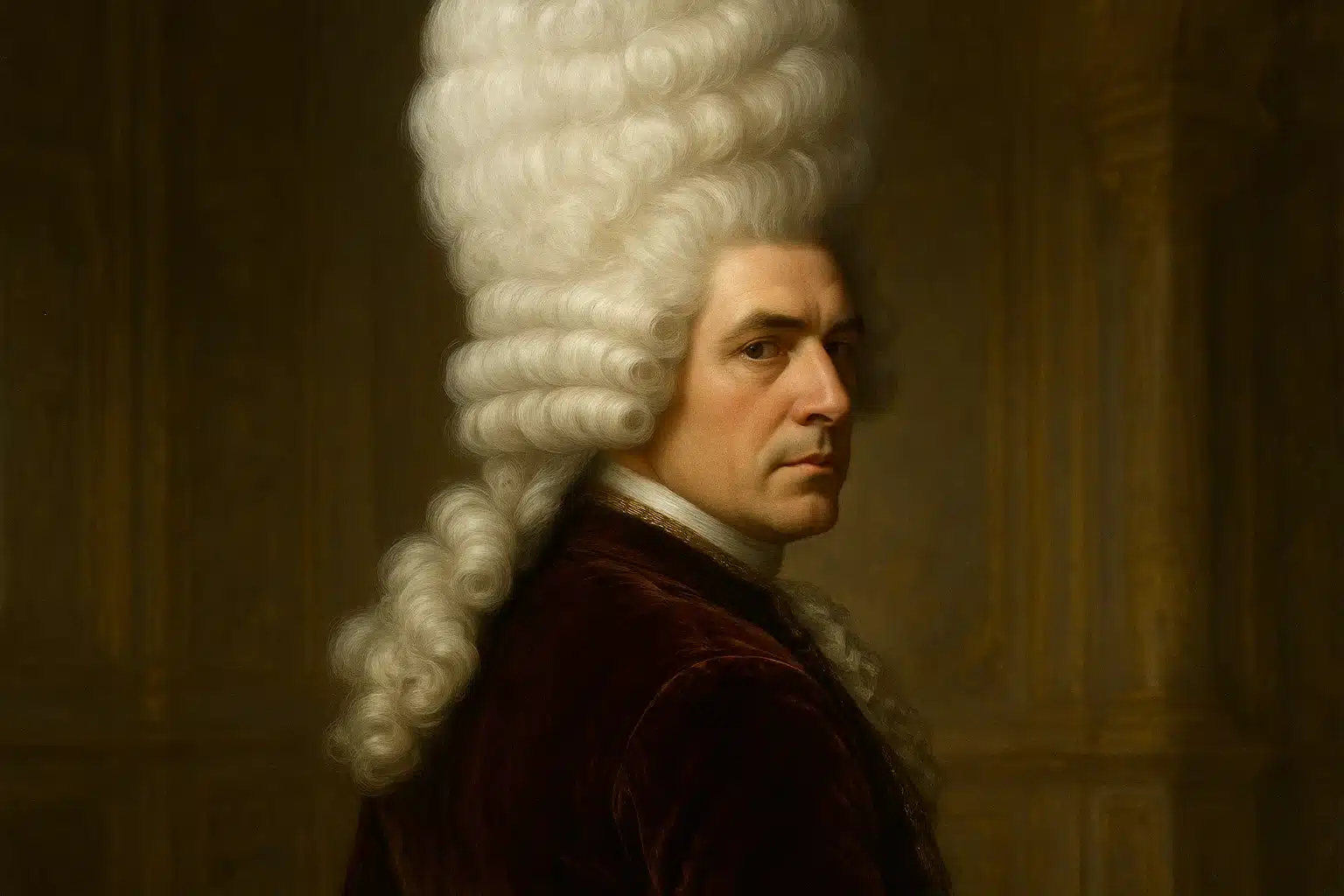
Imagine casually spending the modern equivalent of a luxury sports car on a single hairpiece. In the 17th and 18th centuries, calling someone a “big wig” wasn’t just a colorful idiom—it was a literal financial reality. The larger and more elaborate your wig, the more undeniable your wealth, status, and political power.
To truly understand this fascinating era, we have to look past the funny, powdered curls we often see in history books and period dramas. Just as we recognize the cultural and spiritual authority of wigs worldwide across other great civilizations, European aristocrats transformed the hairpiece from a simple biological replacement into a stunning architectural statement. Over the course of two centuries, what began as a solution to an embarrassing problem evolved into a strictly enforced dress code that defined social hierarchy across the Western world.
Let’s step back in time to explore the Baroque and Rococo eras, debunk some common myths, and discover how the wig became the ultimate power accessory.
The Royal Genesis: From Necessity to Nobility
When examining the history of wigs, the 17th-century European adoption stands out as a profound turning point. The trend didn’t begin as a high-fashion statement; it began as a royal cover-up.
In the late 1500s and early 1600s, Europe was grappling with an outbreak of syphilis. One of the disease’s most common side effects was patchy hair loss. At a time when long, flowing hair was the ultimate symbol of masculine vigor and aristocratic bloodlines, baldness was a reputation-destroyer.
Enter King Louis XIII of France. When the monarch began prematurely losing his hair at age 17, he immediately hired 48 wigmakers to save his image. However, it was his son, the famous “Sun King” Louis XIV, who truly weaponized the wig. Louis XIV used massive, flowing hairpieces to project an image of absolute, god-like authority. Once the King of France declared wigs mandatory for royal appearances, the rest of the European nobility frantically followed suit to maintain their standing at court.
The Hygiene Paradox: Debunking the “Filthy Wig” Myth
If you’ve ever heard that 18th-century wigs were crawling with lice and reeked of poor hygiene, you aren’t alone. It’s one of history’s most persistent myths. In reality, wigs were an incredibly clever hygiene solution.
During an era with limited indoor plumbing and rampant head lice, maintaining natural long hair was a nightmare. The solution? Aristocrats shaved their natural hair entirely. Without a warm scalp to cling to, head lice couldn’t survive. The wig itself became a protective barrier.
Furthermore, if a wig did attract pests, it was sent back to the perruquier (wigmaker). These skilled craftsmen would boil the hairpieces or bake them in ovens to sanitize them completely—a deep-cleaning process that simply wasn’t possible for natural hair attached to a human head.
The Secret of Hair Powder
What about the famous white powder? Rather than being a source of dirt, the powder—typically made of finely milled wheat flour or starch—acted as an early form of dry shampoo. Scented with lavender, orange flower, or clove, the powder absorbed oils and neutralized odors, keeping the wearer smelling fresh in crowded royal courts.
The Anatomy of a Peruke: A Global Hair Economy
As the trend exploded, hair became an incredibly valuable global commodity. The “peruke” (the French term for wig, later anglicized to “periwig”) required extraordinary craftsmanship to construct.
Wigs were woven using a “tress and cap” construction, where individual hairs were knotted onto a silk or cotton base. The materials you chose instantly communicated your net worth:
- Premium Human Hair: The gold standard. Wigmakers heavily relied on a massive peasant hair trade, traveling through rural villages to purchase healthy hair from young women. A fully custom, human-hair peruke could cost upwards of 800 shillings—a sum that could buy a comfortable home.
- Horse and Yak Hair: For the emerging middle class who wanted the look without the royal price tag, horsehair and yak hair offered a budget-friendly, stiff alternative that held its shape well.
This staggering cost difference is precisely where the term “Big Wig” originated. Only the absolute wealthiest lords could afford the heavy, massive, full-bottomed human hair wigs. If you saw a “big wig” walking down the street, you knew you were looking at serious money.
The Language of Style: From Baroque Pomp to Rococo Pouf
Wig styles were not static; they evolved rapidly, serving as a visual timeline of European history.
The 17th-Century Baroque Era
Early periwigs were dark, heavy, and imposing. Known as “full-bottomed” wigs, they cascaded well past the shoulders and parted deeply down the middle. They were designed to make men look larger, older, and more intimidating.
The 18th-Century Rococo Era
As society shifted toward the Enlightenment, fashion lightened up. The massive dark wigs gave way to smaller, powdered white wigs. By 1764, the “Encyclopedia Perruquière” recognized over 115 distinct styles. A few notable ones included:
- The Bob Wig: A shorter, practical wig favored by tradesmen and clerics.
- The Ramillies: A military-inspired wig featuring a long braid tied with bows.
- The Queue: A style where the hair was pulled back into a single ponytail, often enclosed in a black silk bag to keep powder off velvet coats.
The George Washington Misconception
Speaking of the Queue, here is an incredible “aha” moment: George Washington never wore a wig. While many of his founding-father peers did, Washington actually grew his own hair long, pulled it back into a queue, and aggressively powdered it white to match the aristocratic fashion of the day without enduring the heavy heat of a peruke.
Professional Branding: Creating the Modern Uniform
Wigs weren’t just for royals; they became the ultimate tool for professional branding. For non-nobles like lawyers, judges, doctors, and clergy, the wig served as a uniform that instantly signaled education, expertise, and authority.
If you were on trial, you wanted a lawyer whose powdered wig communicated mastery of the law. Even today, the British legal system retains the tradition of judges and barristers wearing horsehair wigs—a direct, living descendant of this 18th-century professional branding strategy.
The Political Fall: Taxes, Revolution, and the Guillotine
No fashion trend lasts forever, and the fall of the wig was as dramatic as its rise.
As the late 18th century approached, the Enlightenment brought a renewed interest in nature, simplicity, and egalitarianism. Suddenly, wearing a towering, expensive artificial hairpiece seemed incredibly out of touch.
The French Revolution was the first fatal blow. As the guillotine claimed the heads of the French aristocracy, wearing an aristocratic peruke in Paris became a literal death wish. Natural hair became the safest, most patriotic choice.
Across the channel, the British dealt the final economic blow. In 1795, the British government passed the Hair Powder Act, imposing a heavy tax on the scented powders required to maintain wigs. In protest of the tax, and influenced by the new Republican values sweeping across from America and France, the public simply stopped wearing them. Almost overnight, the Great Age of the Wig came to a close.
Frequently Asked Questions
What is the difference between a peruke and a periwig?
There is no physical difference! “Peruke” is simply the original French term for a wig. As the fashion crossed the English Channel, the British mispronounced and anglicized the word, turning it into “periwig,” which was eventually shortened just to “wig.”
How did they keep the wigs from falling off?
Wigmakers custom-measured clients’ heads to ensure a tight, vacuum-like fit. Because the wearer’s natural hair was shaved or closely cropped, the wig’s interior cap could grip the scalp securely. In active situations, such as horseback riding, hidden ribbons and pins were used to anchor the piece.
Did women wear wigs during this time?
Interestingly, while men adopted full wigs, women primarily relied on hairpieces, extensions, and pads (called “poufs”) to build their natural hair into towering styles. It wasn’t until the late 18th century, under Marie Antoinette, that women’s hairstyles became so structurally complex that full artificial wigs were occasionally required.
Continuing Your Journey
The story of the 17th and 18th-century wig is a brilliant reminder of how we use style to express our identity, signal our values, and overcome personal challenges. While the towering powdered perukes of the French court have faded into history, the fundamental desire to feel confident, beautiful, and in control of our appearance remains as strong today as it was 300 years ago.
Whether you are navigating hair loss or simply looking to reinvent your personal style, exploring the world of premium hairpieces is a journey of empowerment. With nearly two decades of industry expertise, Wig Superstore is dedicated to providing the educational resources and compassionate care you need to find a solution that makes you feel like royalty.