When you begin the search for a wig today, you are participating in a ritual as old as civilization itself. Whether you are navigating hair loss or seeking a stylistic transformation, it is validating to know that the greatest figures in human history—from Egyptian Pharoahs to British aristocrats—faced similar decisions. They, too, sought solutions that offered dignity, protection, and a projection of their identity.
Understanding the history of wigs is not just an academic exercise; it is a lens through which we can evaluate quality and purpose. The standards of craftsmanship we uphold at Wig Superstore have roots that stretch back over 5,000 years. By examining how ancient cultures engineered these pieces, we gain a deeper appreciation for the modern innovations that allow us to feel confident and beautiful today.
Ancient Egypt: The Cradle of Wig Craftsmanship
The origins of the wig industry as we know it can be traced directly to the banks of the Nile, circa 3400 BC. In ancient Egypt, wigs were not merely accessories; they were essential components of social rank, hygiene, and religious observance.
Engineering Divine Power
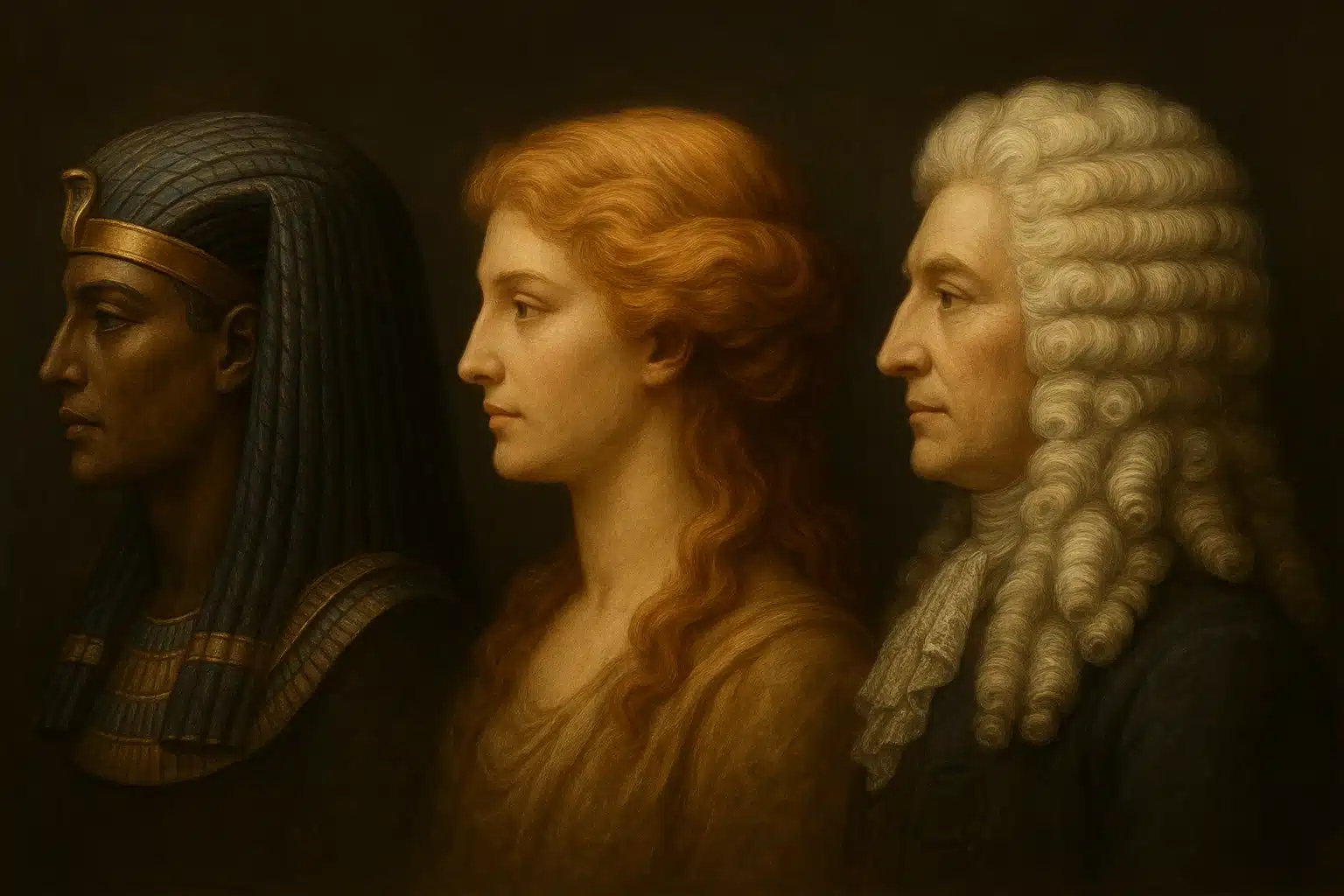
The Egyptians were the first true masters of wig technology. Archaeological evidence, such as findings detailed by Internet Archaeology, reveals that high-status wigs were marvels of engineering. These were not hastily assembled hairpieces. A single high-quality wig could take over 200 hours to produce—a testament to the dedication required to create a natural, durable appearance.
The construction methods used by Egyptian artisans show a sophisticated understanding of ventilation and comfort, concepts that remain relevant when you look for a wig store near me today. They utilized a mesh base, often made of plaited human hair or vegetable fiber, to attach individual strands. This mesh allowed for heat to escape, a critical feature in the desert climate.
To secure the styles, they used a mixture of beeswax and resin. This resin acted similarly to modern styling products, boasting a melting point of 140°F (60°C) to ensure the intricate braids and pleats held their shape under the blazing sun.
The Intersection of Hygiene and Status
While we often associate wigs with aesthetics, the Egyptians utilized them as a practical health solution. The hot climate made head lice a pervasive issue across all social classes. To combat this, men, women, and children would shave their heads—a practice that ensured cleanliness but left the scalp vulnerable to the sun.
The wig became the perfect solution: it prevented lice infestation while protecting the sensitive scalp from sunburn. However, the quality of the wig immediately signaled your standing in society.
- The Elite: Wore wigs made of 100% human hair or, in some cases, high-quality black sheep wool. These were elaborate, often interwoven with gold strands or lapis lazuli.
- The Commoner: If they wore wigs at all, they were crafted from vegetable fibers or grass.
This distinction mirrors the modern landscape, where the difference between a mass-produced synthetic piece and a premium human hair wig defines the wearer’s experience.
Classical Antiquity: Greece and Rome
As power shifted across the Mediterranean, the role of the wig evolved from a necessity of hygiene to a tool of theatrics and social signaling.
Rome: The Politics of Hair
In the Roman Empire, hair was political. The Romans admired the blonde hair of the Germanic tribes they encountered, leading to a surge in demand for wigs made from the captured hair of northern European slaves. Wealthy Roman women would often wear these blonde or red wigs to display their worldly reach and affluence.
The social dynamics of Rome were complex, and wigs played a dual role. They were used to hide baldness—viewed as a physical deformity or sign of weakness in men—and were also used by those wishing to disguise their identity for illicit activities.
Just as a client today might browse wigs in Sacramento to find a style that suits a specific social function or personal need, Romans maintained a wardrobe of hairpieces to navigate their complex social hierarchy. The stigma and celebration of wigs fluctuated with the times, but the demand for skilled knotting and natural appearance never waned.
The Colonial Revival: The Peruke and the Courts
After a decline during the Middle Ages, the wig returned with vengeance in the 17th century, driven by two factors that drive markets to this day: the influence of celebrities and medical necessity.
The Royal Influence
The explosion of the wig trend in Europe can be traced to two kings: Louis XIV of France and Charles II of England. Both monarchs began losing their hair prematurely—likely due to syphilis, which was rampant at the time—and their adoption of the “peruke” (a large, powdered wig) instantly transformed a necessity into a symbol of masculine power.
Suddenly, hair was the ultimate currency of the aristocracy. These wigs were massive, heavy, and incredibly expensive. A top-tier peruke could cost 25 guilders—the equivalent of roughly $10,000 in today’s money. This investment signaled that the wearer was a man of substance and authority.
Practicality Beneath the Powder
Much like in ancient Egypt, the colonial wig served a hygienic purpose. Lice were a plague in the unsanitary conditions of 17th-century Europe. By shaving the head and wearing a wig, the aristocracy could send their hair to a wigmaker to be boiled and baked, effectively killing any parasites, while their natural scalp remained clean.
The maintenance required for these pieces was immense. They required regular powdering—using starch scented with lavender or orange flower—to maintain their white or off-white appearance and to mask odors. When discerning customers today look for the best wig shops in Houston, they are often looking for the same thing the colonial gentry sought: expert maintenance and high-quality materials that stand the test of time.
Modern Legacies and Cultural Memory
The journey from the beeswax-coated braids of Egypt to the powdered perukes of Europe has shaped the modern wig industry. We see the remnants of this history in the British legal system, where barristers still wear wigs to strip away individual personality and represent the anonymity of the law.
The Evolution of Materials
Perhaps the most significant shift in the last century is the democratization of quality. In the past, a natural-looking wig was the exclusive province of Pharoahs and Kings. Today, innovations in synthetic fibers and the ethical sourcing of human hair have made elite-level craftsmanship accessible.
We are even seeing a return to plant-based innovations, mirroring the vegetable fibers of antiquity, with modern researchers exploring hemp and other sustainable materials for wig bases.
The Enduring Need for Expertise
The history of wigs confirms one undeniable truth: hair is intrinsically linked to how we view ourselves and how the world views us. Whether you are visiting a wig store New Orleans to find a piece that matches your vibrant personality, or seeking a medical wig for hair loss, you are part of a lineage that values dignity.
At Wig Superstore, we honor this history by ensuring that every piece we offer meets the standards of durability, comfort, and realism that have been sought after for millennia.
Frequently Asked Questions
Did ancient Egyptians really wear wigs?
Yes, extensively. Archaeological findings confirm that both men and women of the upper classes wore wigs. They were used for hygiene (to prevent lice), protection from the sun, and as status symbols. The British Museum houses several well-preserved examples made of human hair and padded with vegetable fiber.
Why did George Washington wear a white wig?
Contrary to popular belief, George Washington did not wear a wig. He wore his own hair, which he powdered white to align with the fashion of the time. However, many of the other Founding Fathers did wear perukes, which were standard attire for the professional class.
How were ancient wigs attached?
In ancient Egypt, wigs were secured using a combination of beeswax and resin, which had a high melting point to withstand the desert heat. In later European history, wigs were heavy enough to stay on by gravity or were pinned to a cap worn over the shaved scalp.
What is the historical significance of the “Big Wig”?
The term “Big Wig” comes from the colonial era. Because elaborate perukes were so expensive (costing as much as a small house), only the extremely wealthy and powerful could afford the largest, most voluminous styles. Thus, a person of high status became known as a “big wig.”