Have you ever watched a movie and marveled at how an actor’s hair looks completely natural, even in a tight, high-definition close-up? That cinematic magic isn’t just the result of good lighting—it’s the product of decades of brilliant material science. For anyone navigating the emotional journey of hair loss, finding a piece that makes you feel beautiful, secure, and entirely yourself usually starts right at the hairline.
Today’s options represent an incredible evolution of wig craftsmanship and materials. We’ve moved far beyond the heavy, unbreathable foundations of the past into an era of high-fidelity “scalp replication.” But as you browse, you’re likely bombarded with terms like Standard, Swiss, and HD lace. Choosing the right foundation can quickly feel like trying to learn a new language. Let’s sit down, demystify the science of wig lace, and figure out exactly which material will best fit your everyday life.
The Origin Story: Hollywood’s Best-Kept Secret
To understand where wig lace is today, we have to look at where it started. Early wig foundations were built for function over form—heavy meshes designed to hold hair securely but lacking a natural appearance.
High Definition (HD) lace actually began its life as “Film Lace.” As movie cameras evolved to shoot in 4K resolution, standard lace fronts suddenly became visible on screen. The film industry needed a material so incredibly sheer that it would disappear under the scrutiny of high-powered lenses. Film lace was born out of this necessity. However, it’s vital to know a Hollywood secret: this lace was designed for actors who had professional stylists applying and removing it carefully, and it was never originally intended to withstand the rigors of everyday life.
The Anatomy of a Mesh: What Makes Lace “Invisible”?
When we talk about lace “melting” into the skin, we aren’t talking about magic; we’re talking about physics and chemistry. Here is what actually separates standard lace from its advanced counterparts:
Demystifying Denier
In material science, “denier” is a unit of measurement that determines the thickness of an individual thread. Standard French lace has a higher denier, meaning the threads are thicker and more robust. HD lace uses an ultra-low denier. The threads are microscopically thin, which is exactly why the material feels so soft against sensitive scalps.
Nylon vs. Polyester: The Chemical Difference
What is this sheer mesh actually made of? Traditional standard lace is typically woven from Nylon-6, a synthetic polymer known for its stiffness and incredible durability. Advanced meshes and HD laces often blend modified polymers or extremely fine polyesters. This shift in chemistry makes the lace much softer and less prone to causing skin irritation, though it does slightly lower its resistance to high heat.
The Weave: Hexagonal vs. Diamond
If you look at wig lace under a magnifying glass, you won’t see a standard crisscross pattern. High-quality lace utilizes a hexagonal (six-sided) weave rather than a simple diamond pattern. This honeycomb structure allows for multidirectional stretch—meaning the lace moves organically with your facial expressions—and provides superior ventilation so your scalp can breathe.
The Physics of the “Melt”
Why does HD lace seem to completely disappear when placed against your skin? It all comes down to light refraction.
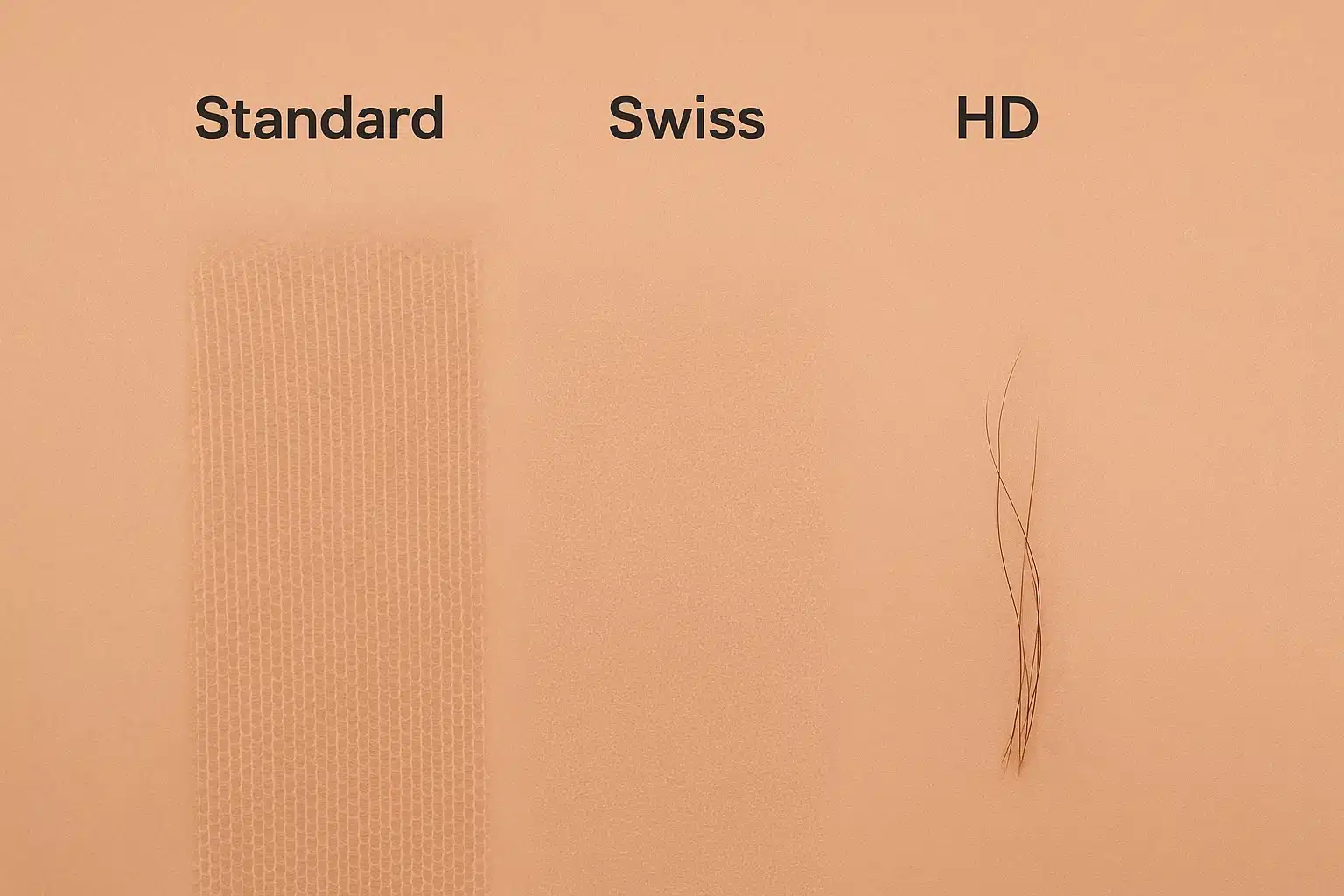
When light hits a thicker, standard lace, the thicker threads catch that light and reflect it back to the eye, creating a slight “grid” or whitish cast on the forehead. Because HD lace has such a low denier, there is physically less surface area for the light to bounce off. Instead of reflecting, the light scatters and passes right through the mesh. This allows your natural melanin to be the dominant color the eye perceives, creating that flawless, invisible melt regardless of your skin tone.
The Durability Trade-Off: Realism vs. Lifespan
Here is where we need to be radically honest: the most “invisible” lace is also the most fragile.
Because HD lace is incredibly thin, the knots used to tie the hair to the mesh must be proportionally tiny. Smaller knots mean the hair is less securely anchored than it is on standard lace. Over time, friction from brushing, styling, and general wear will lead to increased shedding.
This brings us to the concept of “Cost Per Wear.” While HD lace provides unparalleled realism, its delicate nature means it has a shorter lifespan—often 2 to 3 months of heavy rotation. Standard and Swiss lace, while slightly more visible up close, can last 6 to 12 months. When planning your wig maintenance routine, it’s crucial to calculate whether you are looking for an everyday workhorse or a flawless special-occasion piece.
The Ultimate Lace Selection Matrix
To help you make the best choice for your lifestyle, here is how the three main categories stack up:
1. Standard (French) Lace
- Visibility: Visible upon close inspection; requires a bit more makeup to blend.
- Lifespan: Excellent (6+ months).
- Beginner-Friendliness: High. It can withstand tugging and accidental rough handling.
- Best For: First-time wig wearers, gym-goers, and anyone who is tough on their hair.
2. Swiss Lace
- Visibility: Blends beautifully; the industry standard for realistic hairline wigs.
- Lifespan: Very Good (4–8 months).
- Beginner-Friendliness: Moderate. Requires some care but is forgiving.
- Best For: Your daily driver. It is the perfect sweet spot between durability and a natural appearance.
3. HD (High Definition) Lace
- Visibility: Truly invisible; melts seamlessly into any skin tone.
- Lifespan: Short (2–4 months of daily wear).
- Beginner-Friendliness: Low. Requires a very gentle hand to prevent tearing.
- Best For: Special occasions, photo shoots, or experienced wearers who prioritize absolute realism over longevity.
Pro Tips and Myth-Busting
As you explore the market, perhaps looking into popular styles or trendy collections like sensation wigs, keep these insights in mind to protect your investment:
- Myth: All “HD Lace” is actual HD lace. Because HD lace is a premium marketing term, some manufacturers will take cheap, slightly thinner Swiss lace and rebrand it as HD. True HD lace should feel incredibly soft, almost like a fine silk stocking, and have a highly ragged, easily fraying edge when cut.
- Pro Tip: Protect Your Knots. Because the knots on HD and Swiss lace are so delicate, using a liquid knot sealer on the inside of the cap after every wash is a game-changer. Excellent wig care is non-negotiable if you want to extend the life of a fine lace front.
- Pro Tip: Tinting. While HD lace adapts to your skin tone naturally, standard and Swiss laces often benefit from a lace tint spray or a light dusting of your powder foundation to perfect the blend.
Frequently Asked Questions (FAQ)
Does HD lace work on all skin tones without tinting?
Yes! Because of its sheer, low-denier construction, true HD lace acts almost entirely like clear glass. It lets your natural skin tone pull through perfectly, eliminating the need to dye or tint the lace to match your complexion.
Can I reuse an HD lace front?
Absolutely, but you must do so with care. When removing an HD lace wig, always use an adhesive solvent and give it time to work. Ripping the lace off your forehead will stretch the fine hexagonal mesh and cause micro-tears, ruining the melt effect for future uses.
Why does my HD lace rip so easily?
It comes down to its origins as “Film Lace.” It was designed to look invisible on a 4K camera, not to withstand the friction of being pulled on and off every single day. If you find your lace is ripping often, it might be time to transition to a sturdier Swiss lace for daily wear.
Finding Your Perfect Match
Navigating hair loss and alternative hair solutions is a deeply personal journey. There is no universally “perfect” lace—there is only the lace that perfectly fits your current needs, lifestyle, and comfort level.
Whether you opt for the robust reliability of Standard French lace, the balanced sweet spot of Swiss, or the breathtaking realism of HD lace, understanding the science behind the mesh empowers you to make a choice you’ll feel beautiful and confident in. Take your time, weigh your daily routine against the materials, and remember that the best wig is simply the one that makes you feel like yourself again.