
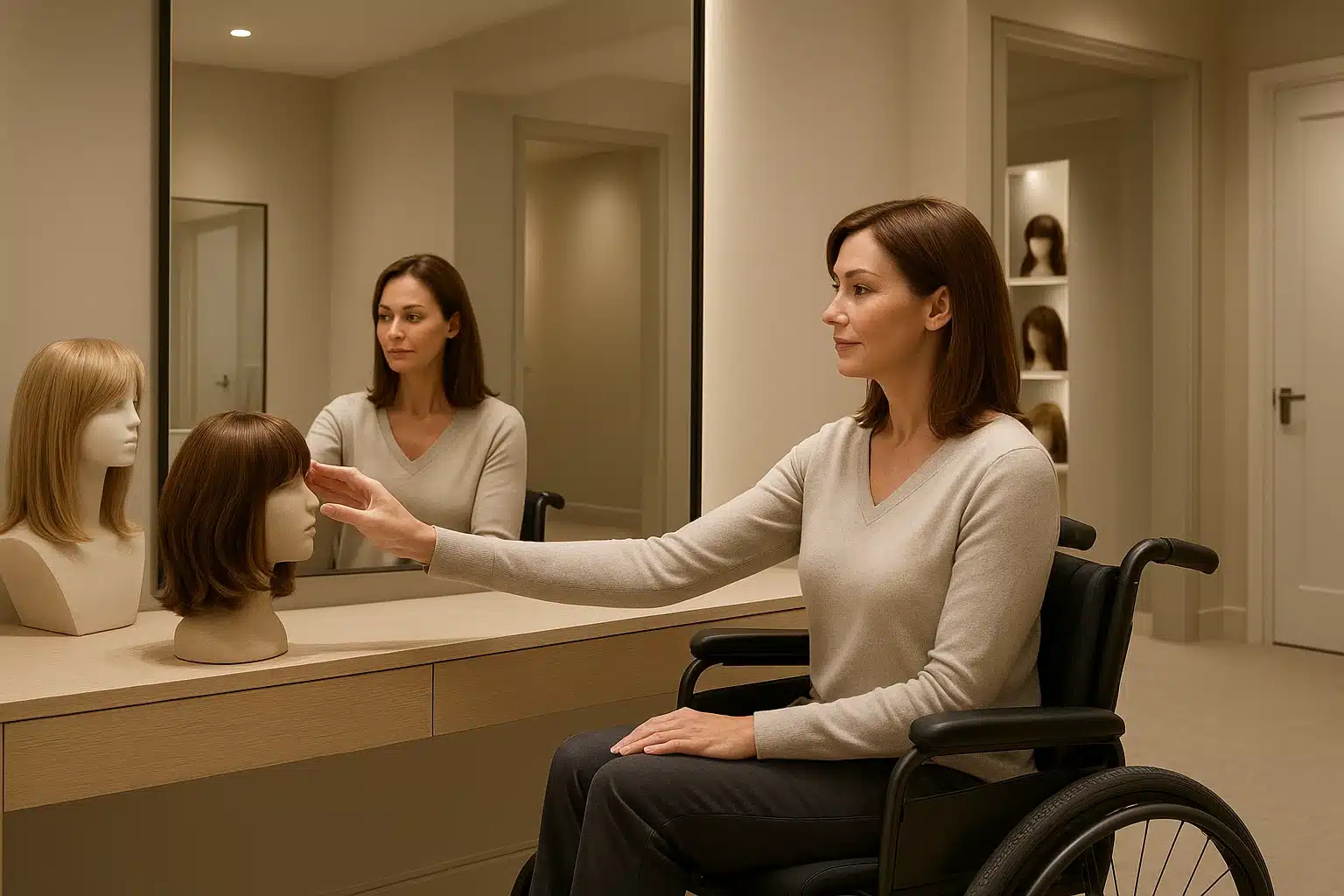
Experiencing medical hair loss from chemotherapy, alopecia, or an autoimmune condition is an incredibly emotional transition. When you add the logistical challenges of navigating a retail store with a wheelchair, mobility scooter, or caregiver, what should be an empowering experience can quickly feel overwhelming. You need more than just a vague online promise of “accessibility”—you need verifiable, dignified spaces that respect both your physical requirements and your privacy.
Unfortunately, generic healthcare directories and standard local search listings rarely provide the granular details you need before making a trip. To set yourself up for a comfortable, stress-free visit, consulting a comprehensive resource like our guide to finding the best wig stores in Garden City, NY: a complete buyer’s guide is the perfect first step. It establishes the baseline for local options, allowing us to dive deeper here into the specific architectural and emotional realities of accessible wig shopping across Nassau County.
Beyond the Basics: Statutory ADA Compliance vs. Real Accessibility
If you’ve ever arrived at a storefront that claimed to be “wheelchair accessible” only to find you couldn’t actually maneuver inside, you already know there is a massive gap between legal compliance and true accessibility.
Under Title III of the Americans with Disabilities Act (ADA), businesses are required to meet minimum physical tolerances, such as 32-inch door leaves. However, functional salon accessibility requires much more than just getting through the front door. The gold standard in retail accessibility is the “36/60 rule.”
- 36 Inches for Circulation: Aisles and pathways must offer a clear, continuous minimum width of 36 inches so you can browse displays without bumping into fixtures.
- 60 Inches for Turning: Private fitting suites require a 60-inch unobstructed circular diameter (or a T-turn clearance) allowing a power wheelchair or mobility device to seamlessly turn around without reversing out the door.
- Zero-Threshold Entries: A truly accessible store features step-free thresholds with a maximum of a 1/4-inch vertical rise (or a 1/2-inch beveled edge) to prevent jolts and ensure smooth entry.
Preserving Dignity: Redefining the “Private Entrance”
For many individuals dealing with medical hair loss, the idea of walking through a busy, public salon floor with exposed mirrors is a major source of anxiety. That’s why “private entrances” are highly sought after. But let’s clarify what a private entrance should be.
All too often, businesses direct clients with mobility devices or privacy needs to a back utility door or a dusty loading dock. This improvised approach sacrifices your emotional safety and dignity. A true private entrance is a dedicated, step-free, executive or clinical corridor designed to protect your privacy during a period of deep vulnerability. It should feel intentional, welcoming, and discreet—never like an afterthought.
The Anatomy of an Accessible Fitting Suite
Once you are comfortably inside, the environment where you actually try on your wig—properly known in the medical world as a cranial prosthesis—must cater to your physical and emotional needs. An ideal accessible fitting suite includes:
- Ample Space: A minimum 100-square-foot footprint ensures plenty of room for your turning radius, as well as comfortable seating for a caregiver or companion.
- Adaptable Seating: The room should feature removable or swing-away hydraulic salon chairs, allowing you to transfer easily or simply remain in your wheelchair during the consultation.
- Optimized Visibility: Mirrors should be glare-free and angle-adjustable, positioned perfectly for seated eye level so you don’t have to strain to see your beautiful new look.
- Acoustic Privacy: Sound-dampening walls are crucial. You will likely be discussing sensitive medical information, scalp sensitivity, and private insurance details. You deserve the peace of mind that your conversation won’t be overheard by the rest of the store.
Hyper-Local Logistics: Navigating Garden City
Garden City offers fantastic retail corridors, but navigating them with accessibility in mind requires some local know-how.
If you are coordinating transit, Nassau County’s Able-Ride paratransit services offer convenient drop-offs along major thoroughfares like Stewart Avenue, Franklin Avenue, and 7th Street. Because Garden City is in close proximity to regional healthcare hubs like NYU Langone Hospital—Long Island, many local medical routes directly intersect with the village’s commercial centers.
If you are driving, pay close attention to municipal parking regulations. Village of Garden City parking fields have specific permit requirements, but vehicles displaying valid New York State Accessible Parking Placards are generally accommodated in designated spaces near crosswalks featuring zero-threshold curb cuts. Always double-check street parking proximity to the boutique’s entrance before your visit.
The Financial Side: Medical Billing for a Cranial Prosthesis
A highly accessible store doesn’t just accommodate your physical mobility; it accommodates your financial navigation as well.
When hair loss is due to a medical condition, you aren’t just shopping for a “wig”—you are shopping for a “Cranial Prosthesis.” To access New York commercial health insurance benefits or Medicare Advantage coverage, you will need a prescription from your oncologist or dermatologist specifically using that terminology.
The boutique’s staff should be well-versed in providing you with receipts that include their National Provider Identifier (NPI), Tax ID, and the required HCPCS coding (usually A9282 or L8010) so you can successfully submit your claim for reimbursement.
The Call-Ahead Script: Your 5-Point “Dignity Audit”
To save yourself time and frustration, never assume a store meets your accessibility needs based on a website logo alone. Use this 5-question telephone vetting script—your personal “Dignity Audit”—before you leave the house:
- “Do you have a completely step-free entrance, and is the doorway at least 32 inches wide?”
- “If you offer a private entrance, is it a dedicated client entryway, or is it a rear service/delivery door?”
- “Are your private fitting suites large enough to give my wheelchair a 60-inch turning radius, plus room for my caregiver?”
- “Can your salon chairs be moved out of the way, or easily adjusted to allow me to stay in my wheelchair while looking in the mirror?”
- “Can you provide invoices formatted with HCPCS code A9282/L8010 for my insurance reimbursement?”
Frequently Asked Questions
What is the difference between a fashion wig and a medical cranial prosthesis?
While they may look similar on the outside, a cranial prosthesis is explicitly designed for individuals with total or substantial hair loss. They feature softer, breathable base materials (like monofilament or hand-tied caps) that won’t irritate a sensitive, bare scalp. Furthermore, the term “cranial prosthesis” is required for medical insurance coding.
Does “ADA compliant” automatically mean a store is completely wheelchair friendly?
Not necessarily. ADA compliance is a legal baseline that focuses on minimum measurements (like door width). Functional accessibility accounts for the actual human experience—such as the height of the mirrors, the ability to maneuver around product displays, and the comfort of the fitting rooms.
Will my insurance cover my cranial prosthesis in New York?
Many private health insurance plans in New York do offer partial or full coverage for a cranial prosthesis if hair loss is due to a medical condition (like chemotherapy or alopecia). You will need a doctor’s prescription, the correct ICD-10 medical necessity diagnosis codes, and an itemized receipt utilizing HCPCS code A9282 or L8010.
Your Next Steps
Finding the right hair replacement system is a deeply personal journey, and you deserve a shopping environment that honors your dignity, privacy, and physical comfort. By understanding the architectural standards of true accessibility and keeping your 5-point “Dignity Audit” script handy, you are fully empowered to take control of your shopping experience.
Remember, you are interviewing the boutique just as much as they are serving you. Take your time, ask the right questions, and choose an environment that makes you feel beautiful, supported, and completely at ease from the moment you arrive.