If you’ve recently started exploring hair replacement options on Long Island, you have likely experienced a familiar sense of sticker shock. Walking into a high-end salon near the Roosevelt Field shopping corridor only to be quoted upwards of $3,000 for a custom piece is enough to discourage anyone. For budget-conscious shoppers—especially those experiencing hair loss from medical conditions, alopecia, aging, or temporary treatments—there is a jarring disconnect between luxury boutique marketing and genuinely accessible options.
When investigating local purchasing options and finding the best wig stores in Garden City, NY, consumers often face an overwhelming divide between custom medical salons with massive entry fees and discount beauty outlets offering very little guidance. Beginners often face severe information paralysis regarding synthetic fiber grades, cap structures, and true price points. But here is the empowering truth: finding a beautiful, natural-looking, and breathable wig does not have to drain your savings. By understanding the anatomy of a wig, leveraging smart retail geography, and knowing how to navigate payment plans and insurance, you can find the perfect piece at a fraction of the expected cost.
The Anatomy of an Affordable Wig: Decoding Caps and Fibers
The biggest hurdle for beginners is understanding the difference between a $40 wig and a $300 wig. Knowing how materials and construction impact price helps you identify the true “sweet spot” for your budget.
Understanding Fiber Categories
Many new buyers assume that human hair is an investment that saves money over time. In reality, the high initial cost ($1,500–$3,500) plus expensive monthly salon maintenance makes it a luxury purchase. Premium synthetic fibers are often the superior budget alternative.
- Traditional Synthetic (Kanekalon): Known for its “shake-and-go” memory, this fiber retains its style even after washing and is weather-resistant. It offers the lowest maintenance but has zero heat tolerance.
- Heat-Friendly Synthetic: These fibers allow for variable styling up to 280°F–320°F. While they offer styling versatility, they require careful maintenance to prevent “friction frizz” at the nape of the neck.
Cap Ergonomics and the “Golden Zone”
Cap construction dictates comfort, breathability, and how realistic the hairline appears.
- Under $50 (Open-Weft / Capless): These offer maximum ventilation (ideal for hot Long Island summers) but typically feature a dense, fixed part. They are perfect for wearing under hats, headbands, or quick outings.
- $60–$150 (The Golden Zone): In this price range, you will find pre-plucked lace front synthetic wigs with natural hair density (120–130%). The lace front provides an undetectable hairline, allowing you to style the hair off your face comfortably.
- $150–$350: This tier introduces hand-tied lace fronts and monofilament tops, which create the ultra-realistic illusion of natural scalp hair growth at the parting zones.
When considering your overall investment, knowing how to budget for wigs primary and backup options is essential for prolonging the life of your hairpieces without overspending.
Navigating the Garden City and Nassau County Retail Landscape
Garden City and the broader Nassau County area feature two distinct shopping experiences. Knowing what you need will help you decide where to go.
Roosevelt Field Mall & Old Country Road Hub
This busy corridor is home to multi-product retailers and beauty supply destinations. Stores like those found along Glen Cove Road in Carle Place offer a massive inventory where you can compare synthetic options side-by-side. These locations are excellent for buyers who know their cap size and want to browse affordable, off-the-shelf options without paying consultation fees.
Specialty Boutiques vs. Hybrid Shopping
Appointment-only specialty boutiques located in nearby Westbury or Levittown often charge a consultation or installation fee. While this can add $100–$150 to your bill, it is sometimes worth it for beginners who need precise custom fitting, professional trimming, or cap sizing.
To maximize savings, many Long Island residents use a hybrid approach: getting professionally measured locally, testing colors under natural daylight, and then turning to online retailers to save 30–50% on the exact same models.
Financing, BNPL, and the Medical Reimbursement Playbook
You don’t need to pay the total cost of a high-quality wig upfront. There are several financial tools designed to make hair replacement accessible.
Exploring “Buy Now, Pay Later” (BNPL)
When searching for buy now pay later wigs, you will encounter platforms like Klarna, Afterpay, and Sezzle. These “Pay-in-4” services break a $120 high-grade synthetic wig into four manageable $30 bi-weekly payments. While convenient, be mindful of autopay schedules to avoid overdrafts or late penalties.
Medical financing options, like CareCredit, are also widely accepted. However, be cautious of deferred-interest clauses—if the balance isn’t cleared within the promotional 6- or 12-month window, retroactive interest rates as high as 29.99% can be applied.
Demystifying the “Cranial Prosthesis” Insurance Loophole
If you are experiencing medical hair loss (such as alopecia or oncology-related loss), your health insurance might cover the cost of your wig. However, terminology is everything.
Never submit a claim for a “wig.” Health insurance companies (like Aetna, Blue Cross Blue Shield, and UnitedHealthcare) classify “wigs” as cosmetic and will instantly deny the claim. Instead, your prescription and invoice must explicitly state cranial prosthesis.
Your Step-by-Step Claim Flow:
- Obtain a doctor’s letter of medical necessity using ICD-10 Diagnosis Codes (e.g., L63.0 for Alopecia Totalis or specific C-codes for oncology patients).
- Ensure the prescription uses the exact phrase “Cranial Prosthesis.”
- Ask your retailer for a formal invoice that includes their Tax ID and HCPCS billing code A9282.
- Submit a CMS-1500 claim form. If denied, always file an appeal—many initial rejections are overturned upon secondary review.
- Remember, Flexible Spending Accounts (FSA) and Health Savings Accounts (HSA) can also be used to purchase medical hair pieces with pre-tax dollars.
Total Cost of Ownership: Extending the Life of Your Affordable Wig
Buying an affordable wig is only half the equation; keeping it looking natural and pristine is the other. Whether you are shopping locally in Nassau County, browsing wig shops nyc for a broader metropolitan selection, or comparing national trends like human hair toppers seattle wa and wig stores in cincinnati, the foundational rules of wig care are universal.
The 3-Point De-Shining Masterclass
Brand-new synthetic wigs often come with an unnatural, plastic-like glare. To transform a $50 synthetic wig into a believable everyday hairpiece:
- Dusting: Lightly dust the hair with cornstarch or dry shampoo to instantly absorb the synthetic shine.
- Tweezing: Subtly pluck the parting line to widen it slightly, making the “scalp” look much more natural.
- Washing: Wash the wig in cool water with a fabric-softener rinse to soften the fibers and dull the factory finish.
Combating Friction Frizz
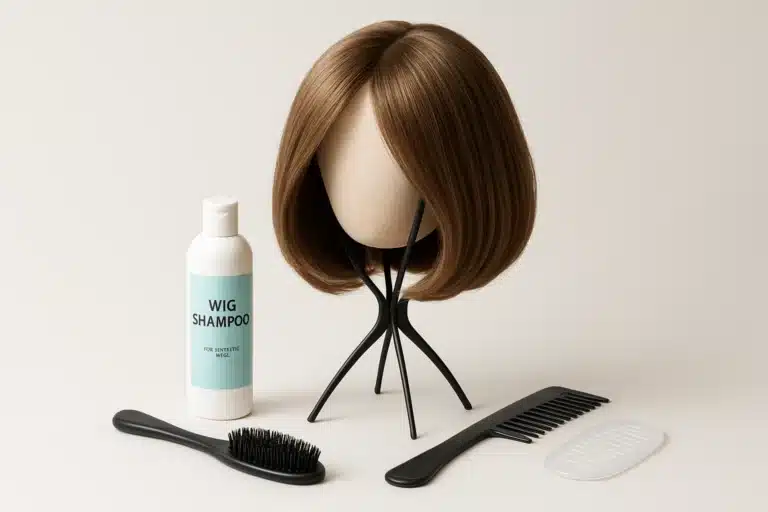
Retailers love to promote “heat-friendly” synthetics, but they often fail to warn beginners about mechanical friction frizz. Friction from rubbing against your shoulders, collars, and winter coats causes the fibers at the nape of the neck to clump and fray within weeks. Prevent this by using a wide-tooth metal or anti-static comb daily, applying leave-in silicone conditioning sprays, and using a low-heat handheld garment steamer to occasionally smooth out frayed ends.
The Two-Wig Rotation Financial Strategy
Instead of wearing a single $150 wig every day until it degrades, purchase two $75 wigs and rotate them daily. Alternating pieces gives the synthetic fibers time to “rest” and bounce back into shape, effectively tripling their combined lifespan compared to continuous daily wear.
Frequently Asked Questions (Beginner’s Guide)
What is the difference between a $40 synthetic wig and a $300 wig?
A $40 wig is typically machine-made with an open-weft cap and a fixed part, meaning the styling cannot be changed. A $300 synthetic wig usually features a hand-tied lace front for an undetectable hairline, a monofilament top that mimics a natural scalp, and high-grade fibers that move more naturally.
Are synthetic wigs obviously fake or overly shiny under daylight?
Out of the box, affordable synthetics can carry a noticeable shine. However, utilizing simple at-home adjustments—like applying dry shampoo or soaking the wig in a cool water and fabric-softener mix—completely eliminates this shine, rendering them virtually indistinguishable from natural hair.
How do I prevent “friction frizz” at the nape of my neck on synthetic wigs?
Friction frizz happens when synthetic fibers rub against clothing. To prevent it, detangle the nape of the neck multiple times a day with a wide-tooth metal comb, apply a silicone-based wig spray to provide “slip,” and use a handheld clothing steamer (if the wig is heat-friendly) to smooth the fibers back into shape.
Can I get a wig covered if I have medical hair loss?
Yes. You must get a prescription from your doctor for a “Cranial Prosthesis” (using HCPCS code A9282). Submit this prescription, along with an itemized receipt from your retailer, to your insurance company.
Taking Your Next Steps with Confidence
Finding an affordable, high-quality wig in Garden City doesn’t require draining your bank account or sacrificing your self-esteem. By educating yourself on fiber types, mastering cap construction, and understanding how to effectively use payment plans and insurance loopholes, you take complete control of your hair loss journey.
Start by identifying your true needs—whether that is a breathable capless design for summer comfort or a lace-front piece for everyday realism. With this foundational knowledge, you are ready to explore the market confidently, ensuring that every dollar you spend translates into beauty, comfort, and enduring quality.