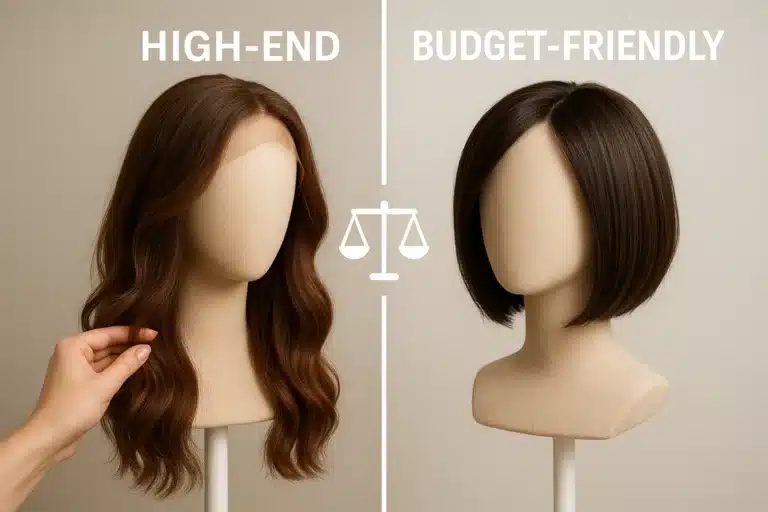
We’ve all experienced that moment of anticipation: you open the box of a brand-new wig, gently pull it from its protective netting, and try it on—only to feel like you’re wearing a shiny, heavy helmet instead of a natural head of hair.
If you’re exploring the world of hair replacement, you might be under the impression that you have to spend over $1,000 to look natural. The internet is filled with two extremes: endless lists of incredibly cheap options that barely last a week, and high-end manufacturer guides that can quickly induce sticker shock.
But what if the secret to gorgeous hair isn’t about how much you spend, but how well you understand wig mechanics? Choosing a budget-conscious wig doesn’t mean sacrificing quality. It simply means understanding the difference between “cheap” and “value,” and knowing a few insider techniques to transform an everyday piece into a flawless, personalized look.
Let’s explore how to choose and optimize a wig that perfectly aligns with your budget, your daily routine, and your life.
The Anatomy of Value: “Cheap” vs. “High-Value”
To find the perfect wig without breaking the bank, we first need to change how we evaluate them. A “cheap” wig often has bulky knots, stiff fibers, and an unnatural shine. A “value” wig, on the other hand, might use cost-effective materials but is constructed in a way that allows for customization.
When assessing a wig’s true value, consider these foundational elements:
- Fiber Types: Standard synthetic fibers hold their style beautifully after washing but can’t be heat-styled. Alternatively, heat friendly synthetic wigs offer incredible versatility, allowing you to use curling irons and straighteners. Pro-tip: Heat-friendly fibers often look more natural and matte right out of the box, though they generally have a slightly shorter lifespan of 2-3 months compared to the 4-6 months of standard synthetics.
- Cap Construction: The foundation of your wig dictates its realism and comfort. Basic machine-made caps are incredibly durable and affordable, while lace front wigs provide a seamless, invisible hairline that allows you to pull the hair away from your face.
Matching Your Wig to Your Daily Lifestyle
Your ideal wig isn’t just about the style you prefer; it’s about how you spend your day. Aligning your wig choice with your lifestyle drastically improves comfort and extends the life of the hairpiece.
The Commuter
If you spend hours in a car, on a train, or constantly throwing on scarves and coats, friction is your biggest enemy. Constant rubbing against collars causes synthetic fibers to tangle and fray at the nape of the neck.The Solution: Opt for stylish bobs or low-friction short styles. If you love long hair, consider keeping it in a loose braid or updo during your commute to protect the fibers.
The Athlete
Sweat, heat, and movement challenge any hairpiece. What many don’t realize is that the chemical composition of sweat can actually degrade certain cap materials over time, while trapped heat causes discomfort.The Solution: Prioritize cap construction over style. Look for high-breathability open-wefted caps. These allow air to circulate freely. Reserve your most expensive pieces for social outings and keep a dedicated, easy-to-wash activewear wig.
The Professional and Socialite
For office environments or close-up social interactions, the primary goal is undeniable realism. The Solution: Invest your budget where it’s most visible: the hairline and the part. Finding highly natural looking wigs often comes down to choosing pieces with a monofilament part or a lace front, which creates the illusion of hair growing directly from your scalp.
The “Expensive-Look” Toolkit: Transforming Budget Finds
The real secret of the wig industry? Even the most affordable wigs can look like top-tier luxury items if you know how to customize them. Here is your technical manual for elevating any wig.
The “Matte-ification” Science
The number one giveaway of a budget wig is the dreaded “synthetic shine.” Synthetic fibers are essentially micro-fine plastics, and by nature, they reflect light much more harshly than biological hair. To neutralize this shine, you have three excellent options:
- Dry Shampoo: A light spritz of dry shampoo absorbs the glare immediately. It’s the fastest, most effective hack for everyday wearers.
- Fabric Softener Soaks: A highly popular (though slightly controversial) community hack. Soaking a standard synthetic wig in a mixture of cold water and fabric softener can help break down the factory coating that causes extreme shine.
- Professional Dulling Powders: Translucent setting powders lightly dusted over the hair can instantly soften the look.
The Density Dilemma
Beginners naturally assume that thicker hair equals a better, healthier-looking wig. However, budget wigs are frequently over-dense, resulting in what many call the “helmet look.” Real hair has natural movement and varied thickness. Taking your wig to a stylist to have the bulk removed with thinning shears—especially around the crown and face-framing layers—is often an absolute game-changer.
Mastering the Hairline
Achieving a seamless transition from your forehead to the wig is an art form.
- The 4-Finger Rule: Place four fingers horizontally above your eyebrows. The top of your index finger is generally where your natural hairline should begin. Pulling a wig too far down is a common beginner mistake that instantly looks unnatural.
- The Art of the Tweeze: Budget lace fronts often feature hairlines that are overly straight and dense. Using tweezers to carefully pluck individual hairs—creating a soft, irregular gradient—mimics biological growth patterns. For a deep dive into this technique, learn the secrets of achieving a perfectly natural wig hairline.
Longevity Math: Smart Wear Habits
When budgeting for hair replacement, the true cost isn’t just the purchase price; it’s the cost-per-wear. This is where “Longevity Math” comes into play.
Did you know that two $60 wigs rotated daily will last significantly longer than one $120 wig worn continuously? Synthetic fibers experience “friction fatigue.” When you wear the same wig every single day, the fibers never have a chance to recover their shape, leading to premature tangling and fraying.
Implementing a “Rotation Strategy” allows the fibers to rest. While one wig is on your head, the other is on a stand, maintaining its structural memory. Pair this rotation with a strict wig care routine—using only cold water and specially formulated synthetic shampoos—and you’ll double the lifespan of your pieces.
Navigating Maintenance as a Penny-Pincher
Protecting your investment requires knowing how to troubleshoot common issues before they require a replacement. If you notice that my synthetic wig is frizzy at the ends, don’t throw it away! A gentle detangling spray, a wide-tooth comb, and occasionally the careful use of a garment steamer (on standard synthetics) can smooth those fibers right back to their factory finish.
Similarly, keeping track of your wig maintenance schedule ensures you aren’t over-washing, which can strip the wig of its built-in luster and stretch out the cap. Washing every 6 to 8 wears is the sweet spot for most daily wearers.
Seamlessly Blending In
When wearing synthetic wigs in your daily life, the ultimate goal is confidence. By ensuring your part is defined (a little concealer on the lace part works wonders), your shine is dulled, and your density is natural, you transform an affordable piece into a true crown.
Frequently Asked Questions (FAQ)
How long do budget synthetic wigs last?
With daily wear, a well-maintained synthetic wig typically lasts 4 to 6 months. Heat-friendly synthetics usually last 2 to 3 months because the fibers undergo more friction and structural changes from styling. You can extend this timeframe significantly by rotating multiple wigs.
Can I use heat on a cheap wig?
Only if the label specifically states it is “heat-friendly” or “heat-defiant.” Using a curling iron or blow dryer on a standard synthetic wig will melt the plastic fibers instantly, ruining the piece.
How much plucking is too much for a budget lace front?
Budget lace is often slightly thinner and more delicate than luxury Swiss lace. Pluck sparingly, focusing only on the very front edge to create a staggered, natural gradient. Never pluck two hairs from the exact same hole, as this can tear the lace material.
Why is my wig so shiny right out of the box?
Synthetic fibers are coated in protective sealants during the manufacturing process to keep them pristine during shipping. This coating, combined with the inherently reflective nature of the plastic fibers, causes the shine. A quick spritz of dry shampoo is the easiest way to resolve this.
Next Steps in Your Wig Journey
Choosing a wig is a deeply personal journey, but it doesn’t have to be a financially overwhelming one. By shifting your focus from simply “buying hair” to mastering the art of customization, you empower yourself to look stunning on any budget.
Start by identifying your primary lifestyle needs—are you a commuter needing low-friction styles, or a professional needing lace-front realism? From there, build your toolkit of dry shampoo, thinning shears, and tweezers. With a little bit of practice and these insider techniques, your everyday wig will become indistinguishable from luxury salon hair.