If you’ve ever accidentally melted a beautiful new wig with a curling iron, you are far from alone. For decades, the golden rule of alternative hair was simple: keep synthetic fibers far away from heat. But the alternative hair landscape has undergone a massive evolution. Today, heat-defiant polymer blends offer the incredible styling versatility of human hair at a fraction of the cost, completely changing how we approach our daily looks.
However, embracing these modern fibers requires a bit of a learning curve. Many beginners find themselves frustrated by unpredictable frizz or curls that fall flat minutes after styling. Fortunately, if you live in or around Essex County, navigating this new world is much easier when you have access to a comprehensive guide to the best wig stores in Newark, NJ. Finding local experts who understand the science behind these fibers is your first step toward hair confidence.
Let’s bridge the gap between shopping local and mastering your new hair. Grab a cup of coffee, and let’s explore the science, the styling secrets, and the best places in Newark to build your ultimate heat-friendly hair toolkit.
The Synthetic Revolution: Why Heat-Friendly Changes Everything
Traditional synthetic wigs are fantastic because they come pre-styled and hold their shape through rain and washing. But if you want to switch your look from sleek and straight to bouncy curls, you need heat friendly synthetic wigs.
Unlike biological hair, which is made of keratin protein, heat-friendly fibers are engineered from advanced synthetic polymers. These polymers have a specific “denier” (thickness) designed to withstand temperatures usually up to 350°F—though, as we’ll learn, you shouldn’t actually go that high. The true magic of these wigs lies in something called “Style Memory.” Once you heat the hair and allow it to cool in a new shape, that new style becomes “baked in.” It will even survive being washed in water, holding its new texture until you apply heat to it again.
Navigating Newark’s Best Wig and Beauty Retailers
Before you can master the styling techniques, you need the right canvas and tools. One of the biggest advantages of shopping locally in Newark is the vibrant, diverse beauty supply ecosystem that caters to every hair need imaginable.
Downtown Newark / Market Street Corridor
Market Street is a bustling hub for beauty enthusiasts. Retailers like Tommy’s Wig Inc., New World Beauty Supply, and Beauty Market are excellent starting points. Here, you can visually inspect the denier of different heat-friendly fibers and speak with staff about which brands hold up best over time.
Broad Street & Halsey Street Hubs
If you are looking for specific wig care products, the Broad Street and Halsey Street corridors—including spots like Bliss Beauty Supplies—offer curated selections. This is where you can find specialized wide-tooth anti-static combs and canvas styling blocks.
Bergen Street & West Side District
For everyday essentials and community supply hubs like Feel Beauty Supply, the Bergen Street district is fantastic. Local stylists often source their canvas blocks, T-pins, and specialized liquid styling lotions from these neighborhood staples.
The “Heat as Medicine” Paradigm Shift
Here is an “aha moment” that transforms how most people view synthetic wig care: Heat isn’t just for styling; it is required for maintenance.
As you wear your wig, the friction from your collar, shoulders, and back causes the microscopic cuticles of the synthetic fibers to fray and become jagged. This is what causes that dreaded nape frizz. Beginners often fear applying heat to fix this, thinking it will cause more damage. In reality, controlled low heat acts as a resurfacing tool, smoothing those jagged polymer edges back down.
The Thermal Range Visual Index
To avoid the “Temperature Trap” of drugstore hot tools with simple High/Low switches, you must use a digital tool. Here is your cheat sheet:
- Detangling & Smoothing: 240°F – 260°F (Ideal for resurfacing friction frizz)
- Curling & Waving: 270°F – 290°F (The sweet spot for changing the style)
- The Danger Zone: Anything over 320°F (Risk of melting or permanently damaging the fiber)
Essential Tool Kit & Product Selection
Proper wig maintenance requires a few specialized tools. Biological hair products are often heavy in drying alcohols or heavy oils, which can degrade synthetic polymers.
Your Newark Shopping List should include:
- Digital Ceramic/Tourmaline Hot Tools: Exact temperature control is non-negotiable.
- Canvas Block & T-Pins: To hold your wig securely. Pro tip: Only place T-pins on the ear tabs and nape, never through the delicate lace front.
- Wide-Tooth Anti-Static Combs: To prevent stretching the fibers.
- Specialty Product Chemistry: Look for lightweight silicone or polysorbate leave-in conditioners. Interestingly, some professional lines, like hair styling products by Rusk, or even specific Asian hair styling products known for lightweight setting lotions, offer great crossover benefits for synthetic hair when used sparingly.
Step-by-Step: Mastering the Clip-and-Cool Technique
If you are wondering how to curl synthetic hair and actually get it to hold, the secret is all in the cooling phase.
Heat softens the synthetic polymer bonds, but the structural reset occurs only when the fiber drops below its transition temperature. If you drop a hot curl from your wand immediately, gravity will pull the softened fiber straight before it sets.
Module A: Safe Straightening (The Tension-and-Glide Method)
- Spray a light synthetic heat protectant on small sections of the hair.
- Set your digital flat iron to 260°F.
- Using a heat-resistant comb to “chase” the iron, apply gentle, even tension and glide the iron down the hair shaft. Do not stop moving, or you’ll create a crease.
Module B: Long-Lasting Curls (The Clip-and-Cool Rule)
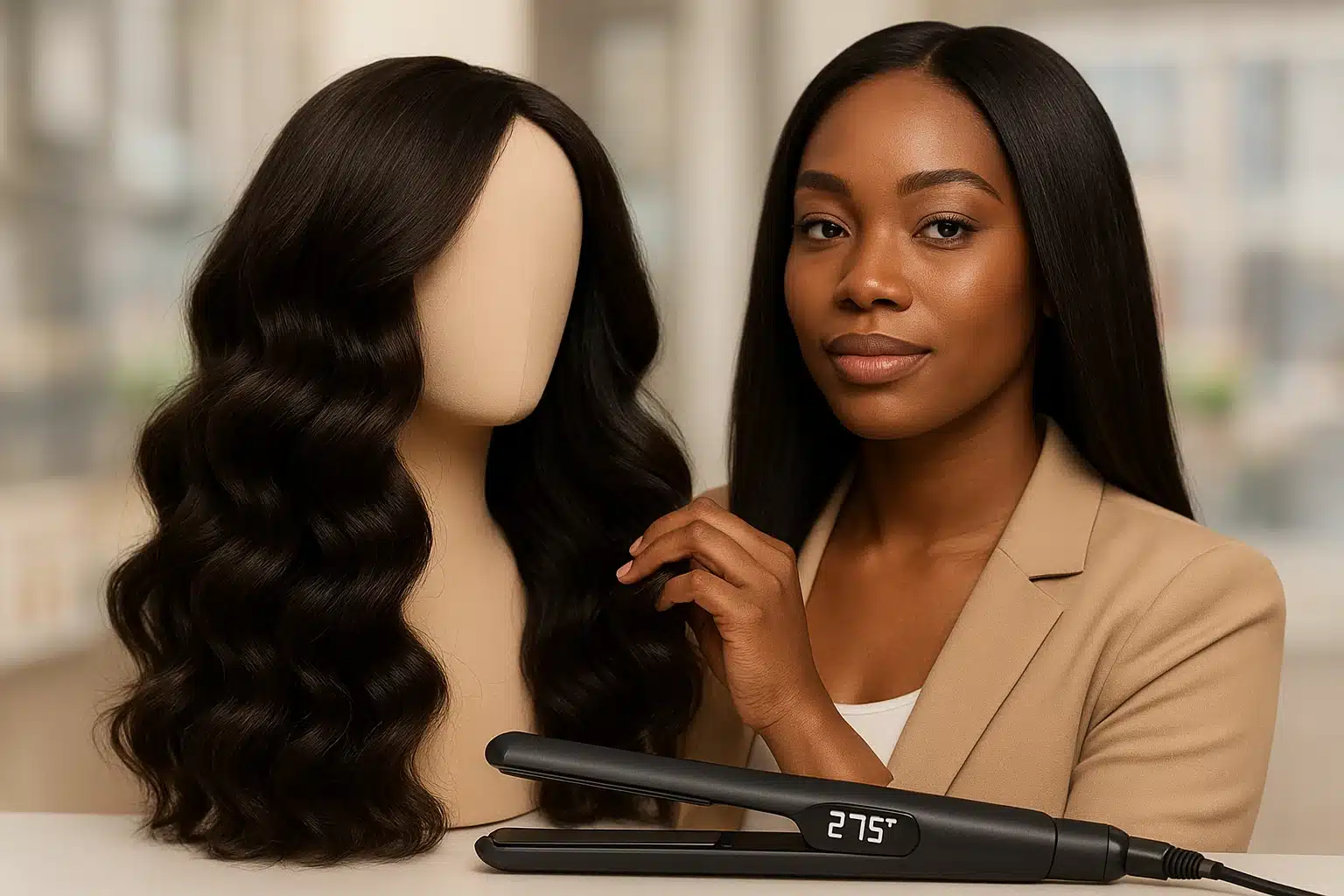
- Wrap a section of hair around a curling wand set to 275°F.
- Hold for 8-10 seconds to allow the heat to penetrate the fiber.
- Gently slide the curl off the wand into the palm of your hand while it is still coiled.
- Use a metal duckbill clip to pin the curl to the wig block.
- Leave it pinned until completely cold (at least 10 minutes). Once cool, the curl is permanently locked in.
Common Beginner Traps to Avoid
Even with the best wig styling intentions, it’s easy to fall into a few common traps:
- The Hot Water Basin Error: Never soak a wig in hot water to clean it. Always use cold water with a gentle downward rinsing motion. Hot water can inadvertently reset the style memory in unpredictable ways.
- The Steamer Trap: While commercial garment steamers are great for removing kinks, holding a steamer too close to a lace cap can melt the delicate root knots, causing massive shedding.
- The Human Hair Oil Myth: Argan oil and thick pomades sit on top of synthetic fibers, turning into a sticky magnet for dirt and lint. Stick to water-based or silicone-based synthetic sprays.
Frequently Asked Questions (FAQ)
What is the exact difference between regular synthetic and heat-friendly synthetic wigs?
Regular synthetic wigs will melt if exposed to any direct heat and cannot be restyled. Heat-friendly (or heat-defiant) synthetics are blended with advanced polymers that allow you to use hot tools (up to roughly 280°F) to safely straighten or curl the hair.
How often should I wash my heat-friendly wig?
A good rule of thumb is to wash your wig every 6 to 8 wears. Over-washing strips away the factory-applied protective coatings, while under-washing allows sweat and oils to degrade the cap.
Why did my heat-friendly wig curl fall out immediately after using a curling wand?
Because the fiber didn’t cool in the shape of the curl! Remember the “Clip-and-Cool” rule: synthetic hair only locks into its new style memory as it returns to room temperature.
Can I use retro hair styling products or heatless styling methods on synthetics?
Yes! Heatless styling (like using foam rollers or flexi-rods) is actually a fantastic way to preserve fiber lifespan. You can roll the hair, apply gentle steam or warm water, and let it air dry completely to set a gentle wave without applying the direct, harsh heat of a metal iron.
Your Next Steps Toward Hair Confidence
Mastering a heat-friendly synthetic wig doesn’t have to be overwhelming. By understanding that heat is both a styling mechanism and a necessary tool for smoothing friction frizz, you are already steps ahead of the average beginner.
Take a weekend to explore the beauty corridors of downtown Newark. Feel the fibers, read the product labels, and invest in a digital temperature-controlled iron. With the right tools and a little bit of polymer science under your belt, you’ll be effortlessly styling your wigs like a seasoned professional in no time.