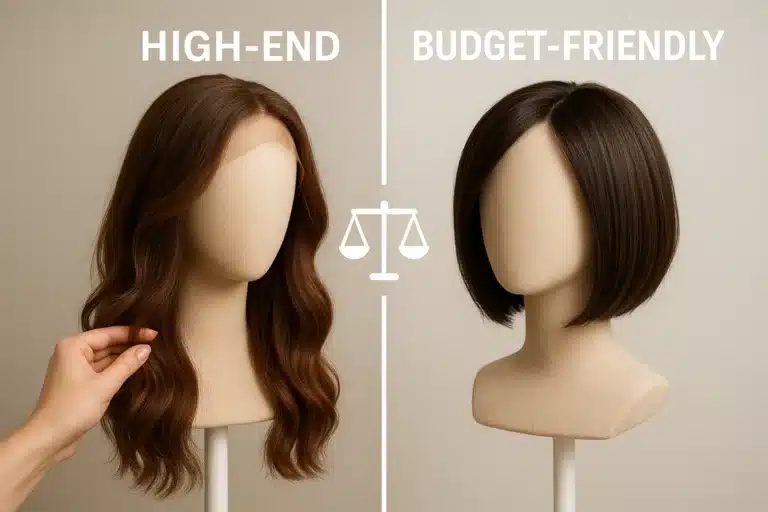
We have all been there. You are scrolling through Instagram or a website late at night, and you see it—the perfect style. The hair looks silky, the hairline seems invisible, and best of all, the price tag is $200 less than what you saw at the local boutique. It feels like a no-brainer. You click “Add to Cart,” imagining how great you are going to look the moment the box arrives.
But when that box finally lands on your doorstep, the reality often hits hard. The hairline is thick and dense, the “transparent” lace is visibly grey against your skin, and the cap feels loose in some spots and tight in others. Suddenly, that bargain purchase feels more like a project than a product. This is the heart of the in-store vs. online wig shopping dilemma that many first-time buyers face. It isn’t just about where you buy; it is about understanding the difference between buying a raw material and investing in a finished, wearable solution.
Beyond the Sticker Price: The “Hidden” Costs of Online Shopping
To understand the true cost of a wig, we have to look past the initial checkout price. Most online retailers sell what is technically known as “boxed” inventory. While marketing materials often label these as “ready-to-wear,” experienced wig wearers know that true readiness is a spectrum.
When you purchase online, you are essentially paying for the product itself, but the labor required to make it look natural falls on you. This is where the “invisible to-do list” begins, and for many, this is where the costs start to climb.
The Unboxing Reality Check
The moment you take a wig out of the box, you are often faced with three immediate challenges:
- Lace Customization: Most wigs come with excess lace that must be cut with precision. One slip of the scissors can ruin the hairline permanently.
- Density Management: Manufacturing standards often result in wigs that are 130% to 150% density. For the average person, this looks unnaturally thick. Thinning a wig requires specialized shears and a knowledge of structural integrity to avoid causing flyaways.
- Knot Bleaching and Plucking: To make the hair look like it is growing from your scalp, the knots (where the hair is tied to the lace) often need to be chemically bleached or physically plucked.
If you are comfortable doing this yourself, the online savings are real. However, if you have to take your new online purchase to a salon for these alterations, you are looking at a “customization fee” that can range from $100 to over $200, depending on your location.
The Service Value Stack: What You Actually Pay For In-Store
When you walk into a reputable wig boutique, the higher price tag on the shelf isn’t just markup; it is a bundled service fee for expertise. You aren’t just buying hair; you are buying the assurance that the hair will look like yours.
The Mathematics of a Professional Fit
A common misconception is that wig sizing is just about the circumference of your head. In reality, a secure wig fitting involves three to five different measurements, including the ear-to-ear distance over the top of the head and the front-to-back measurement.
In-store professionals also assess your head shape—whether it is petite, average, or large—and can alter the cap construction on-site. This prevents the dreaded “wig headache” caused by a cap that presses on your temples or the insecurity of a cap that slips at the nape of the neck.
The Mathematics of Confidence: A Cost Comparison
Let’s break down the Total Cost of Ownership (TCO) over the first month of wearing a wig. This comparison assumes a standard high-quality synthetic piece.
| Cost Factor | Online Purchase Scenario | In-Store Boutique Scenario |
|---|---|---|
| Initial Product Cost | $250.00 | $425.00 |
| Shipping & Insurance | $15.00 | $0.00 (Included) |
| Professional Fitting | DIY (Risk of error) | Included |
| Customization (Cutting/Styling) | $120.00 (Salon fee) | Included |
| Care Products (Shampoo/Stand) | $45.00 | Often discounted/bundled |
| Total First-Month Cost | $430.00 | $425.00 |
| “Peace of Mind” Factor | Low (No return after cut) | High (Support guarantee) |
As the data shows, when you factor in the necessary wig price range options for professional styling and fitting, the price gap often closes completely. The difference is that with the boutique experience, the risk is removed from your shoulders.
The “DIY Risk” Factor: Styling and Maintenance
One of the most significant differences between online and in-store experiences becomes apparent when you attempt to style the wig. Photography lighting and professional styling in product photos can be deceiving.
The Complexity of Texture
If you are looking at curly lace front wigs, the challenge doubles. Curly synthetic fibers are prone to friction frizz and require very specific detangling techniques. In a store, a stylist teaches you exactly how to maintain the curl pattern before you leave. If you buy online, you are often left to learn via trial and error—and error usually means ruining the fiber.
The “Influencer Effect”
Many beginners are influenced by videos featuring sensational wigs for beginners or budget-friendly cosplay options. What these videos rarely show is the hours of work that happened off-camera: the steaming, the product application, and the secure braiding of the biological hair underneath. A professional stylist bridges the gap between the “fresh out of the bag” look and the polished final result.
Longevity: The Hidden Metric
There is also the question of lifespan. A wig that is professionally fitted, washed, and maintained will almost always outlast one that is cared for by a novice guessing at the right techniques.
Many local boutiques offer “refresh” services where you can drop off your wig for a professional wash and steam. This ongoing relationship extends the life of the product. If you rely solely on site:wigsuperstore.com wig maintenance articles without hands-on guidance, you might inadvertently use the wrong water temperature or brush type, shortening your wig’s lifespan by months.
Making the Right Choice for Your Journey
So, which path is right for you?
Choose Online If:
- You are an experienced wig wearer who knows how to cut lace and pluck hairlines.
- You have access to a stylist who specializes in alternative hair.
- You are buying a wig for occasional wear (like cosplay or fashion) and don’t require daily-wear durability.
Choose In-Store If:
- You are experiencing medical hair loss and need a sensitive, private environment.
- This is your first wig, and you are unsure about your size or best color match.
- You want a “walk-out-wearing-it” experience without the stress of customization.
Ultimately, the “best” price isn’t just about the dollars leaving your bank account—it’s about the value you get in return. Whether you choose the convenience of online shopping or the support of a local expert, understanding the full picture ensures that your investment leads to the most important result of all: confidence.
Frequently Asked Questions
Q: Can I buy a wig online and take it to a regular hair salon for styling?
A: You can, but proceed with caution. Bio-hair scissors dull quickly on synthetic fibers, and many traditional hairstylists are not trained in wig cap construction. Always verify that the stylist has specific certification in alternative hair before booking.
Q: Why are in-store wigs non-returnable?
A: Due to hygiene regulations and the nature of the product, wigs are generally considered intimate items. However, buying in-store allows you to try before you buy, drastically reducing the need for returns compared to online shopping.
Q: How much does it cost to have an online wig professionally installed?
A: Prices vary by region, but a full installation (braid down, lace gluing, and styling) typically ranges from $100 to $300. Be sure to factor this into your budget when comparing online prices to store prices.
Q: Does a more expensive wig last longer?
A: Generally, yes. Higher-quality fibers (like heat-friendly synthetic or Remy human hair) and better cap construction (like monofilament tops) are designed for durability. However, lifespan is heavily dependent on proper care and maintenance.