When you are navigating hair loss due to medical treatments like chemotherapy or alopecia, the conversation often revolves around aesthetics. Friends might ask what color you want, or you might find yourself scrolling through endless pages of styles. But for those with sensitive scalps, the most critical factor isn’t how the hair looks in a mirror—it’s how the cap feels against your skin after eight hours of wear.
There is a profound difference between buying a fashion accessory and selecting a medical necessity. While the digital age offers convenience, understanding the in-store vs. online wig shopping dilemma is the first step in ensuring your journey toward hair restoration is comfortable and stress-free. For a scalp that has been sensitized by medical treatment, a hands-on, tactile assessment isn’t just a shopping preference; it is a vital part of your self-care and health regimen.
The “Sensory Science” of Wig Wearing
Most medical authorities, such as the American Cancer Society, provide excellent advice on insurance and prescriptions, but they often lack the technical depth regarding the “sensory load” of a wig. Sensory load refers to the cumulative input your nerves receive throughout the day. A wig that feels merely “okay” when you first put it on can become a source of significant distress, known as “cumulative itch,” as the hours pass.
For a healthy scalp, a slightly rough seam is a minor annoyance. For a scalp undergoing chemotherapy, that same seam can feel like sandpaper. This is where the science of comfort comes into play. It requires shifting your priority from visual density (how much hair is on the wig) to construction delicacy (how the wig is built).
The Hidden Pain Points
Online guides often miss the specific physical pain points of a post-chemo scalp. These include:
- Thermal Regulation: A compromised scalp often struggles to regulate heat, making breathability non-negotiable.
- Pressure Sensitivity: Without hair to act as a cushion, the scalp is more susceptible to pressure headaches caused by ill-fitting tension bands.
- Texture Aversion: Materials that were once tolerable can trigger inflammatory responses.
Anatomy of a Comfort-First Wig
To understand why a fitting is necessary, you must first understand the architecture of wigs for chemo hair loss. Not all wigs are created equal, and the difference usually lies in the “engine” of the wig: the cap construction.
Fashion vs. Medical Grade
If you look at a standard fashion piece, such as a vivi cosplay wig, the focus is entirely on the external visual effect. These caps often rely on “open wefting” sewn together with standard thread, creating ridges that can dig into the skin. In contrast, sensitive scalp wigs utilize entirely different engineering.
Key Construction Elements
- Double Monofilament Tops: This involves a layer of soft mesh where hair is tied, covered by a second layer of silk-like material that rests against the skin. This protects the scalp from the knots, preventing the “prickly” sensation.
- 100% Hand-Tied Caps: Unlike machine-made wigs, every strand is tied by hand into a soft mesh base. This allows the cap to stretch and move with your skin, rather than being a rigid shell that rubs against it.
- Bamboo and Silk Blends: Innovative sensitive scalp wig caps often incorporate bamboo fibers. Research into textile science shows that bamboo possesses superior thermal conductivity compared to synthetics, meaning it pulls heat away from the head, keeping you cool.
The Clinical Comfort Consultation: Why In-Store Matters
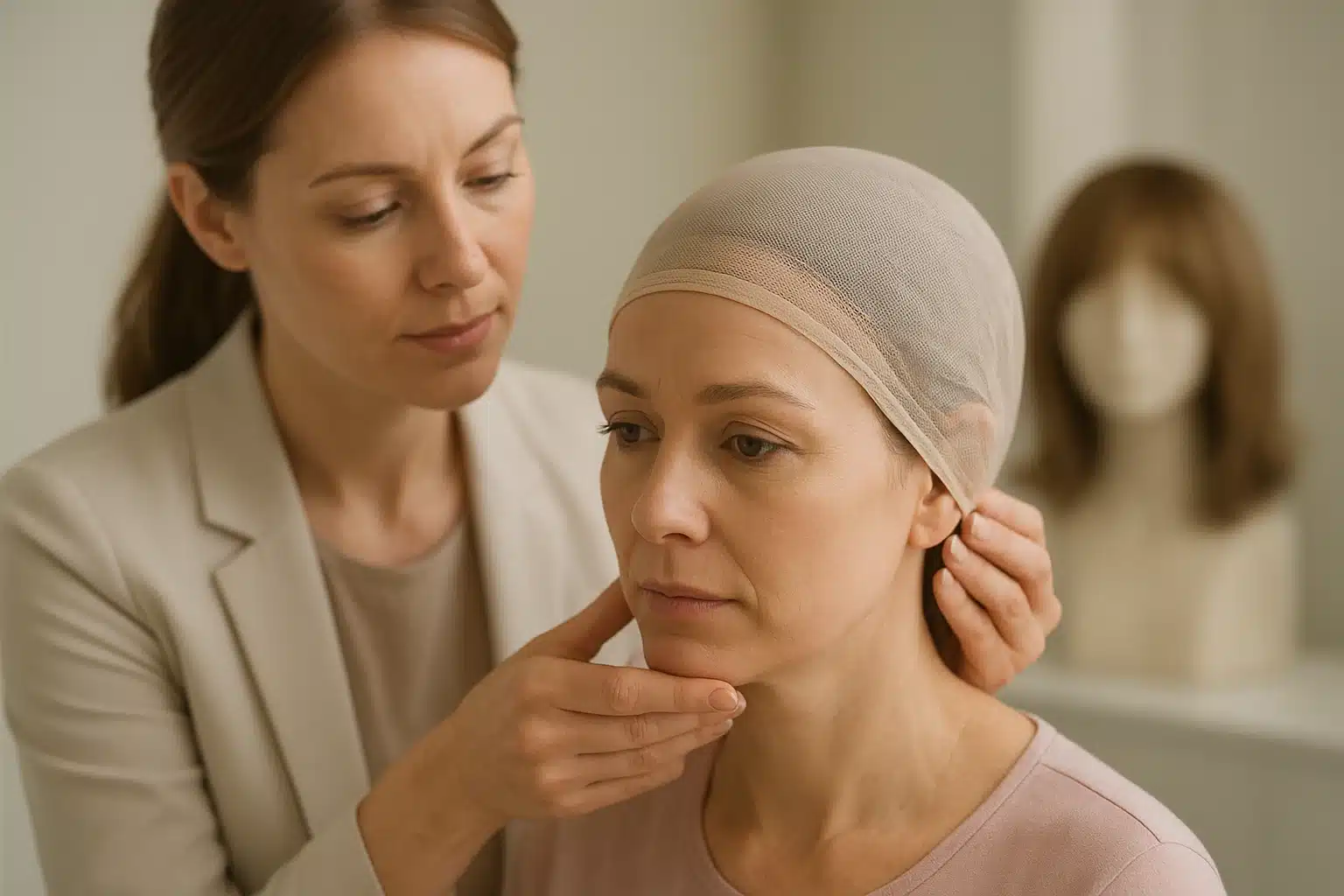
You can read about velvet ear tabs online, but you cannot feel them through a screen. This is why we view the in-store experience not as “shopping,” but as a “Clinical Comfort Consultation.” A specialist in a physical store provides a tactile fitting experience that safeguards your comfort.
Pressure Point Analysis
Every head has a unique topography. You may have a slightly more prominent occipital bone or sensitive temples. An online size chart measures circumference, but it doesn’t account for shape. During an in-store fitting, a specialist can identify “Scalp Hot Spots”—areas where a wig is likely to rub—before you ever make a purchase. They can adjust stays and tension bands to ensure the wig grips securely without compressing sensitive nerves.
The “Four-Finger Rule”
One of the most common causes of irritation is improper placement. If a wig sits too low, it interferes with the facial muscles of the forehead, causing friction. Specialists teach the “Four-Finger Rule” regarding hairline placement, ensuring the wig sits naturally without irritating the sensitive skin of the forehead.
The Tactile Feedback Loop
There is an “aha moment” that happens in a fitting room. It occurs when a client tries on a standard cap, feels the difference, and then switches to a hand-tied medical cap. That immediate tactile feedback allows you to determine your personal tolerance levels. You might realize that while you thought “i love that hair long and black,” the weight of a long, high-density wig pulls too much on your scalp, and a lighter, mid-length style offers the aesthetic you want with the comfort you need.
Advanced Comfort Solutions and Customization
Beyond the wig itself, the method of attachment plays a massive role in scalp health.
Friction-Free Security
Many first-time wearers assume they need glue or tape, which can be disastrous for sensitive skin. In a consultation, you can explore alternatives like the qfitt wig cap. These are designed to provide friction-based security without the need for chemical adhesives.
The Seamless Hairline
For those concerned with a natural look who fear adhesive irritation, specialists can introduce you to concepts like dissolving wig cap technology. While more advanced, understanding how different melting sprays or barrier creams interact with your specific skin chemistry is a discussion best had in person.
Holistic Scalp Health: Beyond the Wig
A comfortable wig experience doesn’t end when you take the piece off. Caring for your scalp is just as important as caring for the hair.
Soothing the Skin
After a day of wear, your scalp needs to breathe and recover. Whether you are looking for local remedies or the best hair masks nz has to offer—often praised for ingredients like Manuka honey which has natural antibacterial and soothing properties—the goal is hydration without clogging pores.
Preparing for Regrowth
As you transition from hair loss to regrowth, your sensitivity levels will change. The grey hair best treatment during this phase is often a gentle, moisturizing approach that softens the new, sometimes coarse stubble, reducing the friction between your natural hair and the wig cap.
FAQ: Navigating Your Comfort Journey
Q: Will wearing a wig prevent my natural hair from growing back?
A: No. A properly fitted, breathable wig will not inhibit hair growth. In fact, protecting your scalp from the sun with a wig can be beneficial.
Q: Can I wear a wig if I have a sensitive, sunburned feeling from chemo?
A: Yes, but material selection is paramount. Stick to 100% hand-tied caps and consider using a bamboo liner for an extra layer of protection.
Q: I’m returning to work soon. Can I wear colored styles?
A: Absolutely. As you recover and return to workplaces that allow colored hair, you may want to express yourself. Just ensure that the internal cap construction remains high-quality, even if you are opting for a fun, vibrant color.
Q: How do I know if my wig is too tight?
A: If you have a headache within 30 minutes or see deep red indentations on your forehead when you remove it, it is too tight. A specialist can adjust this for you.
Q: Why does my wig itch at the nape of my neck?
A: This is a common “hot spot” caused by friction against collars or sweating. A specialist can show you how to adjust the nape tabs or recommend a wig with a velvet-lined nape for protection.
Conclusion
The journey of choosing a wig is emotional, but it should never be painful. By prioritizing the science of comfort and taking advantage of the expertise found in a physical fitting, you ensure that your wig serves you, not the other way around. When your wig feels like a natural extension of yourself, you stop thinking about it—and that is when you truly start to feel like yourself again.