Imagine finding a hairstyle that makes you feel absolutely radiant, only to take it off hours later because of a throbbing headache right behind your ears. Or perhaps you’ve experienced the quiet anxiety of feeling your wig slowly slide backward over your hairline during a conversation. If you’ve ever dealt with these issues and thought, “Maybe this just isn’t for me,” take comfort in knowing the culprit is rarely the hair itself. More often than not, it’s simply a matter of fit.
The reality of the alternative hair industry is that roughly 90% of wigs are manufactured in a standard “average” size. But human heads are beautifully diverse, and forcing a one-size-fits-all approach inevitably leads to physical discomfort and an unnatural look. Fortunately, when you know exactly what to measure and look for, exploring the wig stores in Albuquerque transforms from an overwhelming puzzle into an empowering experience. Whether you require specialized petite size wig caps or extra large wig caps, understanding the mechanics of wig sizing is the first step to reclaiming your confidence.
The Fit Crisis: Why “Average” Isn’t Always Your Best Friend
Many first-time wig wearers assume that a secure fit comes from tight straps or heavy-duty adhesives. In truth, a secure alternative hair piece relies entirely on the precise geometry of the cap itself.
When you wear a cap that doesn’t align with your bone structure, your body will let you know immediately.
Symptoms your wig cap is too small:
- The back of the wig chronically rides up your neck.
- The front hairline slips backward throughout the day.
- You experience consistent pressure headaches, particularly near your temples or behind your ears.
Symptoms your wig cap is too large:
- You notice buckling or puckering at the crown, creating an unnatural “conehead” appearance.
- The ear tabs overlap your natural ears, causing friction, rubbing, and even blisters.
- The entire perimeter slides around loosely, no matter how much you tighten the straps.
Recognizing these symptoms is your diagnostic starting point. From here, you can determine if you need to size down to extra small wig caps or size up to wig caps for large heads.
The 3-Step Measurement Masterclass
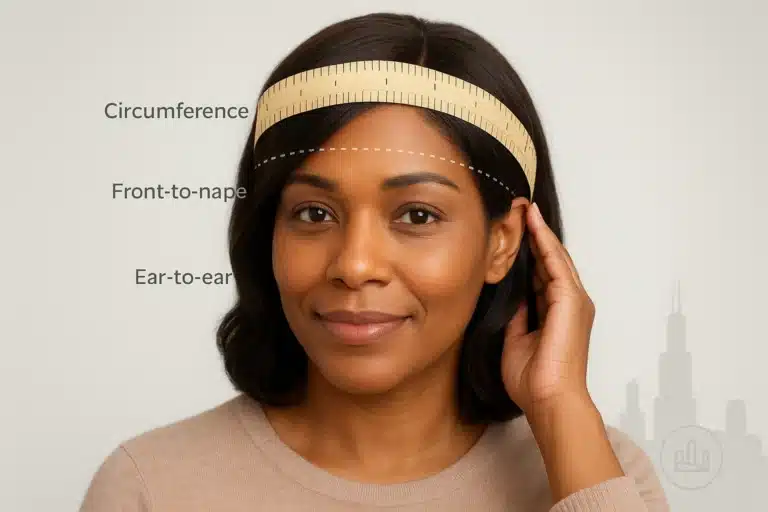
One of the biggest mistakes beginners make is measuring only the circumference of their head. True fit requires a “Three-Dimension Rule.” Before you step foot in a boutique, grab a soft measuring tape and capture these three distinct measurements:
- Circumference: Trace the tape measure around your hairline, starting at the front, pulling it behind your ears, around the nape of your neck, and back to the front.
- Front-to-Nape: Measure from the center of your natural front hairline, straight back over the crown of your head, to the base of your skull (where your neck bends).
- Ear-to-Ear: Measure from the top of one ear, directly over the crown of your head, to the top of the opposite ear.
Once you have your numbers, use this sizing matrix to find your category:
| Cap Size | Head Circumference | Front-to-Nape | Ear-to-Ear | Best Match For |
|---|---|---|---|---|
| Extra Small / Ultra Petite | 19.5″ – 20.25″ | 12.5″ – 13″ | 12″ – 12.5″ | Children or very petite adult frames |
| Petite | 20.5″ – 21.25″ | 13.5″ – 14″ | 13″ – 13.25″ | Smaller adult head shapes |
| Average (Medium) | 21.5″ – 22.5″ | 14.25″ – 14.75″ | 13.5″ – 14″ | Standard adult sizing |
| Large | 23″ – 24″ | 15.25″ – 15.75″ | 14.5″ – 15″ | Larger head shapes / thick natural hair |
| Extra Large | 24.5″+ | 16″+ | 15.5″+ | Maximum capacity |
Sizing Pro-Tip: The “Hair Volume Factor.” Many sizing guides tell you to measure your bare scalp. However, if you are wearing your wig over natural hair—especially if it is thick, curly, or long—you must add 0.5 to 1 inch to your measurements to accommodate that bulk underneath your wig grip or stocking cap.
Anatomy of a Perfect Fit: Cap Construction vs. Stretch
Your measurements are only half the battle. The other half is understanding how different cap constructions stretch and behave in the real world.
Open-Wefted (Machine-Made) Caps
If you are looking for wig caps for large heads, open-wefted styles are incredibly forgiving. Because they feature distinct elastic bands woven between rows of hair (wefts), the cap can easily expand horizontally, offering breathable flexibility.
Lace Front and Monofilament Caps
These caps feature a beautifully realistic but rigid perimeter. The delicate Swiss or HD lace does not stretch. Therefore, if you are shopping for a small cap lace wig, your ear-to-ear measurements must be exact. Forcing a lace wig onto a head that is too large will inevitably cause the delicate lace to tear or buckle at the temples.
100% Hand-Tied Caps
Offering the pinnacle of luxury and comfort, hand-tied caps feature individual hairs tied to a soft mesh base. While they are incredibly gentle on sensitive scalps, they have minimal lateral stretch. They are highly size-sensitive, meaning precision is key. If you desire a large cap pixie wig, for instance, a great hybrid option is a hand-tied top with an open-wefted back, which keeps the short style lying flat without squeezing your circumference.
Navigating Brand Fit Differences
Not all brands interpret “average” the exact same way. For example, European brands like Ellen Wille naturally run a bit snugger, making their “Average” fit more like a petite size wig cap. On the other hand, a brand like Jon Renau tends to run truer to US sizing standards. If your measurements point toward a large cap wig, note that BelleTress large caps run slightly smaller than Jon Renau large caps.
Sourcing Petite and Large Caps: Albuquerque’s Local Directory
While online research is excellent, nothing compares to the peace of mind of trying a piece on locally. When you need non-standard sizing, knowing which Albuquerque boutiques actually stock them saves you time and frustration.
Spellbound Wigs
Location: 12000 Constitution Ave NE G, Albuquerque, NMSpellbound Wigs stands out as a premier local destination for high-end alternative hair. Instead of just carrying the standard “average,” they explicitly stock both petite size wig caps and large cap wig options from industry-leading brands like Jon Renau and Ellen Wille. If you are a medical patient navigating alopecia or chemotherapy, their empathetic, private consultations make finding the right size a comforting experience.
Wigs Wigs Wigs
Location: 1449 Wyoming Blvd NE, Albuquerque, NMOperating as a by-appointment boutique, this shop shines in customized, personal fitting services. Their team excels at evaluating your specific head shape to ensure that your cap lies completely flush to the scalp, minimizing any unnatural bulk.
Trendz Beauty Supply
Location: 4301 Menaul Blvd NE, Albuquerque, NMIf you are looking for foundational accessories, Trendz is an excellent local stop. They are a great resource for stocking up on velvet wig grips, stocking caps, and budget-friendly synthetic options, including extra large wig caps and extra small wig caps.
DIY Adjustments & Professional Customizations
What happens if your measurements fall right between two sizes?
Almost all high-quality wigs come with built-in adjustable straps at the nape of the neck. Using Velcro or hook-and-eye adjusters, you can comfortably alter the fit by up to half an inch.
If you find a large cap wig that you absolutely adore, but you lean closer to an average size, you can utilize the “Elastic Band Method.” A local stylist can splice a comfortable, adjustable elastic band from ear-tab to ear-tab inside the cap. This anchors the wig securely to the back of the head, allowing you to wear a larger cap without the fear of it slipping.
Frequently Asked Questions About Wig Sizing
Why does my wig slide up at the back?
This is the most common symptom of a wig cap that is too small, specifically in the front-to-nape measurement. When the cap doesn’t have enough depth to reach the base of your skull securely, the natural movement of your neck pushes the cap upward.
How do I adjust a wig cap if my measurements cross multiple sizes?
It’s very common to have a Petite circumference but an Average front-to-nape measurement. The golden rule is always to size to your largest measurement. It is much easier to tighten a slightly loose wig using nape straps or an internal elastic band than it is to stretch a cap that is fundamentally too small for your skull.
What is the difference between an average and a large wig cap size?
Typically, an average wig cap fits a circumference of 21.5 to 22.5 inches. A large wig cap accommodates 23 to 24 inches. While a one-inch difference might sound minor on paper, in the mechanics of a wig cap, it drastically changes where the ear tabs rest and how the hairline aligns with your natural features.
Your Next Steps Toward the Perfect Fit
Understanding your unique measurements transforms your shopping journey from a guessing game into a targeted search for the perfect hairpiece. You no longer have to settle for “almost right.”
Take a few moments today to measure your circumference, front-to-nape, and ear-to-ear dimensions. Armed with those numbers—and an understanding of how different cap constructions behave—you’ll be fully prepared to step into any local Albuquerque boutique with confidence. Whether your perfect match requires an ultra-petite fit or a beautifully spacious large cap, your ideal, headache-free hair is waiting for you.