Imagine spending hours finding the perfect hairstyle, only to take it off a few hours later because your scalp is screaming. It’s a frustrating reality for many first-time wig wearers. We often get so caught up in the beautiful exterior—the color, the cut, the bounce—that we completely overlook the foundation resting directly against our skin. But when it comes to daily wear, security, and scalp health, the inside of your wig is far more important than the outside.
If you are tired of tension headaches, awkward slipping, or feeling like you’re wearing a winter beanie indoors, you aren’t alone. The alternative hair industry is shifting, and the focus is finally exactly where it should be: on your physical comfort. Whether you are navigating medical hair loss or simply looking to elevate your daily style, understanding the engineering behind your hairpiece is empowering. For a broader look at how this brand is redefining the market, our complete guide to Beautrium wigs is an excellent starting point. Today, however, we are going to grab a metaphorical cup of coffee and geek out over the fascinating, hidden world of cap construction and scalp comfort technology.
The Hidden Burden of Beauty: Why the Inside Matters Most
For almost two decades, we’ve listened to the deeply personal stories of individuals experiencing hair loss. The common thread? A desperate search for a wig that feels as good as it looks.
Historically, standard wigs were designed with a “one size fits most” mentality, utilizing rigid materials that caused friction, trapped heat, and created pressure points. For oncology patients or those with sensitive scalps, these cheap synthetic meshes act like sandpaper. This is why understanding wig cap construction is the most crucial step in your hair journey. It’s the difference between counting down the minutes until you can take your hair off, and forgetting you’re wearing it at all.
Demystifying Cap Anatomy: What Makes a Wig Comfortable?
Before we explore the cutting-edge solutions, let’s break down the basic terminology you’ll encounter on your search. Think of a wig cap as a house’s foundation—if it’s poorly built, everything resting on it will suffer.
- Standard Wefted Caps: These feature rows of hair sewn onto elastic strips. While affordable and breathable, they often lack the structural integrity needed for a truly customized, seamless fit.
- Mono Wig Caps (Monofilament): A massive step up in comfort. These caps feature a sheer, micro-mesh panel (usually at the crown or parting area) where individual hairs are hand-tied. This allows the scalp to breathe and gives the illusion of natural hair growth.
- 100% Hand-Tied Bases: The luxury standard, where every single hair is tied by hand to a soft, stretchy mesh base, mimicking natural movement and offering supreme softness.
But what happens when you combine the luxury of hand-tied craftsmanship with clinical-grade textile engineering? You get Beautrium.
Solving the Infamous “Conehead” Effect
If you’ve ever put on a wig and noticed the crown buckling upward to create an unnatural, pointed shape, you have experienced the dreaded “conehead” effect. Most people assume they’ve just styled the hair poorly, but it’s actually a mechanical engineering failure of the cap itself.
Here is the physics behind it: A cone-shaped wig is caused by unyielding horizontal tension. When a standard dome cap lacks multi-directional stretch, pulling the sides down securely around your ears forces the excess, un-stretchable fabric at the crown to pop upward like a volcano.
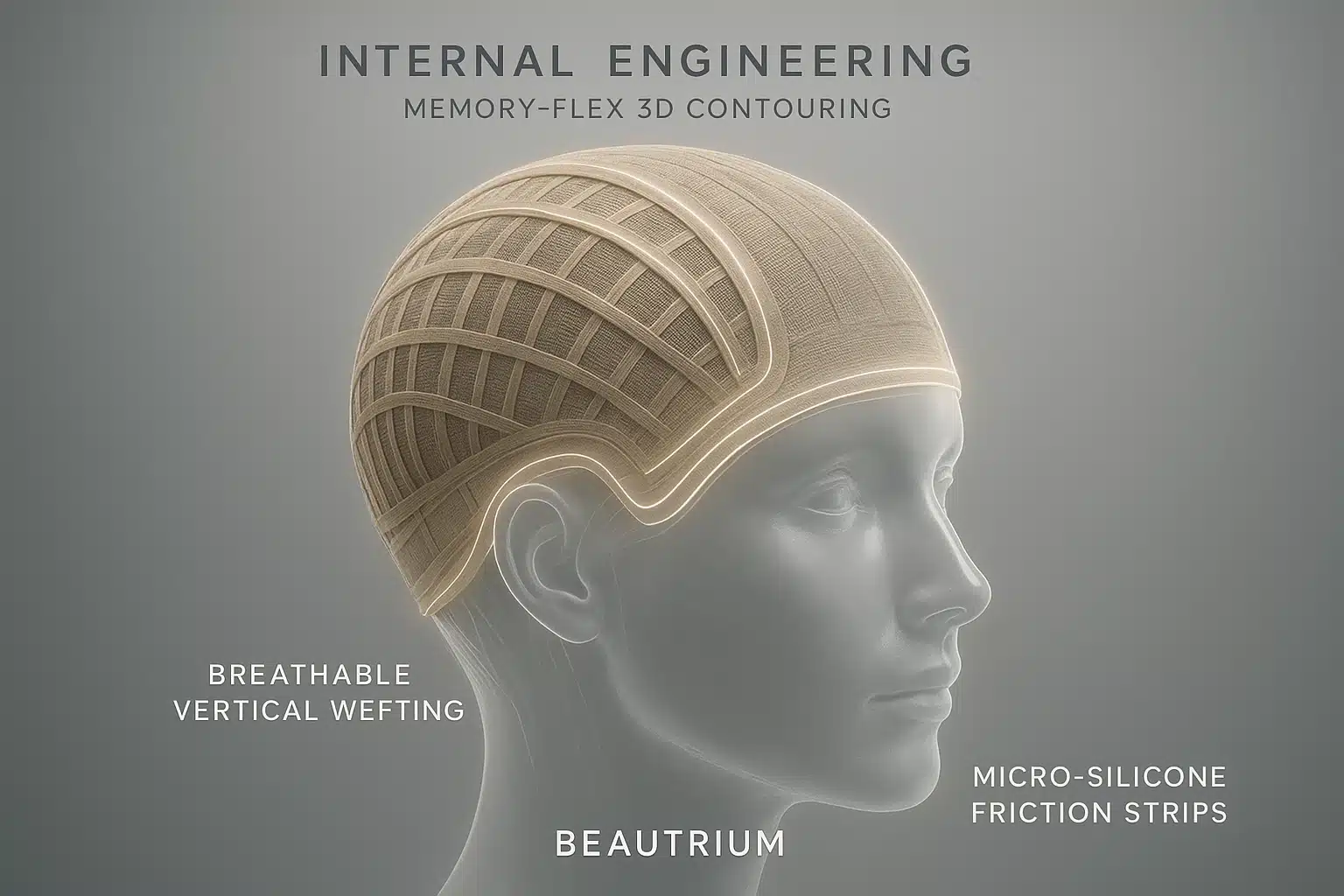
Beautrium solves this spatial puzzle through Memory-Flex 3D Contouring. Rather than using a flat piece of fabric forced into a dome, their caps are ergonomically molded to mirror the natural variations of the human skull. By distributing tension evenly across the parietal (top) and occipital (back) ridges, the cap hugs the head smoothly, entirely eliminating the awkward cone silhouette regardless of your specific head shape.
Beautrium’s Core Innovations: Engineering a Custom Fit
Beautrium has bridged the gap between medical-grade cranial prosthetics and ready-to-wear fashion. Let’s look at the specific technologies that make their caps uniquely comfortable.
1. Thermal Regulation and Bamboo-Silk Linings
Many oncology patients search for “scalp cooling caps for chemo” to protect their follicles during treatment. But what happens after? A sensitive, post-treatment scalp requires exceptional care. Traditional caps use nylon or latex, which trap sebum (natural oils) and sweat, leading to dermatitis.
Beautrium utilizes medical-grade, bamboo-derived viscose and silk-blend linings. Bamboo is naturally hypoallergenic, antimicrobial, and incredibly efficient at wicking moisture. Paired with open vertical wefting, these caps act as “passive cooling caps,” dissipating body heat rather than trapping it.
2. Micro-Silicone Friction Strips
The biggest fear for anyone with complete hair loss is their wig slipping off. Historically, the solution was messy glues or damaging clips. Beautrium integrates ultra-thin, strategically placed silicone friction strips along the hairline and nape.
Because silicone reacts to your natural body heat, it gently grips the scalp without blocking hair follicles or trapping sweat. It provides secure, glueless confidence that holds up through 12-hour days.
3. Ergonomic Nape Adjusters
Standard elastic straps stretch out over time and often create bulky, uncomfortable lumps at the nape of the neck. Beautrium uses a micro-hook adjustment system. These low-profile adjusters allow you to change the circumference by microscopic increments, accommodating asymmetrical head shapes without ruining the alignment of the ear tabs.
Troubleshooting Common Wig Fit Failures
Navigating synthetic wigs and human hair pieces takes practice. Use this quick diagnostic guide to decode what your wig is trying to tell you:
- Symptom: The wig slides backward throughout the day.
- The Cause: The nape tension is too tight, forcing the wig to ride up the back of your head, or there is a lack of friction at the hairline.
- The Solution: Loosen the nape adjusters slightly and look for caps with silicone grip strips to anchor the front.
- Symptom: Uncomfortable buckling or a “conehead” shape at the crown.
- The Cause: Improper elastane distribution; the cap is likely too large or lacks 3D contouring.
- The Solution: Measure your ear-to-ear dimensions carefully. Transition to an anatomically molded cap like Beautrium’s Memory-Flex mesh.
- Symptom: Severe itching along the parting line.
- The Cause: A scratchy nylon base or rough machine-stitched seams.
- The Solution: Upgrade to a double-monofilament top or a bamboo-silk lined cap that puts a soft barrier between the knots and your scalp.
The Customization Protocol: Finding Your Perfect Fit
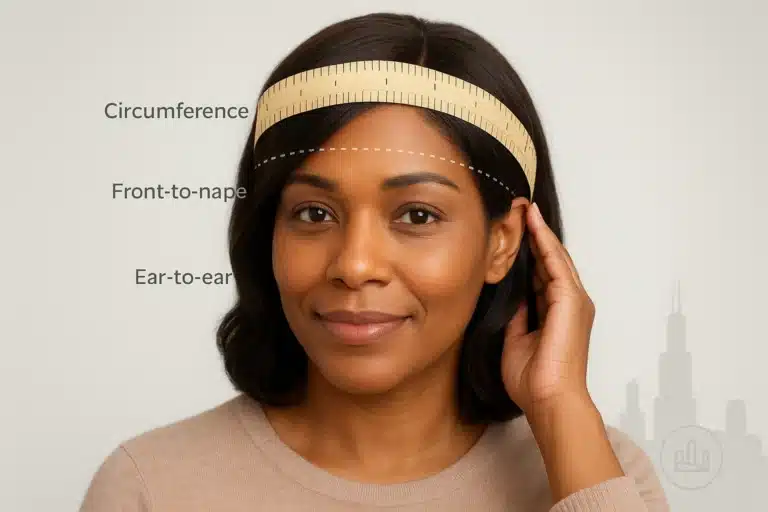
Even the most technologically advanced cap needs to be the right size. To mimic the results of a professional fitting, you need three key measurements:
- Circumference: Trace a soft measuring tape around your hairline, behind your ears, and down to the nape of your neck.
- Front-to-Back: Measure from your natural front hairline over the crown to the bottom of your natural hairline at the neck.
- Ear-to-Ear: Measure from the front of one ear, over the crown of your head, to the front of the other ear.
Having these numbers handy transforms you from an overwhelmed shopper into an informed buyer.
Frequently Asked Questions
What are the best wig caps for 12-hour daily wear?
For extended wear, you want a cap that prioritizes thermal regulation and multi-directional stretch. Hand-tied caps with bamboo or silk-blend linings (like those engineered by Beautrium) are ideal because they prevent heat retention and eliminate the harsh seams that cause friction sores over long periods.
Can standard wig cap construction cause tension headaches?
Absolutely. If a cap does not feature anatomical stretch zones, tightening the straps will create uneven pressure points, typically right behind the ears or across the forehead. This sustained pressure restricts blood flow and leads to tension headaches. This is why micro-adjusters and 3D contouring are vital for comfort.
How does proper wig care impact the lifespan of my cap?
Cap materials, especially elastane and delicate monofilament meshes, break down when exposed to harsh chemicals, hot water, or excessive sweat buildup. Washing your wig with specialized, gentle cleansers and drying it on a properly sized canvas block (never stretching it on a head form that is too large) preserves the memory-flex technology and keeps the bamboo linings soft and hygienic.
Are there specific wigs for adults with complete hair loss that won’t slide off?
Yes. If you have complete alopecia or are undergoing chemotherapy, look for caps equipped with anti-slip silicone strips or polyurethane (PU) patches. These materials gently adhere to the bare scalp using your natural body heat, offering complete security without the need for irritating tapes or liquid adhesives.
Moving Forward with Confidence
Choosing alternative hair is an incredibly personal journey, but it doesn’t have to be a painful one. By shifting your focus from just the hair fibers to the engineering of the cap beneath them, you empower yourself to make choices that prioritize your comfort, health, and peace of mind. You deserve a solution that supports you seamlessly from morning until night.