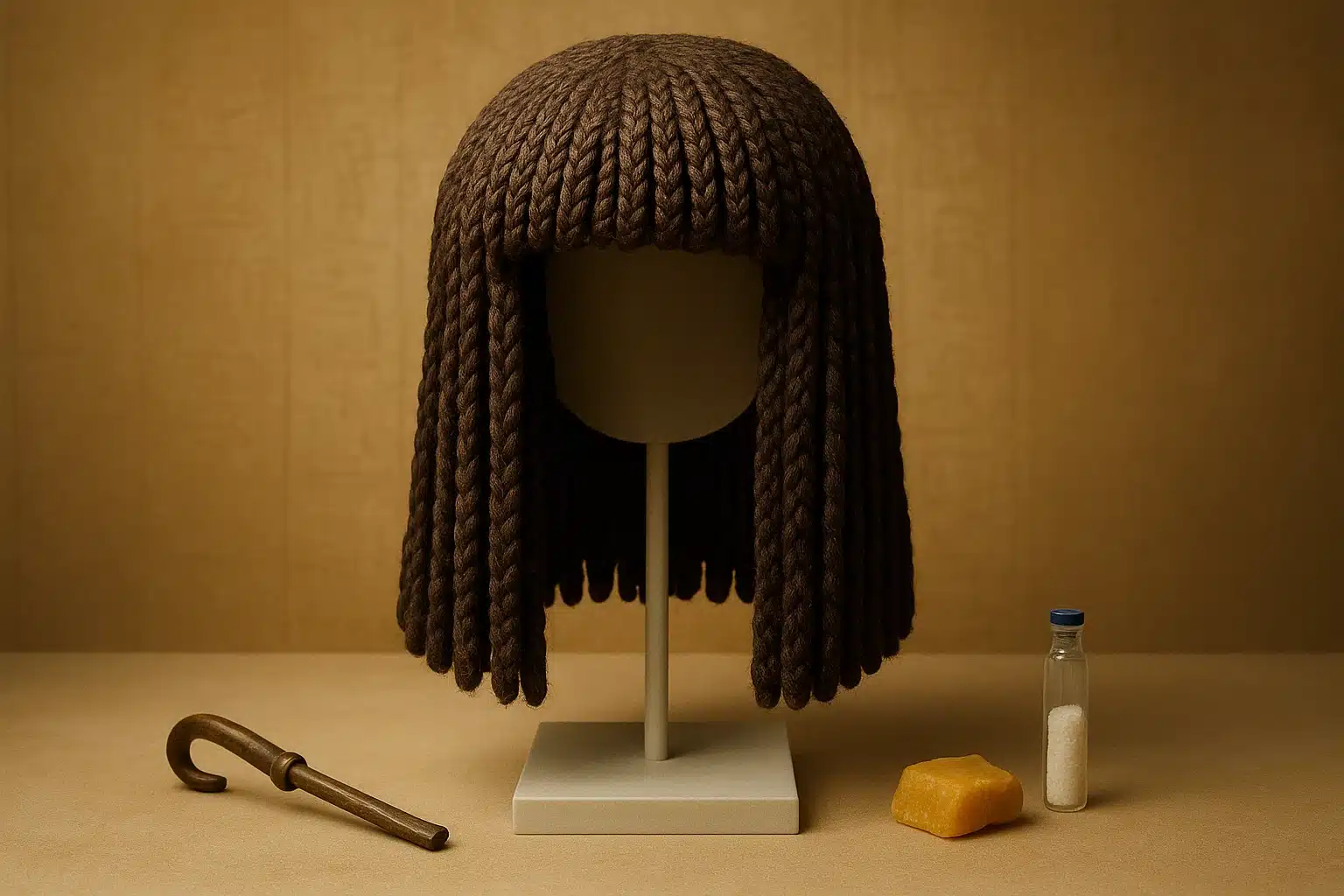
Imagine opening a box that has been sealed for 3,000 years and finding a hairstyle that looks almost ready to wear for a night out. While we often worry about humidity ruining our blowout or synthetic fibers tangling after a few weeks, ancient civilizations had mastered hair preservation techniques that rival modern chemistry.
To understand how these artifacts evolved as symbols of authority, one must first examine The Ancient & Classical History of Wigs: Status, Ritual, and Power, which provides the necessary sociopolitical context for why these maintenance methods were so rigorous. This resource bridges the gap between “what” they wore and “how” they kept it pristine for decades—or in some cases, millennia.
What we find in the archaeological record isn’t just vanity; it is advanced engineering. From the thermal-resistant waxes of Egypt to the complex “sew-in” techniques of Rome, the history of wig maintenance is a fascinating study in hygiene, chemistry, and innovation.
The Hygiene Paradox: Why Shave to Wear Hair?
One of the most common questions new learners ask is, “If they had hair, why shave it off just to wear a wig?” The answer lies in the intense climate of the Nile Valley and a practical approach to health.
Ancient Egyptians, particularly the priestly class, were obsessed with purity. In a time before antibiotics, lice were not just a nuisance; they were disease vectors. By shaving the head and wearing a wig, an individual could separate themselves from the pest. If a wig became infested, it could be treated or discarded without the person suffering. In this light, the ancient wig wasn’t just a fashion accessory—it was a piece of medical technology.
The Chemistry of Cleaning: Ancient “Shampoos”
We tend to think of specific wig shampoos as a modern invention, but the ancients understood the concept of clarifying agents surprisingly well. They couldn’t simply wash human hair wigs with water, as it would lead to matting and fungal growth in the hot climate.
Instead, they utilized a primitive understanding of pH balance. Research indicates the use of two primary agents:
- Natron: A naturally occurring mixture of sodium carbonate decahydrate and sodium bicarbonate (essentially salt and baking soda). This acted as a drying agent and a deep cleanser that stripped oils and killed parasites.
- Citrus Juices: Acidic juices were used to cut through the heavy oils and resins used in styling, acting much like a modern clarifying shampoo to remove buildup.
The goal wasn’t just to make the hair look clean, but to ensure the base—the foundation touching the scalp—remained sterile.
Engineering the Perfect Hold: The 2/3 Beeswax Formula
Perhaps the most impressive discovery in ancient trichology (the scientific study of hair) is how Egyptians prevented their intricate plaits from melting in the desert sun. If you have ever worn a wig in the summer, you know that heat is the enemy of style retention.
Archaeological analysis, specifically from the “Ancient Adornments Project,” revealed a specific “setting” formula that acted as the “Gorilla Glue” of the Bronze Age. They didn’t just use beeswax; they engineered a compound.
The Formula:
- 66% Beeswax
- 33% Conifer Resin
This precise ratio raised the melting point of the mixture to roughly 149°F (65°C). This meant a noble could stand in the blazing midday sun, and their crisp pleats and curls would remain perfectly rigid. It was a permanent styling solution that protected the hair strands from the elements.
The Roman Salon: Slaves, Sew-ins, and Irons
While Egyptians preferred standalone wigs that could be removed (cap-style), the Romans developed a culture closer to modern extensions and complex up-dos. For Roman women, hair was often a mix of their natural locks and added pieces, creating towering styles that required structural engineering.
The Ornatrix and Her Tools
Maintenance in Rome wasn’t a private act of self-care; it was the grueling job of the ornatrix, a highly specialized enslaved hairdresser. These women were skilled artisans who used specific tools that look familiar to us today:
- The Calamistrum: This was a bronze cylinder with a hollow center. The ornatrix would heat the rod in hot ashes and wrap damp hair around it to create tight curls—the great-grandfather of the modern curling iron.
- The Acus Crinalis: Large bone or metal needles used to sew hairpieces directly into the natural hair or to anchor heavy braids.
This distinction is vital: Egyptians built wigs to be taken off; Romans often built styles to stay on, requiring daily maintenance and repair by skilled hands.
Storage Solutions: The Original Wig Stand
How did a wig survive for 3,000 years in a tomb? The secret lay in storage. The ancients understood that when a wig wasn’t being worn, it needed to be protected from dust, light, and deformation.
Wealthy Egyptians utilized specialized wig boxes, often made of acacia wood or papyrus reeds. These weren’t just bins; many contained internal stands or mounts to hold the wig’s shape—similar to the wig stands we recommend today.
Furthermore, they applied organic oils (like almond or moringa oil) to the hair before storage. This kept the human hair fibers supple and prevented them from becoming brittle and snapping over time. It is a testament to their care that we can still examine the construction of these pieces in museums like the British Museum today.
A Modern Reconstruction Guide
To help visualize how advanced these techniques were, here is a comparison of ancient methods versus what we use today.
| Feature | Ancient Method | Modern Equivalent | Purpose |
|---|---|---|---|
| Foundation | Woven human hair mesh | Lace Front / Monofilament | Breathability and scalp cooling |
| Cleanser | Natron & Citrus Juice | Clarifying Shampoo | Remove buildup and sanitize |
| Styling Hold | Beeswax & Resin Compound | Strong Hold Hairspray | Heat resistance and style retention |
| Conditioner | Almond & Moringa Oil | Argan & Jojoba Oil | Moisture and shine |
| Styling Tool | Bronze Calamistrum | Ceramic Curling Iron | Creating texture and curls |
Frequently Asked Questions
Did they use real human hair?
Yes. The highest quality wigs in both Egypt and Rome were made of 100% human hair. Cheaper alternatives were made from wool, palm fiber, or vegetable fibers, much like the distinction between premium human hair and synthetic options today.
Were ancient wigs heavy?
Surprisingly, no. Despite their voluminous appearance, many Egyptian wigs were constructed on a mesh base made of plaited hair. This acted like modern “breathable” cap construction. Research suggests many royal wigs weighed roughly 0.5kg (about 1.1 lbs), which is quite comfortable for daily wear.
Did they have different colors?
While black was the standard in Egypt (often enhanced with dyes), older women utilized henna to hide gray. In Rome, there was a massive trend for blonde hair, often sourced from Germanic captives or bleached using harsh mixtures of goat fat and beechwood ash.
How did they handle the smell?
Hygiene was paramount. Egyptians famously used “perfume cones”—mounds of scented fat placed on top of the wig. As the body heat melted the fat, it released fragrance (like myrrh or cinnamon) that trickled down through the wig, conditioning the hair and masking odors.
Conclusion
The study of ancient wig preservation reveals a universal truth: the desire to feel confident and beautiful is timeless. Whether it was an Egyptian pharaoh using resin to combat the humidity or a Roman matron using a bronze iron for the perfect curl, the challenges of hair maintenance haven’t changed much—only our tools have.
Today, we are fortunate to have lightweight synthetics and specially formulated care products that don’t require heating beeswax or sourcing natron salts. However, understanding the meticulous care our ancestors put into their hairpieces gives us a deeper appreciation for the artistry of wig wearing. It reminds us that caring for a wig isn’t just a chore; it’s a ritual of preservation that has been practiced for thousands of years.