You’ve just unboxed a beautiful new Rene of Paris wig. The color is stunning, the fibers catch the light perfectly, and the quality is undeniable. But as you slip it on and look in the mirror, you might feel a slight hesitation. Perhaps the bangs are just a millimeter too long, or the density feels a bit too heavy for your petite frame.
It’s completely normal to feel a wave of anxiety at the thought of taking scissors to a premium wig. After all, synthetic hair doesn’t grow back. This fear of ruining a valuable investment keeps many wig wearers from experiencing the incredible confidence that comes from a truly personalized fit.
But here is a reassuring truth: modifying a wig doesn’t have to be a guessing game. By understanding the unique architecture of Rene of Paris fibers, you can transition from hoping for the best to practicing confident customization. Whether you are looking to softly thin the crown, add face-framing layers, or perfectly tailor the bangs, this guide will serve as your blueprint for achieving a flawless, custom look.
Understanding the Rene of Paris Difference
Before you even think about picking up a pair of scissors, it helps to understand what makes your wig unique. Treating synthetic wig fibers like biological hair is the most common mistake beginners make.
The Magic (and Physics) of Style Memory
Rene of Paris synthetic wigs feature advanced “Style Memory.” This means the fibers are baked into their specific style—be it straight, curled, or waved. While biological hair responds to water and a quick blow-dry, style memory resists change unless manipulated with specific techniques. When altering your wig, you aren’t just cutting hair; you are interacting with pre-set physics.
Hi-Fashion vs. Orchid Collections: Knowing Your Canvas
Your approach to customization should adapt based on the specific collection you own:
- The Hi-Fashion Collection: Known for its trend-setting cuts and vibrant colors, these wigs often feature a slightly higher density to support modern, voluminous styles. They are excellent candidates for targeted thinning.
- The Orchid Collection: Celebrated for its soft, romantic, and often wavy textures, this line generally requires a lighter touch. Layering an Orchid wig is more about enhancing its natural, pre-set movement rather than drastically reducing its bulk.
The “Before You Snip” Audit
The secret to a successful wig modification happens before any cutting actually takes place.
First, apply the “Four Finger Rule” to measure your face shape against the wig’s proportions. Place four fingers horizontally across your forehead, resting your index finger just above your eyebrows. If the wig’s hairline falls below your pinky, the bangs likely need trimming.
Next, you must identify the Permatease. Permatease is a cluster of short, crimped fibers located at the base of the wig cap, specifically designed to hide the cap construction and provide root lift. Never thin or cut into the permatease. Doing so will expose the base of the wig and destroy the structural volume, leading to an unnatural, flat appearance.
The Wig Modification Safety Scale
To help you build confidence, we’ve developed the Wig Modification Safety Scale. Think of this as your roadmap, starting from the most forgiving techniques to the most advanced.
- Low Risk: The Razor Comb. Using a specialized razor comb gently on the ends of the hair. It lightly textures without altering the core structure.
- Moderate Risk: The Inside-Out Thinning. Removing bulk from the internal layers using specialized thinning shears.
- High Risk: Blunt Bang Cutting. Altering the length of the bangs horizontally across the forehead. (We’ll teach you a much safer way to handle bangs below).
Your Essential Customization Toolkit
Standard craft scissors or kitchen shears are the absolute enemies of synthetic fiber. Because synthetic hair is made of micro-fine plastic fibers, dull or improper blades will cause the ends to fray, curl, and turn into a frizzy mess.
To achieve a professional result, you need:
- Wig-Specific Thinning Shears: Look for shears with a high teeth-count (typically around 30 teeth). Widespread teeth take out too much fiber at once, leaving visible gaps.
- Professional Styling Shears: Extremely sharp, fine-point scissors designed specifically for hair.
- Sectioning Clips: To isolate layers and keep permatease safely tucked away.
- A Canvas Block Head: Modifying a wig while it is on your own head is difficult and risky. A block head allows you to see the wig from all 360 degrees.
Module A: Thinning for Realism (Without the “Spiky Stubble” Trap)
The most common fear when thinning a wig is the “Spiky Stubble” trap—cutting the hair too close to the cap, resulting in tiny hairs that poke straight up through the smooth top layers.
To avoid this, we use the Inside-Out Rule. Always thin from the underneath layers, leaving the smooth top canopy completely untouched.
- Clip up the top third of the wig’s hair (the canopy).
- Locate a mid-layer section, ensuring you are well below the permatease root base.
- Use the Mid-Strand Snap technique: Instead of cutting near the root, close your thinning shears around the middle of the hair strand.
- Gently pull the shears down through the ends.
- Comb the loose hairs out immediately.
By thinning mid-strand on the lower layers, the shorter hairs blend seamlessly into the density, creating a natural, lightweight flow.
Module B: The Art of the Bang
Nothing screams “wig” quite like a heavy, horizontal, blunt-cut bang. When biological hair grows, it grows at slightly varied lengths. To mimic this realism, you must embrace the 45-Degree Angle Secret.
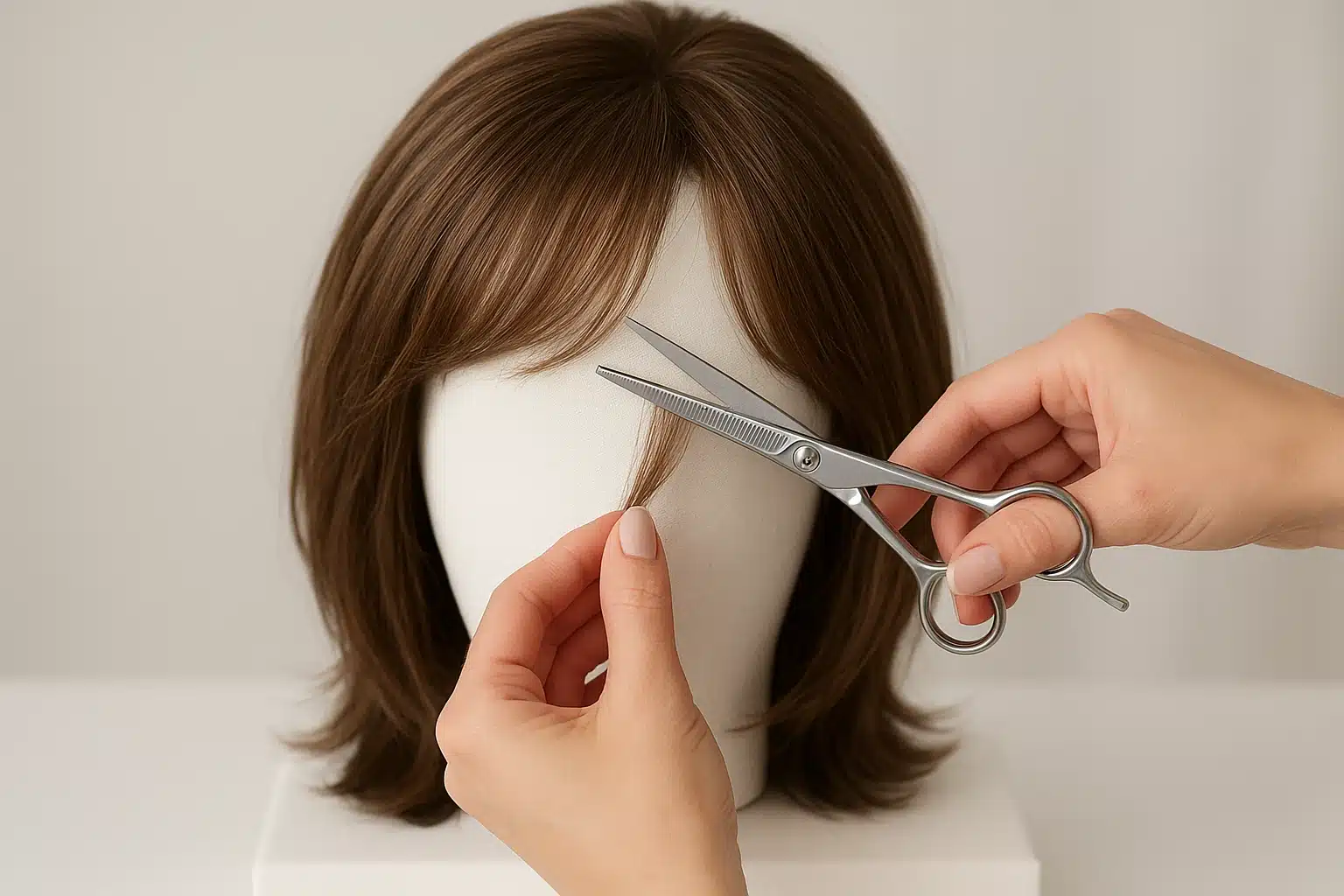
Cutting synthetic fibers straight across horizontally creates a harsh, “plastic” edge. Instead, use the Twist & Point Cut method:
- Gather a small section of the bangs in front of the face.
- Gently twist the section once.
- Holding your sharp styling scissors vertically (at a 45-degree angle), make tiny upward snips into the ends of the hair—never across.
- This technique creates a soft, wispy, feathered edge that frames the eyes beautifully, transitioning your wig from a “helmet” look to a beautifully tailored style.
Module C: Layering and Post-Cut Sealing
If you are adding layers to frame your face—particularly on the wavy Orchid collection—always follow the pre-set wave pattern. Cut where the wave naturally dips inward toward the face, rather than at the crest of a curl.
Once you have finished cutting, you might notice the freshly snipped synthetic ends feel slightly coarse. This is where the Low-Heat Seal method comes in. Using the warmth of your hands, or a specialized low-heat styling tool (only if your specific wig is labeled heat-friendly), gently smooth the freshly cut ends. The mild warmth helps to reseal the synthetic plastic fiber, smoothing out any microscopic fraying caused by the scissors.
Frequently Asked Questions (FAQ)
Can I undo a cut if I make a mistake?
Unlike biological hair, synthetic fibers will not grow back. This is why we champion the “Reversible-First” philosophy. Start with techniques like texturizing the very ends or thinning the deepest under-layers. Always cut a quarter-inch less than you think you need to—you can always take more off, but you cannot put it back.
How do I thin the top without the short hairs sticking up?
The simple answer is: you don’t. You should never thin the uppermost canopy of the wig. Always lift the top layer of hair, clip it safely out of the way, and thin the layers beneath it. The smooth top layer will fall beautifully over the thinned sections.
Can I use regular scissors?
No. Regular scissors, even sharp household ones, lack the micro-beveled edges needed to cleanly slice through synthetic fibers. They will crush and fray the hair, leading to irreversible frizz at the ends.
Taking the Next Step in Your Wig Journey
Navigating the world of hair loss or hair enhancement is a deeply personal journey. Modifying your wig isn’t just about aesthetics; it’s about reclaiming your image and making your hair feel like yours.
At Wig Superstore, we’ve spent nearly two decades helping individuals find beauty, comfort, and confidence through premium hairpieces. We believe that with the right education and compassionate support, you can transform a high-quality wig into a seamless extension of your personal style.
If you’re ready to explore the stunning, high-quality options available to you, or if you simply want to learn more about selecting the perfect base for your customization journey, explore our curated collections. By taking the time to understand your wig’s unique characteristics, you are already well on your way to mastering the art of the perfect fit.