Walking into a wig boutique for the first time can feel overwhelming. Under the bright, flattering halogen lights of a retail showroom, nearly every piece looks flawless on its mannequin. But there is a well-known phenomenon in the industry known as the “Showroom Lighting Trap.” Retail fluorescent lighting effortlessly reflects off high-silicone synthetic coatings, mimicking the look of healthy, hydrated human hair and temporarily masking brittle hair shafts.
When you are making a significant financial and emotional investment in a hairpiece, guesswork simply isn’t an option. Finding a reputable salon is the foundation of any successful hair purchase, and if you are exploring local options, checking out our guide to the best wig stores in Albuquerque ensures you know where to start your journey. But once you walk through those doors, you need to know how to physically inspect the inventory sitting on the showroom floor.
This guide bridges the gap between beginner anxiety and master-level evaluation. By translating complex wig craftsmanship into actionable, tactile testing protocols, you will learn exactly how to verify quality in person—and why Albuquerque’s unique high-desert climate makes these checks absolutely critical.
Decoding Cap Construction from the Inside Out
The most vital part of any wig isn’t just the hair you see—it’s the foundation resting against your scalp. Understanding wig cap construction is the first step in ensuring long-term comfort and realism.
Lace Fronts, Full Lace, and Monofilament Tops
When inspecting a wig’s hairline and parting, you’ll encounter a few key terms. Lace fronts provide a seamless, natural-looking hairline, while a monofilament (mono) top uses a sheer mesh that creates the illusion of natural hair growth directly from the scalp.
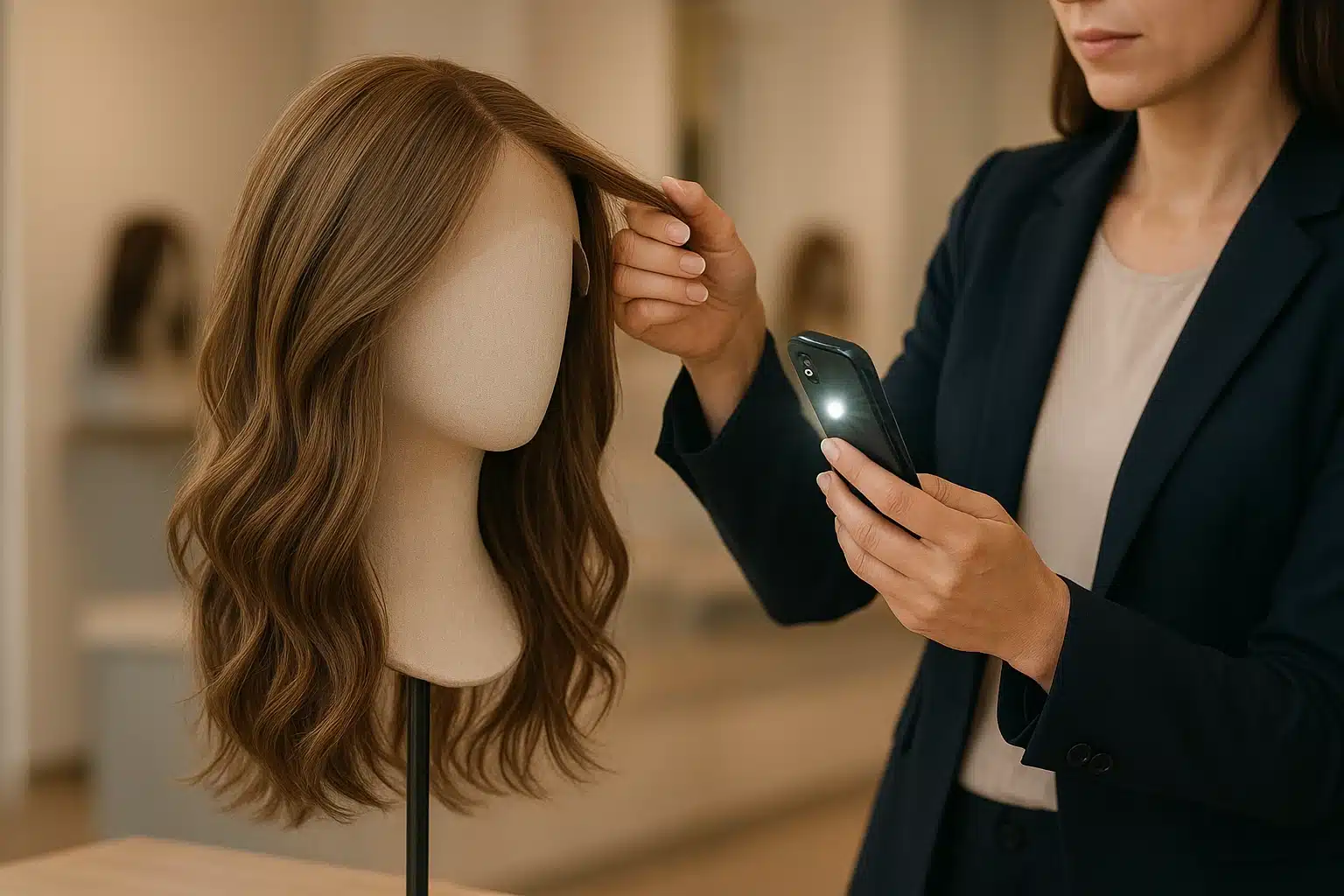
The In-Store Test: Try the “Smartphone Flashlight Test.” Place your hand inside the cap directly under the monofilament mesh or lace top, and shine your smartphone flashlight up through the material. This mimics the way natural light hits the scalp. You should see a highly realistic, scalp-like illusion with fine, single knots of hair tied to the mesh. If the knots look bulky, dark, and clustered, the wig will look less natural under the New Mexico sun.
100% Hand-Tied vs. Open-Wefted
Take a moment to feel the interior of the cap.
- Open-Wefted (Machine-Made): You will feel rows of hair sewn onto elastic strips with spaces in between. This allows for excellent airflow—a major plus for breathability.
- 100% Hand-Tied: The interior will feel soft and seamless. Because every single hair is individually tied to a soft mesh base, it offers the most realistic, multi-directional hair sway and supreme comfort for sensitive scalps.
Evaluating Ear Tabs and Nape Anchors
Don’t forget to test the flexibility of the ear tabs and the nape band at the base of the neck. Give them a gentle stretch. They should feature soft, velvet-like backing to prevent friction and have enough elastic give to sit securely without causing pressure headaches.
Hair Material Authenticity: Human Hair vs. Synthetics
While high-quality lace front wigs come in both premium synthetic and human hair options, telling them apart—and grading their quality—requires more than just a passing glance.
There is a vast grading spectrum: Virgin human hair (never chemically processed), Remy hair (cuticles kept intact and facing the same direction), non-Remy processed hair, heat-friendly synthetics, and standard synthetics.
Here are three showroom-safe tests you can perform to verify authenticity without offending boutique staff:
1. The Cuticle-Slide Resistance Test
How do you detect authentic Remy hair from cheaper, acid-washed hair that has been coated in temporary industrial silicone? Hold a few strands of hair between your thumb and index finger. Slide your fingers down the hair shaft toward the ends—it should feel perfectly smooth. Now, slide your fingers up the hair shaft toward the roots.
If the hair is genuine Remy human hair with intact cuticles, you will feel a slight, natural resistance (like petting a cat backward). If it feels completely slick in both directions, it has likely been stripped of its cuticles and coated in silicone, which will wash out in a few weeks, leaving a tangled mess.
2. The Natural Rebound Elasticity Test
Isolate a single fallen or edge strand. Give it a very gentle tug. Genuine human hair has natural tensile flex—it will stretch slightly and rebound. Low-grade synthetic fibers often suffer from plastic deformation; they either snap easily or stretch out and remain warped, like a cheap rubber band.
3. Density Realism (Why Heavier Is Worse)
A common beginner mistake is assuming thicker hair equates to a better wig. In reality, a natural biological scalp features about 120% to 130% hair density. Wigs boasting 180%+ density often look helmet-like, feature unnatural, heavy hairlines, and trap excess heat against your head. Always look for a balanced, natural density that mimics biological growth.
The High-Desert Reality Check: Albuquerque Environmental Stress Factors
Most national wig guides ignore one crucial factor: your local environment. Albuquerque’s 5,312-foot high-desert altitude, sub-15% relative humidity, intense UV index, and notorious static-dry conditions rapidly expose inferior wig materials.
- Arid Air & Static Electricity: Albuquerque’s lack of humidity aggressively strips moisture from processed human hair and causes intense static friction in synthetics. This accelerates brittle split ends and friction tangles at the nape of your neck.
- The Mile-High UV Index: Intense New Mexico sun can quickly oxidize hair, causing beautiful brunette colors to shift brassy, and can prematurely degrade delicate adhesives.
- Lace Tensile Strength: While ultra-thin “HD Lace” is trending online for its invisibility, it is incredibly fragile. In a high-friction, dry climate, durable Swiss lace is often a much smarter choice, offering a perfect balance of invisibility and tear-resistance.
To survive the high desert, prioritizing breathable open-wefted or 100% hand-tied caps and investing in intact-cuticle Remy hair is not just a luxury—it is an absolute necessity for longevity.
The 4-Zone Tactile Showroom Audit
To make your shopping trip foolproof, memorize this rapid 4-Zone tactile inspection protocol before walking into any store:
- Zone 1: Frontal Perimeter & Lace Boundary: Inspect the knot size at the hairline. Does the hair gradually transition from fine baby hairs to full density, or is it a harsh, solid wall of hair?
- Zone 2: Crown & Parting Mechanism: Run the smartphone flashlight test to evaluate the monofilament mesh realism.
- Zone 3: Interior Under-Cap Architecture: Run your fingers along the inside. Check for rough seams, bulky weft ridges, and scratchy threads.
- Zone 4: Fiber Shaft & Nape Rub Area: Perform the cuticle-slide test and check the nape area for dry friction resistance.
Navigating Albuquerque Showrooms: In-Store Field Protocol
Albuquerque features a diverse retail landscape, from full-service custom boutiques spanning Wyoming Blvd to broad-inventory beauty supply hubs along Menaul and Coors. Navigating these spaces requires knowing how to advocate for yourself.
The In-Store Fitting
When trying on a piece, use the “Four-Finger Rule” to ensure accurate placement. Place four of your fingers flat against your forehead, horizontally above your eyebrows. Your wig’s frontal hairline should begin right where your top finger ends. Additionally, always check your cap circumference size (Petite is generally 21″, Average is 21.5″–22.5″, and Large is 23″+).
Questions Every Buyer Must Ask Store Associates
Empower yourself by asking the right questions. Reading these to a salon associate immediately signals that you understand wig mechanics:
- “Does your salon offer in-house wig customization, such as dry cutting, face-framing, and density thinning?”
- “Can you verify if this is 100% intact Remy hair, or has it been treated with a silicone coating?”
- “I am shopping for medical hair loss. Do you provide itemized coding so I can submit this as a cranial prosthesis for health insurance reimbursement?”
- “What is your explicit policy regarding wig outlet returns, exchanges, or lace customization?”
Frequently Asked Questions (FAQ)
How do I protect my wig from Albuquerque’s extreme dry air?
Hydration is key. For human hair wigs, use salon-quality, sulfate-free moisturizing shampoos, and apply leave-in conditioners focusing on the mid-lengths to ends. Avoid applying heavy oils directly to the hand-tied knots, as this can cause them to loosen.
Is it safe to wear my wig through TSA at the Albuquerque Sunport?
Yes. You can confidently wear your wig through airport security. If the scanner detects bobby pins or metal stays in the ear tabs, you may be subject to a brief pat-down of your hair, but you will not be asked to remove your wig in public.
How do I prevent tangling at the nape of my neck?
Friction from collars, scarves, and static electricity causes nape tangling. Carry a travel-size detangling spray and a wide-tooth wig comb to gently brush out the nape area throughout the day, especially during the dry, windy New Mexico winters.
Should I sleep in my wig?
It is highly recommended that you remove your wig before sleeping. Tossing and turning causes severe friction, which halves the lifespan of the hairpiece and damages the delicate cap architecture.
Your Next Steps Toward Confidence
Transitioning into wearing wigs is a deeply personal journey, and stepping into a showroom shouldn’t feel like stepping onto a used car lot. By utilizing the 4-Zone Audit, understanding cap mechanics, and accounting for the high-desert climate, you transform from an intimidated shopper into an empowered, educated buyer.
At Wig Superstore, our nearly two decades of industry experience are dedicated to providing compassionate customer care and equipping you with the knowledge you need. When you are ready to explore high-quality options that truly support your lifestyle, take these insights with you. Education is your best accessory, and your confidence is always worth the investment.