Imagine finding the perfect wig, taking it home, and realizing the cap size is just a fraction too tight after wearing it around the house for an hour. You carefully place it back into its box, assuming you can simply run back to the store and swap it out like a pair of shoes or a sweater. But when you arrive at the counter, you’re met with a firm, albeit apologetic, “All sales final.”
For many shoppers navigating hair loss, medical treatments, or simply a desire for a new style, this is an emotional and financially stressful surprise. The rules governing hairpieces are incredibly strict compared to standard retail apparel. When you are exploring the best wig shops across the metro area, understanding exactly why these policies exist—and knowing your rights before you finalize a purchase—can save you hundreds of dollars and protect your peace of mind.
Let’s demystify the complex world of wig returns, hygiene laws, and salon policies so you can shop with absolute confidence.
Why Can’t I Just Return It? The Hygiene and Legal Reality
A common misconception is that “federal law makes it illegal to return wigs.” In reality, there is no blanket federal ban. Instead, retailers enforce strict return and exchange policies to manage hygiene risks and comply with stringent state sanitation standards.
In Oklahoma, the State Board of Cosmetology and Barbering (under Oklahoma Administrative Code § 175:10-9-53) has specific rules regarding hairpieces. There is a very distinct legal boundary between a retail sale and a salon service:
- The Retail Sale: Simply buying a boxed wig off the shelf is an unregulated retail transaction. A store may allow an exchange if the item is entirely untouched, depending on their private policy.
- The Salon Service: The moment a licensed professional in an Oklahoma City boutique custom-cuts the bangs, thins the density, alters the cap, or styles the piece, it transforms from a retail product into a licensed cosmetology service. By law, custom services and modified goods are non-refundable.
Shop owners aren’t being difficult when they refuse a return on a worn wig; they are protecting you. Strict return policies ensure that you never accidentally purchase a wig that carries scalp oils, microscopic pathogens, or styling product buildup from a previous customer.
The Spectrum of OKC Store Policies
If you are shopping in Oklahoma City, you will likely encounter three distinct types of store policies based on the business model:
Specialized Medical Hair Boutiques
These shops cater heavily to oncology and alopecia patients. They typically offer private consultations and require you to wear a sanitizing try-on cap in-store. Because they understand the unpredictable nature of medical hair loss, some may offer a strictly conditional 15-day exchange window—but only if the wig is completely unaltered, unworn, and retains all original factory tags.
Full-Service Custom Wig Salons
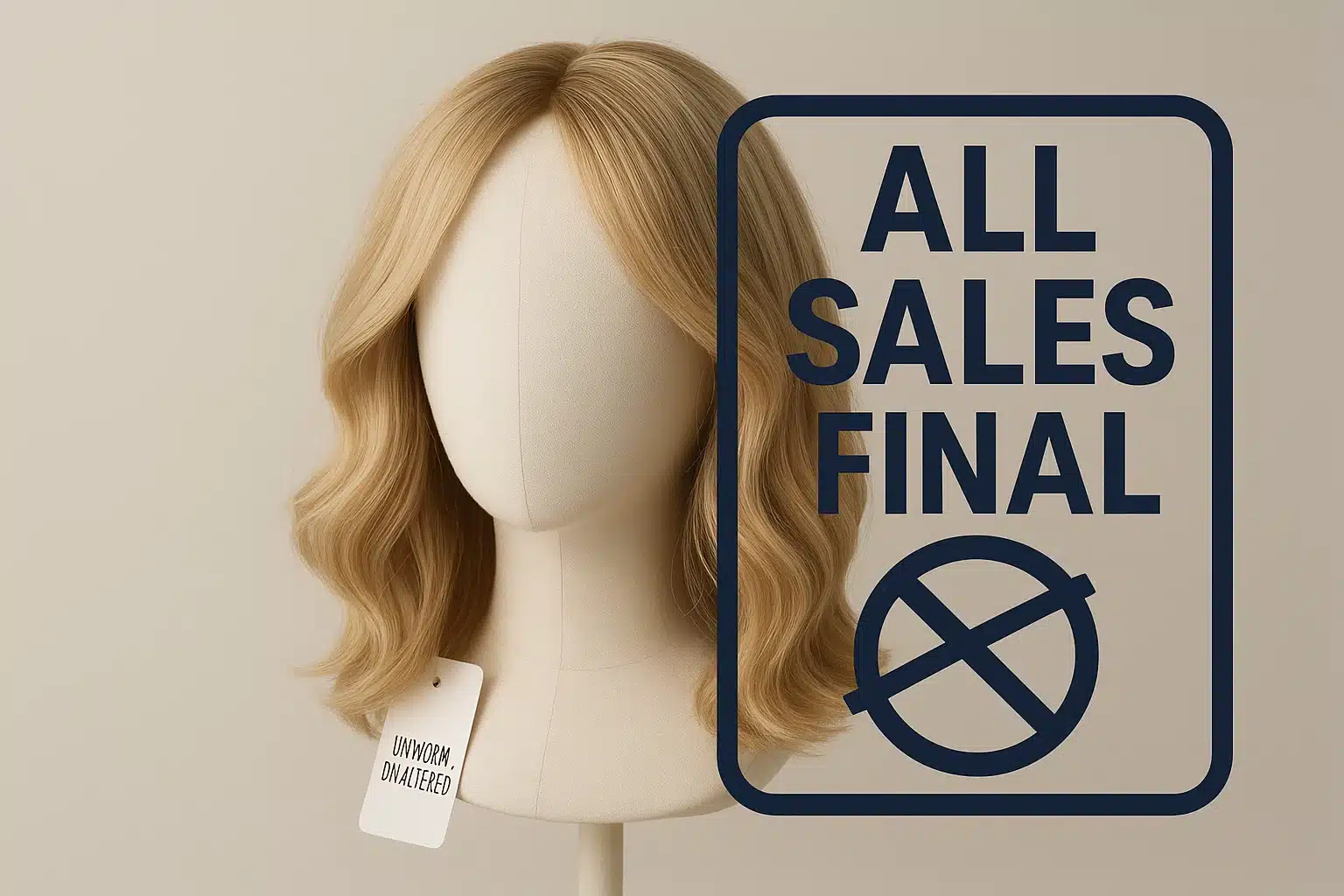
These establishments offer bespoke cap alterations and personalized styling. Because their value lies in customizing the piece to your exact head shape and facial structure, they generally enforce a strict “All Sales Final” policy the moment you walk out the door. Once a wig is cut or tailored, it cannot be resold to anyone else.
High-Volume Beauty Supply Retailers
These stores allow for more casual walk-in browsing with limited fitting assistance. Because of the high volume of traffic and the inability to monitor every try-on, they almost universally rely on standard, non-negotiable final-sale rules at the cash register.
Crossing the “Point of No Return”
If you purchase a wig from a store that does allow conditional exchanges, you must be incredibly careful. It is remarkably easy to accidentally void your eligibility before you even pick up a pair of scissors. Here are the actions that cross the point of no return:
- Cutting the Lace: Trimming even a single millimeter of delicate Swiss or French lace alters the cap tension and makes micro-scalp contact permanent. Once the lace is snipped, the wig is yours forever.
- The Invisible Barrier (Scent): Hair fibers are highly porous. If you try on a wig after applying perfume, while smoking, or even while cooking in a fragrant kitchen, the wig absorbs those odors. Ambient scent transfer is one of the leading causes of rejected returns.
- Structural Manipulation: Tweezing the hairline to widen the part, stretching the ear tabs, or heavily modifying the adjustable nape straps during a prolonged home wear test will distort the wig’s factory memory.
- Product Application: Applying adhesive, wig tape, or heat (even on heat-friendly synthetics) instantly voids any return policy.
The Hidden Factors: Human Hair vs. Synthetic and Medical Billing
You might assume that because a premium European human hair wig costs significantly more, it comes with more lenient return policies. The opposite is actually true.
Fiber Sensitivities and Restocking Fees
Human hair units frequently have stricter return rules and higher restocking fees (often ranging from 15% to 30%). Why? Because human hair is highly sensitive to moisture, ambient odors, and physical manipulation. When a high-value human hair piece is returned (if allowed), it must undergo rigorous ultraviolet and microscopic residue inspections to ensure it hasn’t been damaged or contaminated. The restocking fee covers this intensive sanitation and inspection process.
Navigating Medical Cranial Prostheses
For individuals utilizing medical insurance to cover a wig due to chemotherapy or alopecia, the paperwork adds another layer of permanence. When a store bills your insurance for a “Cranial Prosthesis” (using the medical billing code HCPCS A9282), exchanging or returning the item disrupts processed medical claims and pre-authorizations. Once the insurance claim is filed and the prosthesis is dispensed, reversing the transaction is a massive administrative hurdle, making these sales almost always final.
The “Home Fit” Test Protocol: How to Try On Safely
If your retailer allows conditional exchanges and you want to test the wig at home, follow this strict protocol to protect your investment:
- Use a Nude Cap: Always wear a brand-new, clean nylon wig cap to create a barrier between your scalp and the wig.
- Mind the Environment: Try the wig on in a scent-neutral room. Keep it away from kitchens, pets, and cigarette smoke.
- Keep it Brief: Wear it for under 10 minutes to evaluate the fit without stretching the internal cap construction.
- Do Not Remove Tags: Keep all hangtags, hygiene seals, and manufacturer netting exactly where they are.
- No Alterations: Do not apply heat, do not use adhesives or styling products, and absolutely do not trim the lace.
Your “Before You Swipe” Pre-Purchase Checklist
The easiest way to avoid post-purchase stress is to ask the right questions while you are still at the register. Always ask:
- “If we cut the lace or thin the bangs today, does this become a final sale?”
- “If I take this home and the color looks different in natural lighting, what is your exact return or exchange window?”
- “If an exchange is allowed, do you charge a restocking fee, and what is the percentage?”
- “Do I need to keep a specific hygiene tag attached to remain eligible for an exchange?”
Frequently Asked Questions (FAQ)
Can I return a wig if I change my mind after trying it at home?
In most local shops, no. Unless the store explicitly offers a conditional exchange policy for untouched, tagged items, wigs are generally considered “All Sales Final” due to state sanitation laws and the risk of lice or pathogen transfer.
Does trimming the lace just a tiny bit void the return?
Yes, absolutely. Trimming the lace structurally alters the wig and makes it a customized, used item. It can never be resold as new once the lace is cut.
What is the difference between an exchange, store credit, and a restocking fee?
An exchange allows you to swap the wig for a different color or style of equal value. Store credit gives you a voucher for the amount spent to use later. A restocking fee is a percentage of the purchase price (usually 15%–30%) deducted from your refund or credit to cover the merchant’s cost of inspecting, sanitizing, and repackaging the returned item.
Can I exchange an unopened medical wig if my chemotherapy treatment changes?
This depends entirely on the store’s policy and your insurance. If the box is sealed and untouched, some medical boutiques may allow an exchange. However, if the store has already processed a medical claim (Cranial Prosthesis) through your insurance, the sale is typically final.
Next Steps on Your Wig Journey
Purchasing a wig is a deeply personal investment of both time and money. While the strict return policies in Oklahoma City might feel intimidating at first glance, they ultimately exist to ensure that when you purchase a high-quality wig, you are receiving a pristine, hygienic, and perfectly crafted product.
By understanding the differences between a retail purchase and a customized salon service, acknowledging the “point of no return,” and asking the right questions before you buy, you take total control of your shopping experience. Take your time, communicate openly with your wig specialist, and embrace the journey toward finding a style that makes you feel beautiful, confident, and completely yourself.