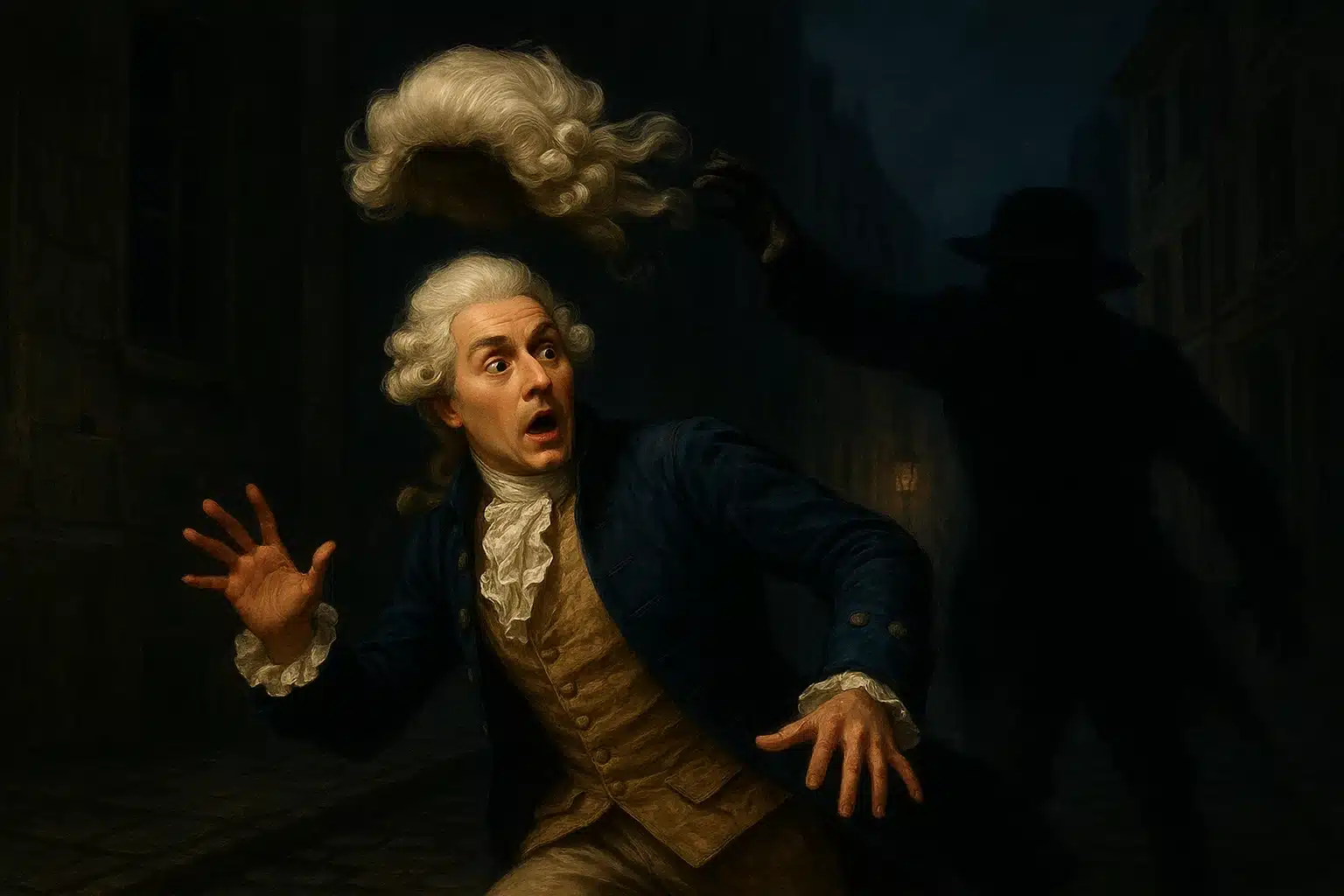
Imagine walking down a dimly lit cobblestone street in 1750s London. You’re wearing your finest tailored coat and polished shoes, but the most valuable item you own is sitting right on top of your head. When we look back at the grand history of wigs in European nobility and fashion, the focus is usually on the towering heights, powdered curls, and sheer glamour that defined an era of high-society extravagance.
What often gets left out of the history books, however, is the very real danger of wearing one. In 18th-century London and Paris, stepping out in a high-quality peruke was the modern equivalent of walking through a crowded city street wearing a solid gold Rolex. This incredible value spawned an entire underground industry of highly specialized criminals. Today, we’re going to step back in time to explore the fascinating, surprisingly organized world of 18th-century wig-snatching, and the ingenious ways everyday people tried to protect their prized hairpieces.
The Economics of the Peruke: Wearing a Fortune on Your Head
To understand why anyone would risk prison to steal a hairpiece, we have to look at the economics of the 18th century. Today, we know that premium human hair is an investment, but in the 1700s, human hair was incredibly scarce and fiercely commodified. In fact, high-quality human hair was literally worth twice its weight in silver.
While the working class might wear rough wigs made of horsehair, goat hair, or even boiled wool, the elite wore meticulously crafted human hair perukes. A top-tier gentleman’s wig could cost upwards of £40. To put that in perspective, £40 was more than an average laborer earned in an entire year.
This extreme cost disparity actually gave birth to a phrase we still use today. A person of high status and wealth was called a “Bigwig,” because quite literally, only the wealthiest individuals could afford the largest, most elaborate, and most expensive wigs. And to a thief, a bigwig meant a big payday.
The Criminal’s Toolkit: Anatomy of a Wig Snatch
Wig theft wasn’t just a crime of opportunity; it was a highly organized art form. Because London and Paris were crowded, chaotic, and lacked a modern police force, criminal syndicates developed incredibly creative methods for separating a gentleman from his hair.
Here are a few of the most infamous techniques used by 18th-century thieves:
The “Boy in the Basket”
This is perhaps the most cinematic of all historical wig-stealing tactics. A tall, strong thief would dress as a baker or tradesman, carrying a massive, covered woven basket on his shoulders. Inside the basket, however, wasn’t bread—it was a small boy. As the “baker” walked past a wealthy gentleman in a crowded market, the boy would silently pop the lid, snatch the wig right off the gentleman’s head, drop back inside, and pull the lid shut. The victim would be left stunned and bare-headed while the “baker” calmly kept walking.
The “Chiving Lay” (The Carriage Slice)
Riding in a Hackney coach (the 18th-century equivalent of a taxi) didn’t guarantee your safety. Many of these carriages had flexible leather backs. A thief—or a specialized gang known as a “chiving lay”—would run up behind the moving carriage. Using a sharp blade, they would slice a hole directly through the leather behind the passenger’s head, grab the wig, and disappear down a dark alley before the coachman even knew what had happened.
The Wall-Perched Thief
In the narrow, winding alleys of London’s “danger zones” like Fleet Street and Drury Lane, thieves would perch on low-hanging walls, balconies, or signs. When an unsuspecting aristocrat walked underneath, the thief would simply reach down, lift the peruke, and scramble away across the rooftops.
The 18th-Century Security Manual: Protecting Your Investment
Just as people today buy phone cases and laptop locks, the 18th-century elite had to engineer ways to protect their liquid assets. It became a daily game of cat-and-mouse between peruke makers and the criminal underworld.
If you were a gentleman or lady trying to keep your hair secure, you might employ a few of these physical security measures:
- Internal Drawstrings and Buckles: Peruke makers began sewing hidden straps, drawstrings, and even small buckles into the wig’s foundation. These would fasten tightly under the chin or around the back of the head, ensuring that if a thief pulled on the wig, it wouldn’t easily come off.
- Carriage Modifications: Tired of the “chiving lay,” wealthy individuals began ordering custom carriages lined with solid wood backing or heavy metal mesh layered behind the upholstery, completely ruining the blades of any would-be carriage slicers.
- The “Wig-Guard” Servants: The most effective, though expensive, security measure was human capital. High-society members hired tall footmen whose sole job was to walk slightly behind them, keeping a watchful eye on the perimeter to deter any snatchers.
The Aftermath: The Underground Wig Market
You might wonder: What exactly does a thief do with a stolen wig? They couldn’t exactly wear it, and pawning a recognizable, custom-made £40 peruke was incredibly risky.
Instead, stolen wigs were immediately rushed to the “Old Clothes” market—a thriving, unregulated secondary economy. Here, fences (receivers of stolen goods) operated like chop-shops for hair. A master wig-maker working in the criminal underground would quickly un-stitch the wig, boil the hair to change its distinct curl pattern, and re-weave it into a completely different style. The “serial number” of the wig was essentially erased.
Records from the Old Bailey (London’s central criminal court) from 1674 to 1913 are filled with dramatic testimonies of people trying to reclaim their stolen hair. Often, specialized “Thief-Takers”—men like the infamous Jonathan Wild, who acted as a corrupt mix of private investigator and gang leader—would offer to find your stolen wig for a hefty “recovery fee,” which was usually just a ransom paid back to the very thieves he employed.
Paris vs. London: A Tale of Two Cities
While London wig theft was largely driven by pure economics and opportunistic gangs, the atmosphere in Paris carried a different tension. As the 18th century wore on and the rumblings of the French Revolution began, the wig became a deeply polarizing symbol of the hated aristocracy.
In Paris, snatching a wig wasn’t just a way to make a quick livre on the black market; it was an act of public humiliation. Stripping a nobleman of his powdered peruke in the street was a symbolic stripping of his power and status, adding a layer of political rebellion to a common street crime.
Frequently Asked Questions (FAQ)
Why couldn’t people just hold onto their wigs?
Wigs were often heavily powdered, greased with pomatum, and quite heavy. Grabbing your own wig in a panic could crush the elaborate styling, ruining the piece entirely. Furthermore, thieves struck with the element of surprise, often leaving the victim too disoriented to react in time.
Did women’s wigs get stolen too?
While women certainly wore hairpieces and elaborate extensions, full wigs were predominantly worn by men in the 18th century. Women’s hair was usually styled using their natural hair intertwined with supplemental pieces, making it incredibly difficult to snatch off in one quick motion.
How did the materials affect the theft rate?
Material was everything. Thieves rarely targeted horsehair or wool wigs because the resale value was almost zero. Only the pure human hair wigs (often sourced from rural peasants and sold to city peruke makers) had the astronomical value worth risking the hangman’s noose.
Were there any laws specifically against wig theft?
There didn’t need to be a specific “wig law.” In 18th-century England, the “Bloody Code” meant that stealing anything worth more than 12 pence (a tiny fraction of a pound) was a felony punishable by death or transportation to a penal colony. Stealing a £40 wig was considered a major grand larceny.
The Evolution of Confidence and Care
Learning about the wild history of wig-snatching gives us a profound appreciation for how far the world of hair enhancement has come. In the 18th century, wearing a high-quality wig required constant vigilance, physical security measures, and an ever-present fear of loss.
Today, the journey of finding and wearing the perfect wig or hairpiece is—and should be—an entirely different experience. It’s no longer about projecting aristocratic dominance or guarding your head from street thieves. It’s about personal empowerment, restoring confidence during times of hair loss, and expressing your unique beauty in a safe, supportive environment.
After nearly two decades in the industry, we at Wig Superstore understand that a great wig is still an investment, but the only thing it should capture is admiration. By focusing on compassionate care, industry-leading expertise, and the highest-quality materials, we ensure that modern wig wearers can step out their front doors feeling beautiful, secure, and completely at ease—no “Wig-Guard” footman required.