When we think of hairpieces in the ancient world, our minds almost invariably drift to the banks of the Nile. We picture the sleek, geometric bobs of Cleopatra or the gold-threaded braids of the Pharaohs. It’s a familiar image, but it tells only half the story. If we shift our gaze slightly eastward to the Tigris and Euphrates—the cradle of civilization known as Mesopotamia—we find a culture where hair wasn’t just about fashion or sun protection. It was a weapon of intimidation, a badge of divinity, and a rigid code of law.
While the Egyptians favored hairpieces for cleanliness and climate control, the Assyrians and Babylonians treated hair as a visual language of absolute power. Exploring the ancient & classical history of wigs reveals that in the Near East, an elaborate coiffure was the primary way kings asserted their dominance over nature and their subjects. For the modern reader, understanding this history validates a timeless truth: how we style our hair has always been a profound declaration of who we are and the space we intend to occupy in the world.
The Anatomy of a Mesopotamian Wig: More Than Just Hair
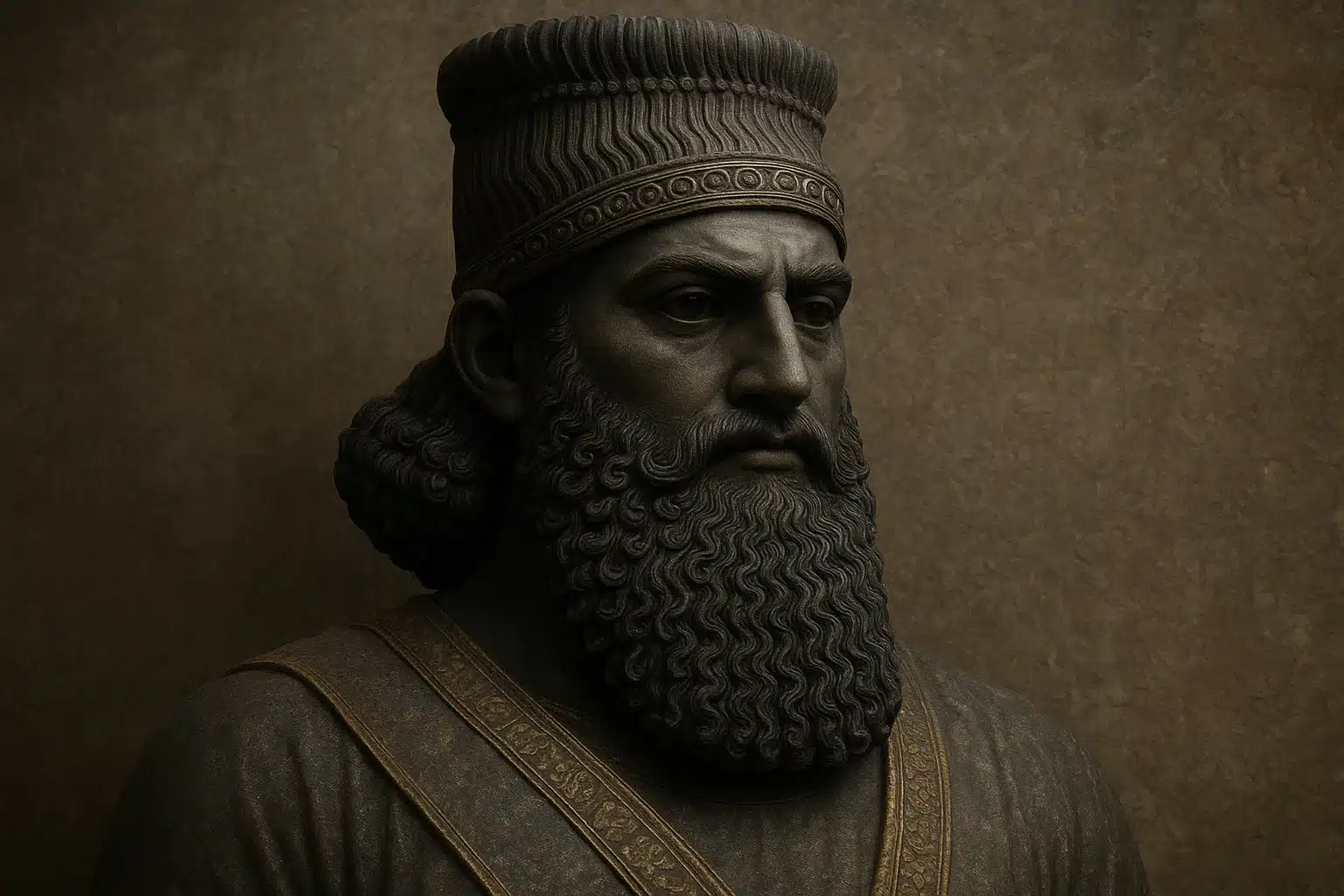
One of the most fascinating aspects of Mesopotamian hair artistry is the “technology” behind the texture. If you look closely at reliefs of Assyrian kings like Ashurbanipal, you’ll notice rows of tight, perfectly uniform curls that look almost architectural. This wasn’t accidental, and often, it wasn’t entirely natural.
The Preference for Wool and Fiber
While human hair was used, the “barbed” look—that distinct, crimped texture seen in statutes—was difficult to maintain with human strands alone. To achieve that gravity-defying volume, artisans often incorporated sheep’s wool and palm fibers.
Why wool? It holds a crimp much better than human hair. Just as modern wigs use synthetic fibers to maintain style memory, ancient stylists recognized that mixing textures allowed for more durable, imposing shapes. These fibers were woven into the natural hair or created as separate pieces to add bulk and height, creating a silhouette that commanded respect.
The First Curling Irons
We often think of heat styling as a modern convenience, but Mesopotamian stylists were pioneers in thermal manipulation. To achieve those rigid rows of curls, they used heated iron bars. This required immense skill to avoid burning the scalp or singeing the fibers—a testament to how much value society placed on the presentation of hair.
The Beard-Wig: A Symbol of Masculine Authority
In ancient Assyria, the beard was not merely a grooming choice; it was the ultimate signifier of masculinity, virility, and status. In fact, the beard was so crucial to the concept of authority that it transcended biology.
The Artificial Extension
Many historians argue that the long, rectangular beards seen on royal statues were likely “beard-wigs” or elaborate extensions. Natural beard growth rarely achieves the density and uniform length depicted in these reliefs. Kings would likely tie false beards made of human hair or goat hair into their natural growth to create the massive, square profile that symbolized “Lamasu-like” strength (referencing the mythical winged bulls with human heads).
The Gender Pivot: Women in Power
Perhaps the most striking evidence of the beard’s power comes from the rare instances of female rule. Much like the Egyptian Pharaoh Hatshepsut, there is evidence suggesting that high-ranking women in the Near East occasionally donned false beards in ritual or official contexts. This wasn’t about trying to “be a man,” but rather about stepping into a role of authority that was culturally coded as masculine. It’s a powerful reminder that hairpieces have historically served as tools of empowerment, allowing the wearer to transcend societal limitations.
Kings vs. Priests: The Visual Language of Rank
In Mesopotamia, you could identify a person’s role in society instantly by the state of their hair. The culture operated on a strict binary of “Hirsute vs. Shorn.”
The Royal “Mane”
The King represented the apex of vitality. Consequently, his hair was portrayed as abundant, thick, and obsessively groomed. This symbolized a surplus of life force. The use of oil was prevalent, not just for shine, but to bind the complex arrangements of curls and waves.
The Priestly Shave
In stark contrast, many classes of priests were completely shaved—head, face, and body. This removal of hair symbolized a separation from worldly vanity and a state of ritual purity. While the King’s wig/beard combo shouted, “I rule the earth,” the priest’s smooth skin whispered, “I serve the divine.” This duality helps us understand that hair (or the lack of it) was the primary uniform of the ancient world.
The Chemistry of Status: Color and Omens
If you’ve ever looked up a royal henna hair dye review or searched for natural coloring methods, you are participating in a tradition that dates back four millennia.
The Obsession with Black
In the Mesopotamian worldview, black hair represented youth, vigor, and the favor of the gods. As kings aged, maintaining this illusion was critical. They utilized early forms of hair dye, often plant-based mixtures similar to modern henna and indigo, to mask grey.
Dream Omens and Grey Hair
The psychological weight of hair color is best illustrated in the Iškar Zaqīqu, an ancient Mesopotamian “Dream Book.” These clay tablets listed omens related to dreaming. Dreaming of grey hair was often interpreted as a loss of vital force or a shifting of status, whereas dreaming of lush, black hair foretold success. This cultural anxiety around greying drove the innovation of dyes and the use of wigs to maintain a facade of eternal youth—a sentiment that many of us can empathize with today.
Frequently Asked Questions
Q: Did commoners wear wigs in Mesopotamia?
A: Generally, elaborate wigs and false beards were reserved for the elite—royalty, military leaders, and high-ranking officials. Commoners usually wore their natural hair in simpler styles, though they would emulate the “frizzled” texture if they could.
Q: How did they keep these heavy wigs on?
A: Much like today, they likely used a combination of bands, pins, and perhaps sticky substances derived from plants or resins (like beeswax) to secure extensions and false beards to their natural hair or skin.
Q: What is the “barbed” style often mentioned in history books?
A: “Barbed” refers to the specific stylization of curls seen in Assyrian reliefs, where the hair ends in a tight, spiraled hook that resembles a barb. It was a stylistic convention to show the wearer was civilized and controlled.
Conclusion
The history of hair in Mesopotamia and Assyria teaches us that the desire to control our appearance is as old as civilization itself. Whether through the crimping of wool fibers to create volume or the donning of a ceremonial beard to command a room, our ancestors understood that hair was a medium of communication.
Today, while we may not use sheep’s wool or iron bars, the underlying motivation remains the same. We use wigs and hairpieces to present the best version of ourselves, to navigate social roles, and to feel confident in our identity. It is a profound link between the modern wearer and the ancient kings—a shared understanding that hair is power.
For those interested in exploring how these ancient traditions of quality and care translate to the modern era, you can continue your journey by learning about the craftsmanship behind today’s high-quality wigs.