Picture the late 1700s. For decades, the towering, powdered peruke was the ultimate status symbol. If you wanted to project power, wealth, and influence, you wore a wig. In fact, if we trace the journey of aristocratic hair trends from the extravagant Baroque period through to nuanced Victorian styles, it’s clear that bigger truly meant better. But almost overnight, the very hairpiece that commanded respect became the punchline of satirical jokes—and eventually, a dangerous liability.
What happened? The decline of the powdered wig in the early 19th century wasn’t just a fleeting change in fashion. It was a massive cultural earthquake driven by rebellious philosophers, biting social critics, and political revolutions. Let’s dive into the “Great Hair Debate” and explore how society’s sudden craving for authenticity forever changed the way we view our hair.
The Catalyst: Rousseau and the Call of the “Natural Man”
To understand why wigs fell out of favor, we have to look at the philosophers who sparked the change. During the Enlightenment, a powerful new idea took hold: nature is pure, and human-made artifice is corrupt.
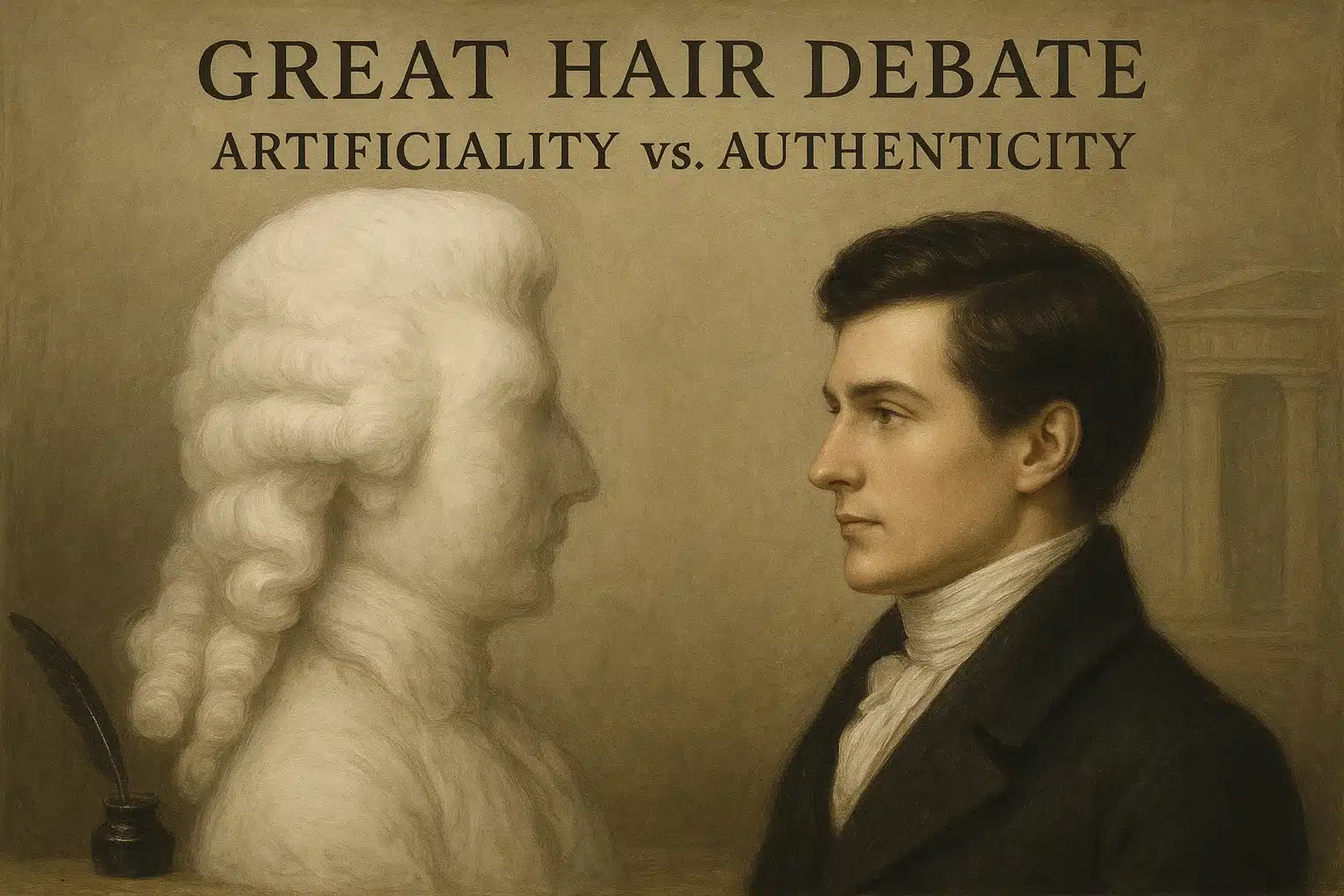
Leading this charge was Jean-Jacques Rousseau. In his highly influential work Emile, Rousseau glorified the “Natural Man”—a person who lived authentically, free from the superficial trappings of high society. Suddenly, the elaborate, heavy, and obviously artificial wigs of the aristocracy were no longer seen as majestic. Instead, they were viewed as physical representations of a corrupt and out-of-touch ruling class.
For the first time, an intellectual line was drawn in the sand: the “Authentic Man” wore his natural hair, while the “Corrupt Courtier” hid behind layers of powdered horsehair and silk.
The Satirists’ Pen: When “Big Wigs” Became a Punchline
As philosophy shifted, social commentators and artists were quick to weaponize the trend. The late 18th century saw an explosion of satirical prints mocking wig-wearers. Cartoonists depicted aristocrats buried under comically oversized hairpieces, using the wig to signify effeminacy, vanity, and political corruption.
The public eagerly consumed this social commentary. The wig was no longer just a fashion accessory; it was a political statement.
Here’s an interesting “aha” moment: Because of this intense social pressure, many leaders tried to find a middle ground. You might picture George Washington with a pristine white powdered wig, but he actually never wore one. Washington painstakingly powdered and styled his own natural hair to bridge the gap between respected tradition and the new, authentic ideal.
The Bloodshed and The Pocketbook: Revolution and Taxes
Philosophy and satire planted the seeds of doubt, but it took politics and economics to truly kill the powdered wig.
The French Revolution: A Life-or-Death Fashion Choice
When the French Revolution erupted in 1789, the rejection of the “Old Regime” became violently literal. Wigs were deeply associated with the aristocracy. Walking the streets of Paris in a powdered peruke was akin to wearing a sign that said, “I oppose the revolution.” In this era, wearing your natural hair wasn’t just a fashion choice—it was a survival tactic to keep your head attached to your shoulders.
The 1795 Hair Powder Tax
Across the English Channel, the final nail in the coffin was driven by economics. In 1795, British Prime Minister William Pitt the Younger implemented the Hair Powder Act. To fund the Napoleonic Wars, he levied a tax of one guinea per year on hair powder.
To put this in perspective, imagine a modern government passing a massive luxury tax just to use hairspray. The impact was immediate. Those who stubbornly paid the tax were mockingly dubbed “Guinea Pigs” by the press. For the vast majority of the public, the cost was simply too high. Almost overnight, men washed the powder out of their hair and abandoned their wigs entirely.
The Great Masculine Renunciation and the New Icon
This mass abandonment of wigs was part of a broader sociological phenomenon known as the “Great Masculine Renunciation.” Men collectively traded their bright silks, lace, and powdered wigs for plain, dark, tailored clothing.
Enter Beau Brummell.
Brummell, the original “dandy,” became the new fashion icon of the early 19th century. He championed a cropped, natural, and meticulously clean hairstyle. Brummell’s philosophy was simple: a gentleman should look impeccable without looking like he tried at all.
This sparked a fascinating transition in wig-making. Because men still experienced hair loss, they couldn’t simply rely on towering perukes to cover it up anymore. This era birthed the “invisible peruke”—the direct ancestor of the modern wig. The goal shifted from creating obvious, artistic spectacles to crafting undetectable, natural-looking hairpieces.
The Legacy: Why the 19th Century Matters to Your Hair Today
The Great Hair Debate of the early 19th century fundamentally changed our relationship with hair. The victory of the “Natural Man” philosophy established a standard we still hold today: we crave authenticity.
When you browse high-quality synthetic or human hair wigs today, you are participating in a tradition that began with this very shift. Modern wig wearers desire the lush volume and style of the past, but with the completely undetectable realism demanded by 19th-century critics. The desire for a wig that looks exactly like a natural head of hair—a piece that makes you feel beautiful, confident, and completely yourself—is a direct descendant of society’s historical quest for authenticity.
Frequently Asked Questions About the Decline of the Wig
Did George Washington wear a powdered wig?
No! This is a common misconception. George Washington grew his own hair long, pulled it back into a queue (a ponytail), and powdered it white. He avoided wigs, likely to project a more natural, egalitarian image while still adhering to the formal standards of the time.
What was a “Guinea Pig” in the 18th century?
After the British government passed the Hair Powder Tax of 1795 (charging one guinea per year to use hair powder), the people who chose to pay the tax and continue powdering their hair were mockingly called “Guinea Pigs” by political cartoonists.
Why did men stop wearing elaborate wigs, but women’s fashion remained complex?
This is due to the “Great Masculine Renunciation.” In the 19th century, men’s fashion shifted toward utility and uniformity (dark suits, natural hair) to project seriousness and business acumen, while women’s fashion was left to carry the societal burden of displaying wealth, beauty, and artistry.
What is an “invisible peruke”?
As obvious powdered wigs fell out of style, men experiencing hair loss still needed solutions. The “invisible peruke” was an early 19th-century hairpiece designed to mimic natural hair growth as closely as possible, marking the beginning of the modern, undetectable wig industry.
Continue Your Hair History Journey
The history of hair is deeply intertwined with human psychology, politics, and the enduring quest for self-expression. Understanding the past helps us appreciate the incredible craftsmanship and compassionate care that goes into modern hairpiece design today.
If you found this deep dive fascinating, keep exploring! Whether you are a history buff curious about the evolution of beauty standards, or someone navigating your own hair journey looking for the perfect, natural-looking style, there is always more to learn. Dive into our educational resources to discover how today’s high-quality wigs perfectly blend historical artistry with modern, undetectable realism.