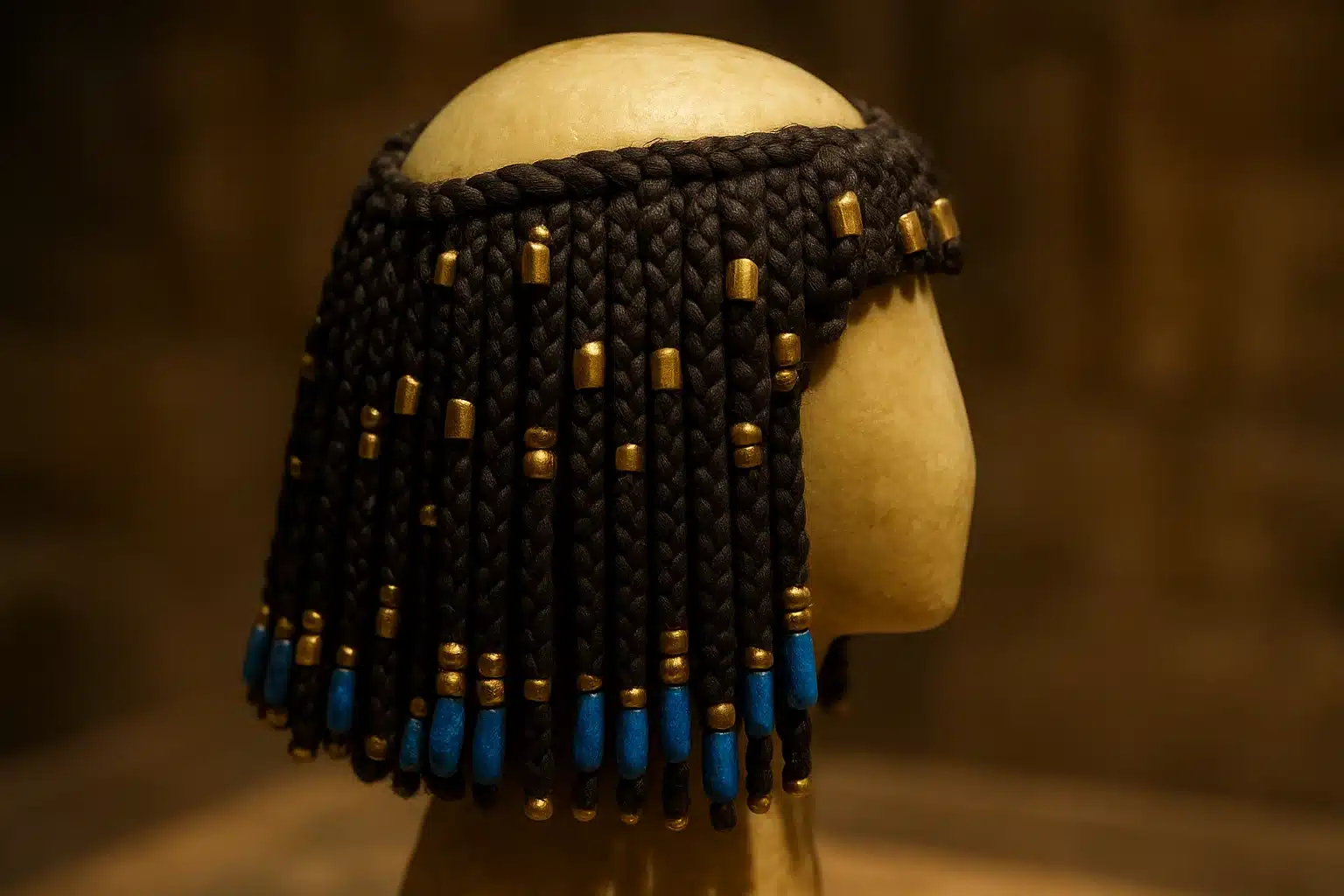
Imagine stepping onto a red carpet today. You notice the diamonds, the designer clips, and the carefully structured updos. We often think of this obsession with hair accessories as a modern phenomenon, fueled by celebrity culture and high fashion. But if we travel back three thousand years to the banks of the Nile or the temples of Mesopotamia, we find that our ancestors were the original influencers of hair ornamentation.
For the ancients, a wig was never just a wig. It was a canvas for communication. Whether it was the golden toggle beads of an Egyptian noble or the modest ribbons of a Grecian matron, every accessory told a story of rank, religion, and identity. To truly understand why these civilizations invested so much engineering into their hair systems, we have to look at the broader Ancient & Classical History of Wigs: Status, Ritual, and Power. Just as we curate our appearance today, they used these adornments to signal their place in the world.
The Engineering of Beauty: How It All Stayed Put
One of the most common questions modern wig wearers ask is, “How do I keep this secure?” It turns out, ancient stylists were asking the exact same question, but with much higher stakes. When your “hair accessories” are made of solid gold, lapis lazuli, or heavy beeswax, gravity is your enemy.
The “Braid-In” Anchor
Unlike modern clips that snap onto a weft, ancient adornments were often integrated into the structural integrity of the wig itself. Archaeological evidence suggests that gold tubes and beads weren’t just slid onto hair; they were often sewn or braided into place to prevent slipping.
Experimental archaeology—specifically the work regarding Roman hairstyles by researchers like Janet Stephens—reveals that ancient stylists used needle and thread to create “sewn hairstyles.” This technique created a rigid, secure foundation (a literal scaffolding of hair) that could support the weight of heavy metal ornaments without them sliding off during a banquet or ceremony.
The Slider Mechanism
In ancient Egypt, “toggle beads” or wide-bore tubes were popular. These functioned similarly to the sliders on a modern drawstring. A thick braid of human hair or vegetable fiber (often stiffened with beeswax) would be threaded through a gold or ceramic tube. The friction of the hair against the interior of the bead kept it in place, allowing the wearer to adjust the height of the ornamentation—a brilliant example of early functional fashion.
Gold, Glaze, and Gemstones: The “Bling” of Antiquity
When we look at museum artifacts, we often see the jewelry separated from the wig. To understand the visual impact, we have to mentally reassemble them.
The Sounds of Status
The Mesopotamians, particularly in the Royal Tombs of Ur, took wig adornment to an acoustic level. The famous “Gold Wigs” found in these tombs were actually helmet-like constructions of hammered gold, designed to mimic the texture of hair. But for those wearing fiber wigs, gold ribbons and willow-leaf pendants were woven in.
The intent here was sensory. As the wearer moved, the gold leaves would clink gently against beads of carnelian and lapis lazuli. This soft chiming sound announced the wearer’s arrival before they were even seen. It was an auditory display of wealth—quite literally, the sound of money.
Egyptian Faience and Glass
While gold was for the elite, bright color was the ultimate goal. The Egyptians mastered “faience”—a sintered-quartz ceramic that created vibrant turquoise and blue beads. These were threaded onto the ends of wig braids.
This wasn’t just aesthetic; it was protective. The color turquoise was linked to Hathor, the goddess of beauty and motherhood. By tipping their wig braids in blue, wearers were invoking divine protection.
The Fillet and the Ribbon: Social Signals in Silk and Linen
Moving toward the Greco-Roman world, the ornamentation becomes less about heavy “bling” and more about social coding.
The Fillet (Not the Fish)
In classical studies, a fillet refers to a headband, typically made of ribbon, leather, or cloth. In ancient Greece and Rome, the fillet was the primary way to secure a wig or natural hair, but it was also a strict social signal.
- The Vittae: In Rome, a woolen fillet bound into the hair signified a woman’s purity and modesty. It was a “do not touch” sign woven directly into the hairstyle.
- The Diadem: A flat metal fillet worn across the forehead signaled royalty or victory.
For the modern reader, think of this like a wedding ring. It’s a small accessory, but it communicates your relationship status instantly. The fillet did the same for ancient women, telling the world whether they were married, unmarried, or consecrated to a deity.
The Great Head Cone Mystery: Dismantling the “Melting Fat” Myth
Perhaps the most famous—and misunderstood—wig accessory in history is the Egyptian “Perfumed Head Cone.”
For decades, historians and tour guides have repeated a somewhat unappealing story: that ancient Egyptians wore cones of solid animal fat on their heads at parties. As the party heated up, the story goes, the fat would melt, dripping perfumed grease over the wearer’s wig and body to cool them down and make them smell good.
Here is the “Aha” moment: That theory is almost certainly wrong.
The Amarna Breakthrough (2019-2020)
Recent excavations at Amarna challenged the “melting fat” theory. Archaeologists discovered two skeletons topped with these very cones. The analysis revealed they were not solid blocks of fat, but rather hollow shells made of beeswax.
Why does this matter?
- Beeswax doesn’t melt easily: It has a much higher melting point than animal fat. It wouldn’t drip all over your expensive wig.
- They were hollow: This suggests they were lightweight “hats” or symbolic attire, not single-use moisturizing bars.
- Wig Protection: Anyone who wears a high-quality wig knows that saturating it in animal grease is the fastest way to ruin the fiber. The Egyptians, who were master wig-makers, would likely not have designed a ritual that destroyed their intricate hairpieces.
The Scent Profile
While they didn’t melt, they were likely perfumed. The beeswax acted as a carrier for scents like myrrh or Mendesian oil (a mix of balanos oil, myrrh, and cassia). The cone was a slow-release air freshener, surrounding the wearer in a “scent bubble” of sanctity and status, symbolizing rebirth and vitality without ruining the hair beneath.
From Pharaoh to Commoner: Who Wore What?
There is a common misconception that wigs and adornments were the exclusive domain of the Pharaohs. We tend to view history through the lens of King Tut’s gold mask.
However, the “democratization of the wig” is a fascinating historical shift. The Amarna discovery mentioned above was crucial because the skeletons found with head cones were not royalty. They were working-class individuals buried in a common cemetery.
This changes our understanding of the ancient world. It implies that ordinary people also had access to “dress up” rituals. Just as you might save up for a high-quality wig or a designer accessory today to feel confident at a special event, ancient commoners invested in beeswax cones and simple wigs to participate in the divine rituals of their time.
Frequently Asked Questions
Q: Did the wax cones really ruin the wigs?
A: No. The latest research indicates they were made of beeswax, not low-melting animal fat. They were likely hollow and lightweight, designed to sit atop the wig without melting into the fibers.
Q: Were ancient wigs heavy with all that gold?
A: Yes, they could be. The “Gold Wigs” of Ur were essentially helmets. However, everyday wigs adorned with beads used clever weight-distribution techniques, like braiding the ornaments near the scalp or using counterbalance weights, much like modern theater costumes.
Q: What is the difference between a headband and a fillet?
A: Functionally, they are similar. However, historically, a “fillet” often carried specific ritual or social meaning (like priesthood or marriage status), whereas a headband can be purely decorative.
Q: Did men wear these adornments too?
A: Absolutely. In Egypt and Mesopotamia, men of high status wore elaborate wigs and often used gold spacers and bands. Wig adornment was a human expression, not strictly gendered.
Conclusion
When we look back at the jewels, fillets, and cones of the ancient world, we see a reflection of our own desires. We see a need to beautify, to communicate our status, and to feel confident. The technology has changed—we now have lightweight synthetics and invisible lace fronts rather than beeswax and heavy gold—but the psychology remains the same.
Understanding the care and engineering that went into these ancient pieces helps us appreciate the artistry of hair replacement today. It reminds us that seeking confidence through hair is not a modern vanity; it is a timeless human tradition.
Curious about how wig technology has evolved from beeswax to breathable caps? Explore our educational resources to continue your journey through history.