There is a distinct feeling of anticipation when you unbox a new wig. The fibers are glossy, the style is set, and the potential for a new look is right there in your hands. However, once you place it on your head, you might notice something common among high-quality wigs: it looks a little too perfect. Perhaps the density feels heavy around the ears, or the ends hang with a bluntness that doesn’t quite mimic the natural sway of bio hair.
This is the “out-of-the-box” dilemma. Manufacturers often create wigs with 130% to 150% density to ensure longevity and coverage, but for many wearers, this can feel bulky. While many guides suggest professional tailoring, there is a middle ground between wearing it as-is and booking a salon appointment. With the right approach, you can perform subtle customizations yourself. If you are looking for a deep dive into professional-grade modifications, our guide to advanced wig cutting & layering techniques covers complex structural changes. However, for those seeking to simply soften a look, add movement, or personalize the length without a full re-cut, this manual is your starting point.
The Philosophy of the “Subtle Shift”
Before you pick up a pair of shears, it is crucial to understand the goal. We aren’t trying to change the architecture of the wig; we are trying to enhance its “wearability.” Think of this process less like a haircut and more like sculpting.
The primary difference between wig cutting and traditional hair cutting is the lack of regrowth. This reality often paralyzes beginners with fear, leading them to avoid customization entirely. However, by focusing on “reversible thinking”—techniques that remove weight from the interior rather than length from the exterior—you can make impactful changes with minimal risk.
The Essential Toolkit for Safe Customization
You cannot achieve a soft, natural look with kitchen scissors. Standard scissors create blunt, straight lines that look artificial on synthetic fibers. To customize safely, you need tools designed to feather and soften.
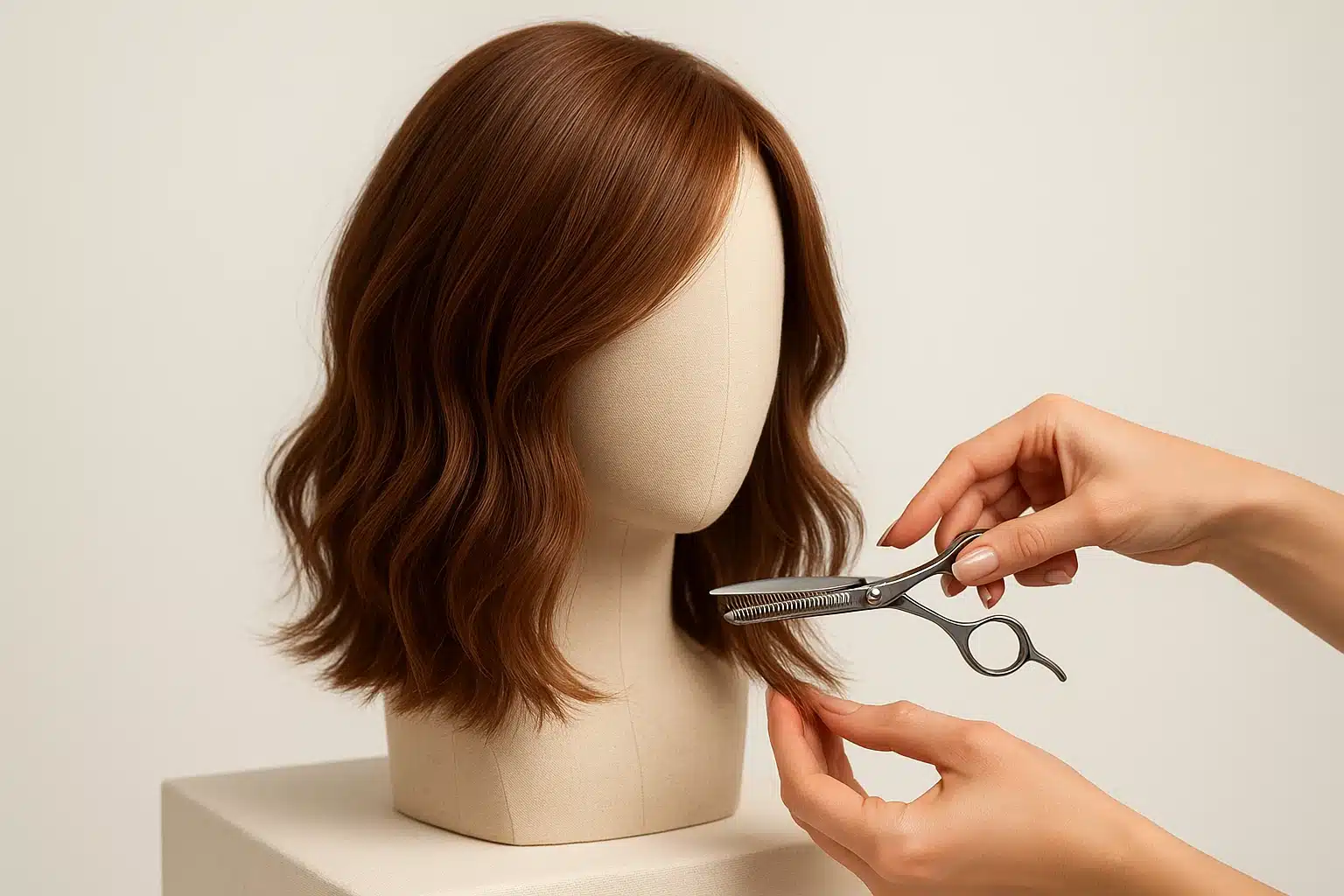
- Thinning Shears: These look like regular scissors but have teeth on one or both blades. They only cut a percentage of the hair captured between the blades, making it nearly impossible to chop off a “chunk” by accident.
- Razor Comb: This is arguably the most beginner-friendly tool. It allows you to “comb out” bulk and gently shorten layers without creating hard lines.
- Canvas Block Head and T-Pins: You need to see the wig in 3D. Pinning your wig to a canvas head allows you to walk around it and view the density from all angles.
- Wide-Tooth Comb and Clips: For sectioning the hair to ensure you are only cutting where intended.
The “No-Fly Zones”: Where NOT to Cut
Success in customizing a pre-styled wig is 80% knowing where not to cut.
- The Crown: Never use thinning shears or a razor directly on the crown (the very top of the wig). Short hairs here will stick straight up (the “cockatoo effect”) and cannot be smoothed down easily.
- The Top Wefts: Avoid cutting the hair that covers the wefts (the tracks) of the wig. You need this density to ensure the cap construction remains invisible.
- The Front Hairline (for beginners): Unless you are experienced, avoid altering the lace front or immediate hairline. These areas require delicate precision.
Technique 1: Weight Mapping and Internal Thinning
If your wig feels like a “helmet,” the issue is usually internal density, not length. The solution is internal thinning.
This technique focuses on the hair that sits underneath the top layer. By removing bulk here, the top layer can lay flatter against the head, creating a more natural silhouette.
- Section the Wig: Clip the top 1/3 of the hair up and out of the way. You will be working on the middle and lower sections.
- The Twist and Cut: Take a small section of hair (about an inch wide) from the under-layer. Twist it gently.
- The Inch Rule: Using your thinning shears, make a snip about one inch away from the root (never at the root) and another snip mid-way down the shaft.
- Comb It Out: You will see loose fibers come out in the comb. This is the bulk leaving the wig.
Note: Always start with less. You can always go back and thin more, but you cannot put density back in.
Technique 2: Point Cutting for Soft Ends
One of the tell-tale signs of a wig is a heavy, blunt perimeter. Natural hair tends to be slightly uneven and wispy at the ends due to different growth cycles. To mimic this, use point cutting.
Instead of holding your shears horizontally to cut length off, hold them vertically—pointing up into the ends of the hair. Snip small “V” shapes into the ends. This technique shatters the blunt line, softening the edge and allowing the hair to move more fluidly against your shoulders. This is perfect for customizing a bob or a lob (long bob) that feels too stiff.
Technique 3: Adding Dynamic Movement with Slide Cutting
If you love the length of your wig but feel it hangs like a curtain around your face, you need to introduce dynamic movement. This is often achieved through slide cutting or “slithering.”
This technique connects shorter layers around the face to the longer length in the back without creating a “step” or a shelf of layers.
- The Setup: Section off the hair near the front that you want to frame your face.
- The Motion: Using a razor comb or very sharp shears (partially open), gently slide the tool down the shaft of the hair toward the ends. Do not close the scissors; let the sharp edge shave off slivers of hair as it travels down.
- The Result: This creates a tapered effect where the hair naturally curves inward toward the face, rather than hanging straight down.
Pro Tip: Finding a high-quality foundation is crucial for these techniques to work well. While online browsing is convenient, many wearers find that identifying the best wig shops in houston—or top-tier retailers in their local area—allows them to understand cap construction and fiber quality before customizing. A better wig responds better to customization.
Synthetic vs. Human Hair: The Cutting Difference
It is vital to recognize the material you are working with.
- Human Hair: Cuts like bio hair. It is more forgiving because you can use heat to smooth out minor imperfections.
- Synthetic Fiber: This is essentially a fine plastic. It has “memory,” meaning it wants to snap back to its original baked-in style. When you cut synthetic hair, you are permanently altering the fiber’s end. Using a razor comb is often better for synthetic wigs because it stretches the fiber slightly before cutting, creating a tapered tip that mimics the look of a natural hair strand better than a blunt scissor cut.
The Final Shake and Set
Once you have thinned the bulk and softened the ends, the customization isn’t finished until you set the style.
For synthetic wigs, the “final shake” is literal. Hold the wig by the nape and give it a vigorous shake to let the fibers settle into their new, lighter weight distribution. If you have added face-framing layers, you may need to use a steamer (held at a distance) to encourage the new shorter hairs to sweep back or curve under. The heat from the steam resets the fiber memory to your new custom cut.
Frequently Asked Questions
Can I use regular paper scissors to trim my wig?
No. Paper scissors are generally too dull for hair fibers and can cause the ends of synthetic hair to fray or “split,” leading to frizz and tangling. Always use sharp hair shears or a fresh razor.
How much hair should I remove when thinning?
Follow the “15% Rule.” Aim to remove no more than 15% of the density in a single session. Wear the wig for a day, see how it feels, and then remove more if necessary.
Will cutting my wig ruin the fibers?
Cutting itself doesn’t ruin fibers, but using dull tools can. Also, cutting too close to the wefts/cap can compromise the structural integrity of the wig. Stick to the mid-lengths and ends to be safe.
I cut a layer too short. How do I fix it?
Don’t panic. If a layer is too blunt or short, use thinning shears on the ends of that specific section to blend it into the surrounding hair. Texturizing the mistake usually hides it better than trying to cut everything else shorter to match.
Do these techniques work on curly wigs?
Yes, but be very careful. Curly wigs spring up when weight is removed. Always cut curly wigs dry and leave them slightly longer than you think you need to account for the “shrinkage” factor.
By mastering these subtle alterations, you transition from simply wearing a wig to owning your style. It stops being a product you bought and becomes a seamless part of your personal expression.