Let’s be real for a second: when most wig guides talk about an “active lifestyle,” they picture a serene morning jog or an hour at the gym. But if you’re a parent, a grandparent, or a pet owner, your “active lifestyle” probably looks a lot more like dodging a toddler’s sticky fingers, leaning over a steaming stove, or wrestling a sixty-pound Golden Retriever before your first cup of coffee.
You aren’t just looking for breathability. You’re looking for survival gear.
For nearly two decades, we’ve worked with individuals experiencing hair loss, and we’ve learned that standard wig advice often ignores the beautiful, chaotic reality of family life. Whether you’re a busy mom needing quick solutions or navigating a bustling household full of kids and pets, choosing the right wig comes down to mastering the “High-Impact Family Lifestyle.”
Let’s explore how to choose, secure, and maintain a wig that stands up to the beautiful messes of daily life.
The Reality Check: Redefining “Active Wear”
Most wear and tear on a wig doesn’t happen on a treadmill; it happens in the living room. We call this “mechanical stress.” It’s the friction from your collar as you check your blind spot in the carpool lane. It’s the sudden “toddler tug” when your little one reaches up for a hug. It’s the enthusiastic puppy greeting that knocks you off balance.
Understanding these daily stressors is the first step in finding a wig that gives you confidence instead of anxiety.
The Stress Map: Where Wigs Take the Most Heat
If we were to look at a “Stress Map” of a wig worn by a parent or pet owner, two zones light up immediately:
- The Nape (Back of the Neck): This area suffers the most friction from car seats, winter coats, and baby carriers.
- The Crown and Front: This area faces the brunt of sudden physical contact—petting, grabbing, and those inevitable sticky toddler hands.
Under the Hood: Cap Construction for High-Friction Environments
To survive the toddler tug, you need to look beneath the hair fibers. The foundation of your wig—the cap—dictates how well it will stay on your head and how naturally it moves.
When exploring the different types of wig caps, you’ll generally encounter two main contenders for family life:
- Traditional Wefted Caps: These are incredibly breathable and often more budget-friendly. Because they are designed with open rows of hair, they are excellent for staying cool while chasing kids around the park.
- Monofilament Caps: If durability against pulling is your primary concern, monofilament is your best friend. In these caps, individual hairs are hand-tied into a sheer base. This design doesn’t just look flawlessly natural; it distributes tension beautifully. If a child pulls a section of hair, the stress is spread across the cap rather than focused on a single track, making it highly resistant to tearing.
The Security Masterclass: Conquering the “Grabbing Fear”
The number one question we hear from new moms and grandmas wearing wigs is: “Will it fall off if my child pulls it?”
It’s a valid fear, but it’s entirely preventable. Instead of relying on heavy glues that can be messy and time-consuming, we recommend the “Triple-Lock Method” for parent-proof security:
- The Internal Straps: Almost all quality wigs feature adjustable velcro or hook straps at the nape. Adjust these so the wig feels comfortably snug, like a gentle hug around the back of your head.
- The Friction Barrier: This is the game-changer. Wearing a velvet wig grip creates a one-way friction barrier against your scalp or natural hair. It acts like microscopic hooks that lock the wig cap in place, preventing it from sliding backward during a sudden tug.
- The Four-Finger Rule Placement: Place the front of the wig exactly four fingers above your eyebrows. A properly positioned wig is structurally harder to pull off than one sitting too far forward or backward.
Toddler-Proof Tip (The Pivot and Pin): If a child does grab your hair unexpectedly, don’t pull away! Gently pivot your head toward the pull to release the tension while casually placing your hand at the base of the wig to stabilize it.
The Durability Spectrum: Which Hair Fiber Fights Back?
The “Static-Dander Trap” of Synthetic Wigs
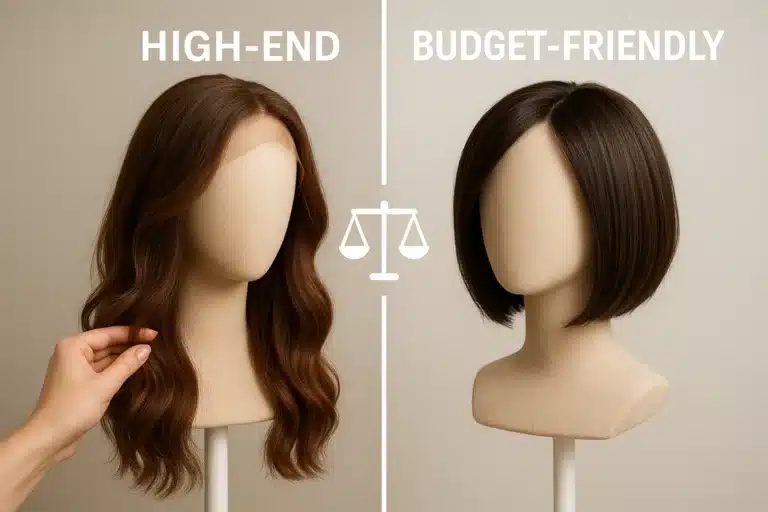
Synthetic wigs are a brilliant, budget-friendly “Ready-to-Play” option because they feature “style memory.” You can wash them, let them dry, and the style bounces right back without any heat tools. This is a massive win for time-poor parents.
However, pet owners need to know about the “Static-Dander Trap.” Synthetic fibers generate static electricity through daily friction. This static turns your wig into a literal magnet for dog hair, cat dander, and household dust, leading to tangles and frizz.
The Fix: Incorporate a daily anti-static spray and establish a dedicated routine for synthetic wig care to keep the fibers smooth and repel pet hair.
Human Hair: The Resilient Choice
While human hair requires styling just like your natural hair, the physical strands are stronger. They don’t generate the same static cling as synthetic fibers, making them highly resistant to pet dander. They also handle the heat from a steaming dishwasher or an open oven far better than synthetic alternatives.
Environmental Shielding: The “Gym Wig” Rotation Strategy
Fitness enthusiasts have a strategy that translates perfectly to family life: the “Gym Wig” rotation.
You don’t wear your finest silk blouse to the dog park, and you shouldn’t feel pressured to wear your most premium wig there either. Many of our clients keep a “High-Impact” wig—often an older piece or a less expensive synthetic option—specifically for messy crafts, gardening, or roughhousing with the dog. They save their refined, pristine wig for work, date nights, or Zoom calls.
This strategy instantly doubles the lifespan of both pieces. It also means less time worrying about lace front wig care when a puppy is trying to lick your face!
5-Minute Nightly Reset for Busy Households
You don’t have an hour for maintenance every night. Try this 5-minute reset to reverse the day’s mechanical stress:
- Detangle from the Bottom Up: Use a wide-tooth comb to gently work out tangles starting at the nape (where collar friction happens) and moving upward.
- The “Sticky Finger” Wipe-Down: If a toddler’s jelly-covered hands made contact, use a damp, alcohol-free wipe to gently spot-clean the fibers. Never scrub; just blot.
- Proper Storage: Place the wig on a canvas block or wig stand overnight—out of reach of curious cats and teething puppies!
Finding Your Perfect Fit
Navigating hair loss while managing a busy household takes immense strength. You deserve a solution that brings you peace of mind, allowing you to focus on the moments that matter—whether that’s a grandchild’s school play or a quiet evening on the couch with your dog.
With almost 20 years in the industry, Wig Superstore is built on compassionate customer care. Whether you are searching for wigs nashville locally or browsing our premium collections online from across the country, we are here to provide the expertise you need to feel beautiful and confident every single day.
Frequently Asked Questions (FAQ)
Is a lace front wig too delicate for a house with pets and kids?
Not necessarily, but it requires awareness. Lace fronts are delicate because the hairs are tied to a sheer material to create a natural hairline. If you have a highly active puppy that jumps, or a baby in the “grabbing” phase, you might prefer a basic front or a monofilament top for daily wear, saving your lace front for lower-impact days.
How do I remove pet hair from my synthetic wig?
Do not try to aggressively brush it out, which can stretch the synthetic fibers. Instead, lightly mist the wig with a specialized synthetic wig conditioner or a gentle anti-static spray. Use your fingers or a wide-tooth comb to gently separate the pet hair from the wig fibers.
What is the most durable wig style for active moms?
Shorter styles (bobs or pixie cuts) are universally the most durable for busy lifestyles. They eliminate the friction at the nape of the neck (the primary cause of tangles) and keep hair out of reach of tiny, grabbing hands. If you prefer long hair, consider a wig that can be easily pulled back into a low, loose ponytail using a soft scrunchie to prevent fiber damage.