When you run your fingers through the silken strands of a premium human hair wig, you are connecting with a story that spans continents. It is a journey that transforms a biological asset into a tool for confidence and beauty. However, the path from a donor in a distant village to a display stand in the United States is often shrouded in mystery. As you begin the process of identifying quality in your search for the perfect hairpiece, understanding the origin of that hair becomes just as crucial as the style itself.
For many first-time buyers, the focus is naturally on aesthetics: the bounce, the color, and the realism. But as you deepen your knowledge, a pressing question often arises: Where did this hair come from, and was it obtained fairly? The human hair industry is complex, and unfortunately, the line between voluntary donation and exploitation can sometimes blur. By arming yourself with the right knowledge, you can move beyond standard marketing labels and ensure your purchase supports dignity and transparency.
The “Remy” Myth: What The Label Doesn’t Tell You
One of the first terms you will encounter in your research is “Remy.” It is often marketed as the gold standard of quality, which leads many consumers to believe it is also the gold standard of ethics. This is a common misconception.
“Remy” is a technical description, not an ethical certification. It simply means that the hair cuticles (the outer layer of the hair shaft) are all aligned in the same direction, from root to tip. This alignment prevents tangling and creates that coveted smooth texture. While Remy hair is desirable for its longevity and look, the label tells you absolutely nothing about how the hair was acquired. Hair can be “Remy” and still be sourced through coercive means. To find truly ethical hair, we must look past the texture and investigate the source.
The Sourcing Spectrum: From Temple to Market
To navigate the ethics of wig buying, it helps to understand the three primary categories of human hair sourcing. Think of this as the “Chain of Custody” for your wig.
1. Temple Hair (The Ethical Standard)
Much of the world’s highest-quality hair comes from India, specifically from Hindu temples. Here, millions of people participate in a practice called tonsuring—shaving their heads as a religious act of devotion, gratitude, or surrender of ego. This is widely considered the most ethical source because the donation is voluntary. The temples then sell this hair to fund community services, such as education, healthcare, and infrastructure. Because the hair is shaved directly from the head and bundled immediately, it retains its natural cuticle alignment naturally.
2. Fallen Hair (The Grey Area)
“Fallen hair” refers to hair that has been gathered from brushes, combs, or floors. Because this hair is not cut directly from the head, the cuticles are often misaligned (facing different directions), which leads to matting. To correct this, manufacturers often use harsh acid baths to strip the cuticles entirely, followed by a silicone coating to simulate shine. While collecting fallen hair isn’t necessarily unethical—it’s essentially recycling—the extensive chemical processing required reduces the lifespan of the wig.
3. Forced or Coerced Sourcing (The Red Flag)
This is the dark side of the industry that investigative reports often highlight. In impoverished regions, individuals may be coerced into selling their hair for a pittance, or in extreme cases, forced to give it up against their will. This supply chain thrives on opacity. If a retailer cannot tell you the country of origin or the method of collection, it is a significant warning sign.
The Store Owner Stress Test: 5 Questions to Ask
You don’t need to be a supply chain expert to shop ethically; you just need to know which questions to ask. A reputable wig provider, like those of us who have spent decades in the industry, will welcome these inquiries because they allow us to showcase the integrity of our partners.
When visiting a boutique or browsing an online store, use these questions to gauge transparency:
“Can you walk me through the journey of this specific wig?”
A knowledgeable retailer should be able to tell you the origin (e.g., “This is European hair sourced from Eastern Europe” or “This is Temple hair from India”). If the answer is a vague “It’s imported 100% human hair,” press for more details.
“How does the manufacturer verify their supply chain?”
Top-tier manufacturers maintain strict audit logs. They can often provide documentation or Certificates of Authenticity (COA) that trace the hair batches. You aren’t necessarily looking to see the physical invoice, but you are looking for the retailer’s confidence in discussing their manufacturer’s vetting process.
“What is the difference in sourcing between your dark and grey human hair wigs?”
This is a sophisticated question that often surprises retailers. Human hair grey wigs are among the hardest to source ethically. Why? Because the donor pool (older individuals) is smaller, and they are less likely to grow their hair long for donation. Consequently, genuine grey human hair commands a premium. If a store offers cheap human grey hair, it is likely chemically processed yak hair or synthetic blends disguised as human hair.
“Is this hair ‘Single Drawn’ or ‘Double Drawn,’ and how does that affect the donor?”
- Single Drawn: Hair harvested as a ponytail. It contains different lengths (like natural hair growth), meaning the ends are tapered.
- Double Drawn: Shorter hairs are removed by hand so the bundle is thick from root to tip.While this is technically a style preference, “Double Drawn” involves significantly more labor. Ethical brands ensure that the workers sorting this hair are paid fair living wages, often in safe facilities rather than unregulated workshops.
“Do you carry brands that support the ‘Fair Trade’ philosophy?”
While there is no universal “Fair Trade” stamp for hair like there is for coffee, many high-end manufacturers have established their own rigorous ethical standards. They build relationships with communities rather than just buying form faceless aggregators.
The Economics of Ethics: Why You Pay More
One of the most common friction points for new buyers is the price difference between verified ethical hair and standard market hair. It is helpful to understand the math behind the price tag.
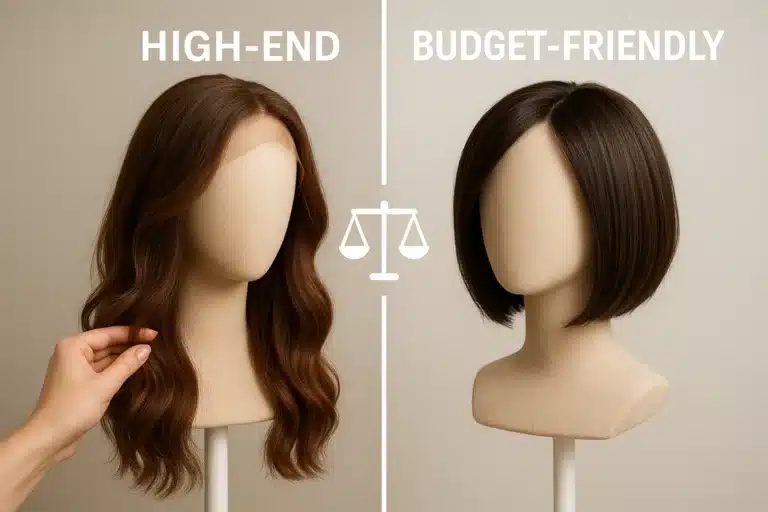
When you purchase a budget-friendly human hair wig from a fast-fashion marketplace, the low cost often comes at the expense of the donor’s compensation or the factory worker’s safety. In contrast, an ethically sourced wig includes:
- Fair Compensation: Whether it is a direct payment to a donor or a payment to a temple that funds community works.
- Safe Processing: Proper sterilization and gentle processing (for colored wigs human hair or texture alterations) require expensive, regulated chemicals and skilled labor.
- Quality Control: Ensuring the hair is truly 100% human (not mixed with synthetic or animal fibers) requires rigorous testing.
Red Flags: When to Walk Away
As you navigate the market, be wary of these common warning signs:
- The “Shein-Level” Price Tag: If a “100% Human Hair” wig costs $50, it is mathematically impossible for that hair to have been sourced, transported, and constructed ethically.
- Buzzword Overload: Be skeptical of listings that string together every keyword (e.g., “Virgin Brazilian Peruvian Malaysian European Hair”). These geographic markers are often marketing gimmicks rather than actual origin points.
- Mystery Blends: Terms like “Human Hair Blend” often hide a very low percentage of human hair mixed with heat-resistant synthetic fibers.
Frequently Asked Questions
Is European hair always more ethical than Asian hair?
Not necessarily. “European hair” is a texture classification (finer, thinner denier), not always a geographic guarantee. While some hair is ethically sourced from Eastern Europe, the label is often slapped on processed hair from other regions to justify a higher price. Always ask about the specific country of origin.
Are “halo wigs” or “drawstring pieces” subject to the same ethical concerns?
Yes. Even though halo wigs human hair and drawstring wig human hair use less material than a full wig, the sourcing principles remain the same. In fact, because these pieces rely heavily on blending seamlessly with your biological hair, the quality of the cuticle alignment (and thus the ethical sourcing) is even more critical to prevent matting.
Does ethical hair last longer?
Generally, yes. Ethical sourcing usually prioritizes hair health. Because the hair hasn’t been stripped by harsh acid baths to fix sourcing errors (like misalignment), the cuticles remain intact. This means the hair stays soft, retains moisture better, and lasts significantly longer than unethically sourced, heavily processed alternatives.
Taking the Next Step
Becoming an educated consumer is the first step toward finding a hairpiece that makes you look good and feel good. By asking the right questions, you are not being difficult; you are advocating for a transparent industry that values human dignity.
[]
As you continue your research, remember that a trustworthy provider will never pressure you. They will view your questions as an opportunity to share their passion for quality. Whether you are looking for a medical necessity or a cosmetic enhancement, you deserve to know the story behind your hair.