Navigating the world of alternative hair can often feel like learning an entirely new language. You might have found a style you absolutely love online, but a lingering fear holds you back: Can I actually style this without ruining it? We’ve all heard the horror stories of synthetic fibers melting into a plastic mess under a hot curling iron, leaving beginners anxious and confused about what they can and cannot do with their new hair.
If you live in North Texas, you understand the immense value of stepping into a local boutique, touching the fibers with your own hands, checking the cap fit, and receiving immediate, compassionate coaching from a professional. For buyers who need face-to-face styling advice and a chance to explore specialized inventories, consulting a guide to the best wig stores in Fort Worth TX is the perfect first step. Finding a local specialist bridges the gap between scientific fiber behavior and finding a piece that makes you feel beautiful and confident.
The Plot Twist: Why Your Wig Actually Requires Heat
There is a massive misconception in the alternative hair community. Many wearers actively avoid using hot tools on their heat friendly synthetic wigs because they want to “protect” or “save” the fibers.
In reality, the exact opposite is true.
Heat-friendly fibers are designed to beautifully replicate the soft texture and natural movement of human hair. However, this softness comes with a unique challenge known as the Friction Frizz Dilemma. Because these fibers have higher surface friction than standard synthetics, daily movement against your neckline, shoulders, and winter coats causes microscopic fraying.
🚨 CRITICAL MYTH BUSTER: Many wig wearers avoid styling their heat-friendly wigs with hot tools because they want to “save the fibers.” In reality, heat-friendly synthetic wigs require heat. Without regular low-heat smoothing (every 3–5 wears), friction from your shoulders and clothes will cause the fibers to fray, clump, and frizz permanently. Think of low-heat flat ironing as an anti-aging treatment for your wig!
Regular application of low heat (around 275°F) with a flat iron acts as a polymer resurfacing treatment, literally sealing the frayed outer layers back into a smooth, pristine state.
The Science of Styling: The Polymer Glass Transition Theory
Have you ever tried to curl a synthetic wig, only to watch the curl instantly fall flat the moment you take the iron away? You aren’t doing it wrong—you just need to understand the science of the fibers.
When heated, polyester and polyimide fibers reach what scientists call a “glass transition state.” During this phase, the molecular bonds in the hair loosen up, making them ready to accept a new shape. However, if you drop the curl while the hair is still hot, gravity simply pulls those loose bonds back into a straight line.
The secret? The cooling phase.
The new style only “locks” in place when the fibers cool completely in their coiled position. This freezing process resets the molecular bonds into their newly shaped curl. To get curls to stay, you must roll the heated hair, pin it to your wig block, and allow it to cool completely for at least five minutes before letting it drop.
Master the Salon System: How to Safely Style Your Wig
Effective wig maintenance and styling requires a combination of the right tools and proper technique. Here is the exact system professional stylists use to protect and prolong the life of specialized caps.
The Essential Tool Kit & Cap Protection
Before you plug in a single hot tool, you need to protect the foundation of your wig.
- The 21-Inch Canvas Rule: When styling a wig off your head, never use a canvas block larger than 21 inches. Larger blocks will permanently stretch out the elastic wefting of average and petite caps.
- T-Pin Placement Mapping: Pinning your wig to the canvas block incorrectly can destroy it. Pins must only pass through the thick velvet ear tabs and the double-reinforced polyurethane nape strip. Never pin through the delicate lace front or monofilament top, as this will tear the delicate hand-tied materials.
The Action (Straightening & Curling)
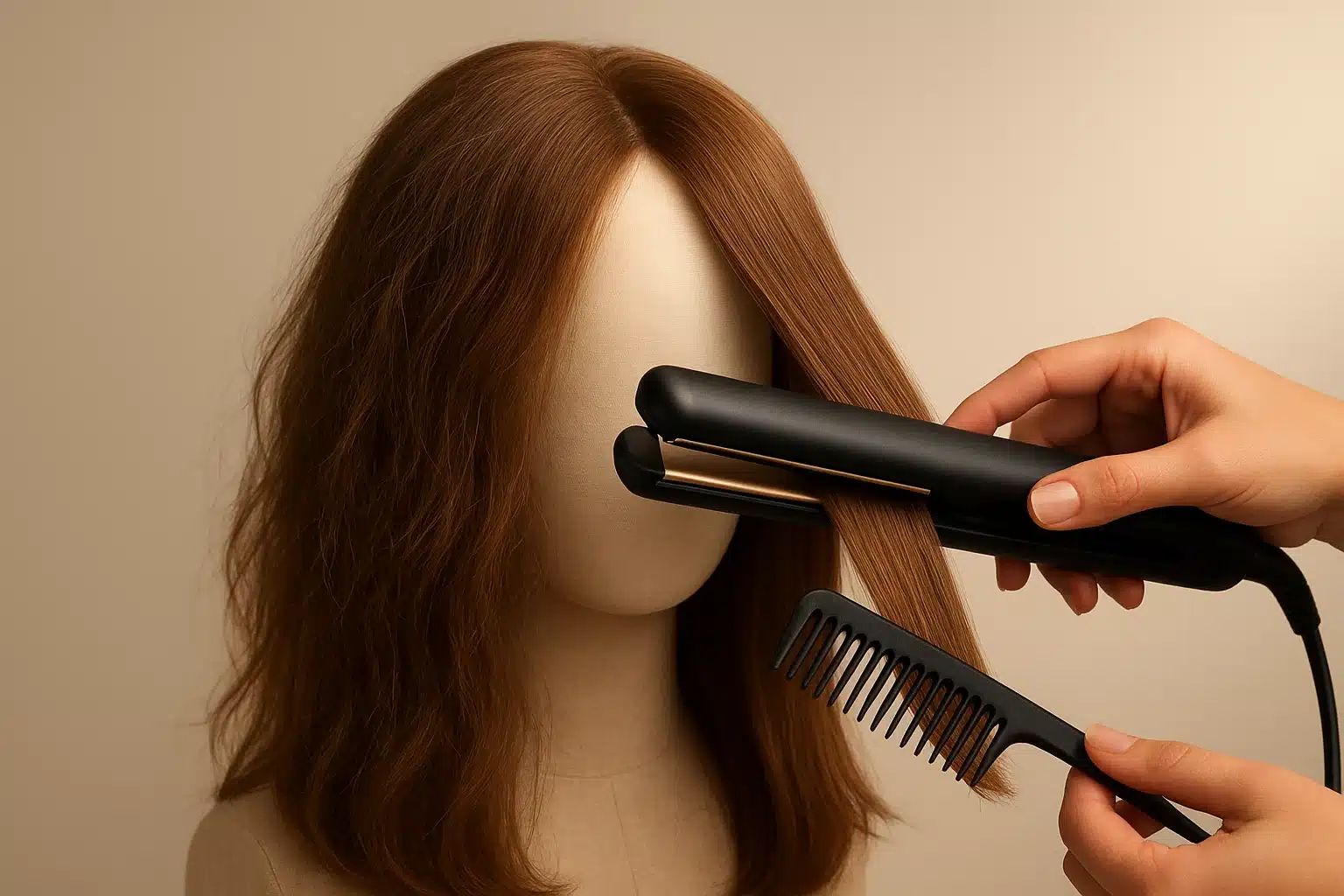
- Straightening (The Chase Method): Run a wide-tooth carbon comb slowly through a small section of hair, immediately following it (chasing it) with your flat iron set to a safe temperature. This keeps the fibers perfectly aligned while they are smoothed.
- Curling (Roll, Pin, and Cool): Wrap the hair around a curling wand, slide the coiled hair off into your palm, use a metal duckbill clip to pin the curl to the canvas block, and let it sit for five minutes to cool.
The “Nape Test” Protocol and Temperature Thresholds
What if you have an older wig or bought a piece without a tag, and you aren’t sure if it can handle heat? Enter the “Nape Test.”
Take a flat iron set to 250°F and apply it to a single, hidden strand of hair at the very bottom nape of the wig. If the hair singes, melts, or goes limp, it is standard synthetic and cannot take heat. If the iron glides smoothly, it is heat-resistant.
For known brands, keeping a temperature guide nearby is incredibly helpful. For example, a frequent question we hear is, “are jon renau wigs good for daily heat styling?” Absolutely. Their Heat Defiant lines are some of the most resilient on the market, provided you stay within the correct temperature thresholds:
| Fiber Brand / Type | Ideal Styling Temp | Maximum Safe Limit | Best Styling Tool |
|---|---|---|---|
| Jon Renau HD (Heat Defiant) | 275°F – 280°F | 350°F | Flat Iron (Chase Method) |
| Raquel Welch / Gabor HF | 275°F – 300°F | 350°F | Curling Wand / Flat Iron |
| Envy Hair (Blend) | 280°F – 310°F | 350°F | Variable Heat Irons |
| Standard Synthetic (e.g., classic Gigi) | NO HEAT | NO HEAT | Fabric Steamer (Indirect) |
Fort Worth Store Directory: Where to Find Specialized Boutiques
Finding an expert who understands the nuances of medical-grade, heat-stylable pieces is essential. Here are some of the top specialized boutiques in and around the Fort Worth area:
1. Wig Studio (Fort Worth)
Located on S Hulen St, this family-owned boutique has been operating since 2007. They excel in personalized, high-touch consultations for both medical hair loss patients and fashion wearers. They carry premium heat-friendly brands like Jon Renau, Raquel Welch, and Envy. Best of all, they provide hands-on client training to teach you exactly how to use variable-heat tools on your new synthetic fibers.
2. Miss Sassy’s Sparkles & Wigs
Situated inside The Mercantile on Camp Bowie Blvd, Miss Sassy’s has been a community institution for over 35 years. They are highly specialized in compassionate, private fittings for oncological and alopecia clients. With a massive showroom of over 2,500 pieces, they carry premium heat-resistant synthetic toppers and full wigs, offering a beautifully supportive retail environment.
3. Hair Solutions by Sharon
Also located on S Hulen St, Sharon brings nearly 40 years of local expertise to the Fort Worth and TCU communities. Her boutique focuses heavily on premium hair toppers, integration pieces, and high-quality heat-resistant options. If you need expert customization or density thinning so your wig doesn’t look bulky, this is a wonderful destination.
4. Mimi’s Wig Boutique (Regional Destination Highlight)
While technically located in Dallas on Campbell Rd, Mimi’s (established in 1979) is a regional destination well worth the drive. As one of the nation’s largest full-service wig boutiques, they are famous for their educational social media platform, “Mimi’s Wig Chicks.” They are a premier stockist of high-heat synthetics from Ellen Wille, Raquel Welch, and Jon Renau, offering comprehensive physical and virtual consultations.
Frequently Asked Questions
Can I style standard synthetic wigs with heat?
No. Standard synthetic wigs (made from modacrylic fibers) will permanently melt if exposed to direct heat from curling irons or flat irons. If you need to smooth a standard synthetic wig, you must use indirect heat, like a fabric steamer, while combing through the fibers.
Why is the hair at the nape of my neck clumping and matting?
This is a classic sign of friction frizz. The hair rubbing against your collar creates microscopic damage to the fibers, causing them to tangle and clump. To fix this, use a detangling spray, carefully comb out the snarls with a wide-tooth comb, and use a flat iron on a low setting (275°F) to smooth and reseal the fibers.
What is the difference between a style name and a fiber type?
It’s easy to get confused by style names. For example, if you are looking for a “Gigi” wig, you must clarify the brand. The popular Gigi by Envy is a standard synthetic and cannot take heat. However, the Gigi by Sensationnel uses heat-resistant polymers. Always verify the manufacturer’s fiber specifications before styling.
Continuing Your Alternative Hair Journey
Experiencing hair loss or simply stepping into the world of wigs for the first time can feel incredibly vulnerable. You deserve to feel beautiful, confident, and entirely in control of your look. By understanding the unique science behind your hairpiece and connecting with local, compassionate experts in Fort Worth who can customize your style, you are setting yourself up for long-term success.
Remember, maintaining a beautiful wig isn’t about avoiding care—it’s about empowering yourself with the right education to make your hair look fabulous, day after day.