If you’ve recently purchased your first heat-friendly synthetic wig, you are likely experiencing a very common, very understandable emotion: technical anxiety. The fear of taking a curling iron to your beautiful new hair and accidentally melting it is enough to keep your styling tools locked away in a drawer.
But here is a surprising secret from nearly two decades in the wig industry: heat isn’t the enemy of your synthetic wig. In fact, heat is its greatest restorative tool.
Most people don’t realize that heat friendly synthetic wigs actually require occasional heat to stay smooth and look natural over time. By shifting our perspective from “will I ruin this?” to “how can I use heat to heal this?”, you unlock the true versatility and longevity of your hairpiece.
Let’s demystify the advanced technology behind Rene of Paris Hi-Fashion fibers, erase the fear of melting, and explore how to care for your wig through every stage of its lifecycle.
The Science of “Heat-Friendly” Technology
To understand how to care for your wig, it helps to understand what it’s made of. Traditional synthetic wigs are made from standard modacrylic fibers. They hold their factory-baked style brilliantly, but if you expose them to an open oven door or a hot curling iron, they will singe and melt.
Rene of Paris heat-friendly fibers (like those found in their Hi-Fashion and Gigi collections) are different on a molecular level. These high-heat resistance fibers are engineered with what we call “permanent style memory.”
Style memory means that whatever shape the fiber is in when it cools down, it will hold onto that shape permanently—through rain, high humidity, and even washing—until heat is reintroduced. This makes heat-friendly fibers remarkably durable against weather elements, but it also means understanding how temperature affects them is crucial for proper synthetic wig care.
The “Goldilocks Zone” and The Cool Shot Concept
The number one question beginners ask is: What temperature do I use?
For Rene of Paris heat-friendly fibers, 275°F (135°C) is the “Goldilocks Zone.”
- Below 275°F: Nothing happens. The heat isn’t strong enough to reset the molecular bonds.
- Above 300°F: Damage begins. The fiber starts to dry out, lose its natural movement, and can eventually melt.
Before you touch a tool to your wig, always perform the “Back-Strand Test.” Take a small, hidden section of hair at the lower nape of the neck, apply your styling tool at 275°F, and ensure the fiber responds well.
The Ultimate “Aha” Moment: It’s All in the Cool Down
If you’ve ever tried to curl a synthetic wig, watched the beautiful ringlet fall flat the second you removed the iron, and wondered what went wrong—you aren’t alone.
Here is the golden rule of styling synthetic hair: Synthetic fiber only “learns” its shape during the cooling phase, not the heating phase.
If you heat a strand of hair and let it drop while it is still hot, gravity will pull it straight as it cools. To create a curl, you must use the “Pin-and-Cool” method. Wrap the hair around your iron, gently slide the coiled hair off the barrel, and pin the curl to your wig block. Do not touch or unpin the hair until it is completely, 100% cool to the touch. Once cooled, that curl is locked in permanently until you flat-iron it out!
Routine Wig Maintenance: Defeating Friction Frizz
As you wear your wig, you’ll eventually notice the hair at the nape of the neck starting to feel crunchy, dry, or tangled. This is known as “friction frizz,” and it’s the most common challenge in everyday wig maintenance.
Friction frizz is a micro-climate issue. As the fibers rub against your collar, sweaters, or winter coats, the subtle friction creates a static heat. Over time, this micro-heat slowly bends and distorts the tips of the fibers, making them feel like straw.
The 3-Minute “Nape-Save” Protocol
Don’t wait for your wig to become severely matted. Implementing a weekly Nape-Save protocol will drastically extend the life of your piece:
- Spray a high-quality detangler or anti-static spray onto the nape section.
- Gently comb through with a wide-tooth comb (never a standard hairbrush, which can stretch and snap synthetic fibers).
- If frizz is starting to form, it’s time to reset the fiber.
Restorative Styling: Using Heat to Heal
When standard wig care brushing isn’t enough to remove friction frizz, it’s time for the “Memory Reset.” This is where heat becomes a restorative tool rather than just a styling choice.
When those ends get crunchy, you aren’t dealing with “dryness” the way human hair gets dry (synthetic hair doesn’t absorb moisture). You are dealing with thousands of microscopic kinks in the plastic fiber.
How to Reset Your Fiber:
- Place your wig securely on a canvas block head.
- Section off the frizzy area.
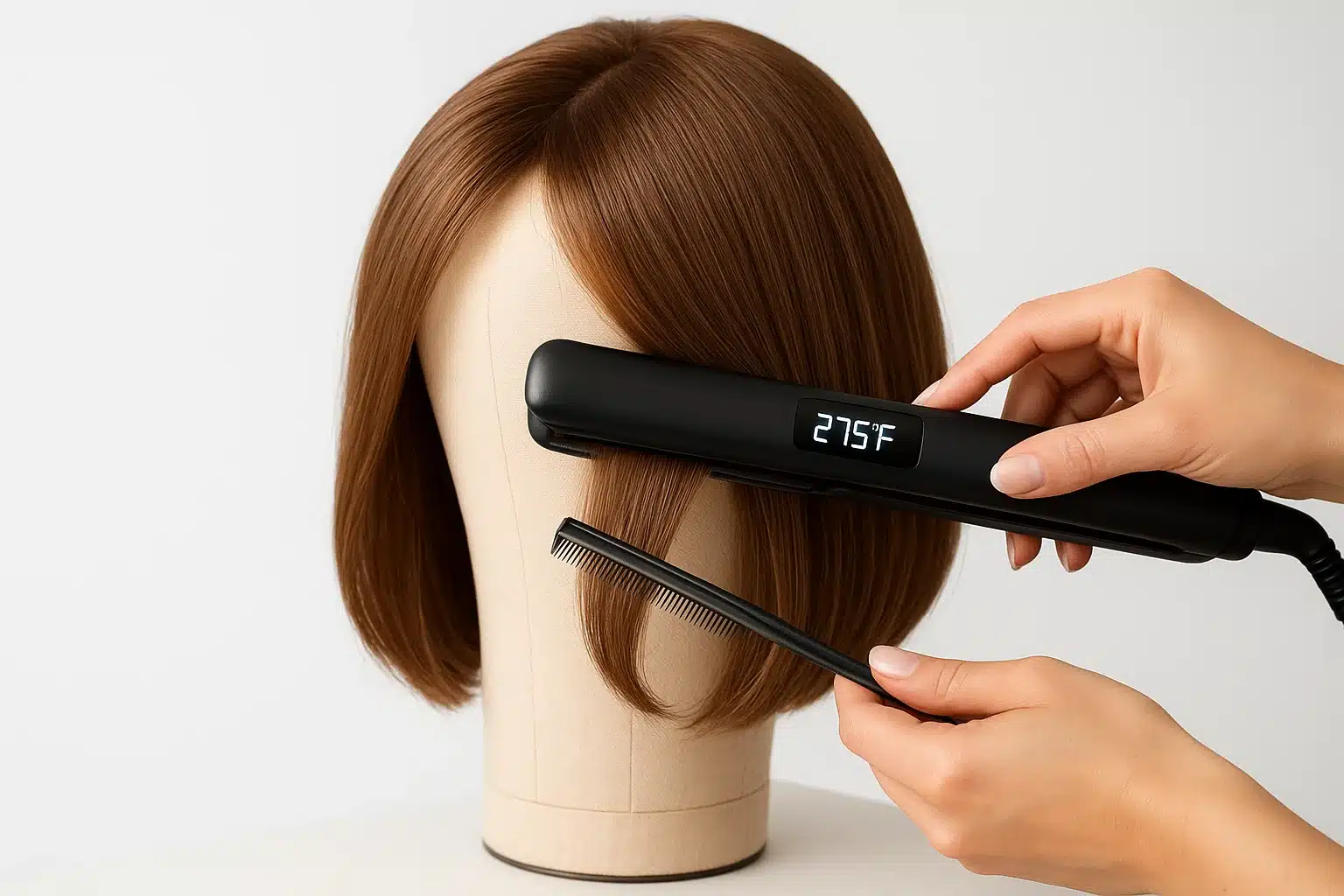
- Heat a ceramic flat iron precisely to 275°F.
- Slowly pass the flat iron over the frizzy section, following immediately with a fine-tooth metal comb.
- The heat will melt away the microscopic kinks, and as the fiber cools while perfectly straight, it will permanently reset to a smooth, factory-fresh finish.
By regularly smoothing out the nape with a flat iron, you are actively preventing the frizz from traveling up the hair shaft and ruining the wig.
Comprehensive FAQ for Beginners
Will normal hot tools melt my wig?
They can, if they aren’t temperature-controlled. Avoid tools with vague settings like “Low/Medium/High.” You need digital tools that allow you to dial the temperature exactly to 275°F (135°C).
Can I use a regular hair dryer on my heat-friendly wig?
Standard blow dryers can be risky because the airflow temperature is difficult to control and can exceed safe limits. If you must use a blow dryer, use it on the “Cool” or lowest warm setting. However, it is almost always better to let your wig air-dry on a stand overnight to preserve the fiber integrity.
Why does my wig look unnaturally shiny, and can heat fix it?
New synthetic wigs sometimes have a high shine due to the protective coating applied during manufacturing. While normal washing naturally reduces this shine over time, heat does not remove shine. Instead, a light dusting of dry shampoo is the best trick for instantly achieving a natural matte finish.
How often should I wash my heat-friendly wig?
Generally, you should wash your wig every 6 to 8 wears. Over-washing strips the fibers of their protective coating, while under-washing allows oils and sweat from your scalp to break down the cap materials.
The Journey Forward
Experiencing hair loss or transitioning to wearing wigs can feel overwhelming, but caring for your hair shouldn’t be. By understanding that your Rene of Paris heat-friendly wig relies on heat to stay fresh, smooth, and styled, you take the power back into your own hands.
You no longer have to fear the curling iron. Armed with the knowledge of the 275°F Goldilocks Zone and the magic of the Cool Shot, you can maintain, style, and restore your beautiful wig for months to come.
If you are ready to learn more about keeping your synthetic hair looking flawless from unboxing to its final wear, explore our deeper resources on wig care to ensure you always step out feeling beautiful, confident, and entirely yourself.