You are likely standing at a crossroads that feels less like a shopping decision and more like a pivotal life moment. On one side, there is the immediate, non-invasive route of high-quality wearable hair. On the other, the allure of a “permanent” surgical solution. It is easy to get paralyzed by the upfront sticker prices, but experienced hair restoration experts know that the price tag on the website is rarely what you pay in the long run.
To truly make an empowered decision, you need to look beyond the initial transaction and understand the Total Cost of Ownership (TCO) over five, ten, or even twenty years. Whether you are considering a follicular unit extraction (FUE) or investing in a premium human hair piece, both paths carry ongoing financial and lifestyle commitments. This guide acts as your financial auditor, helping you understand the real cost of hair restoration so you can choose the path that aligns with your budget and your peace of mind.
The 10-Year Horizon: “Subscription” vs. “Capital Expense”
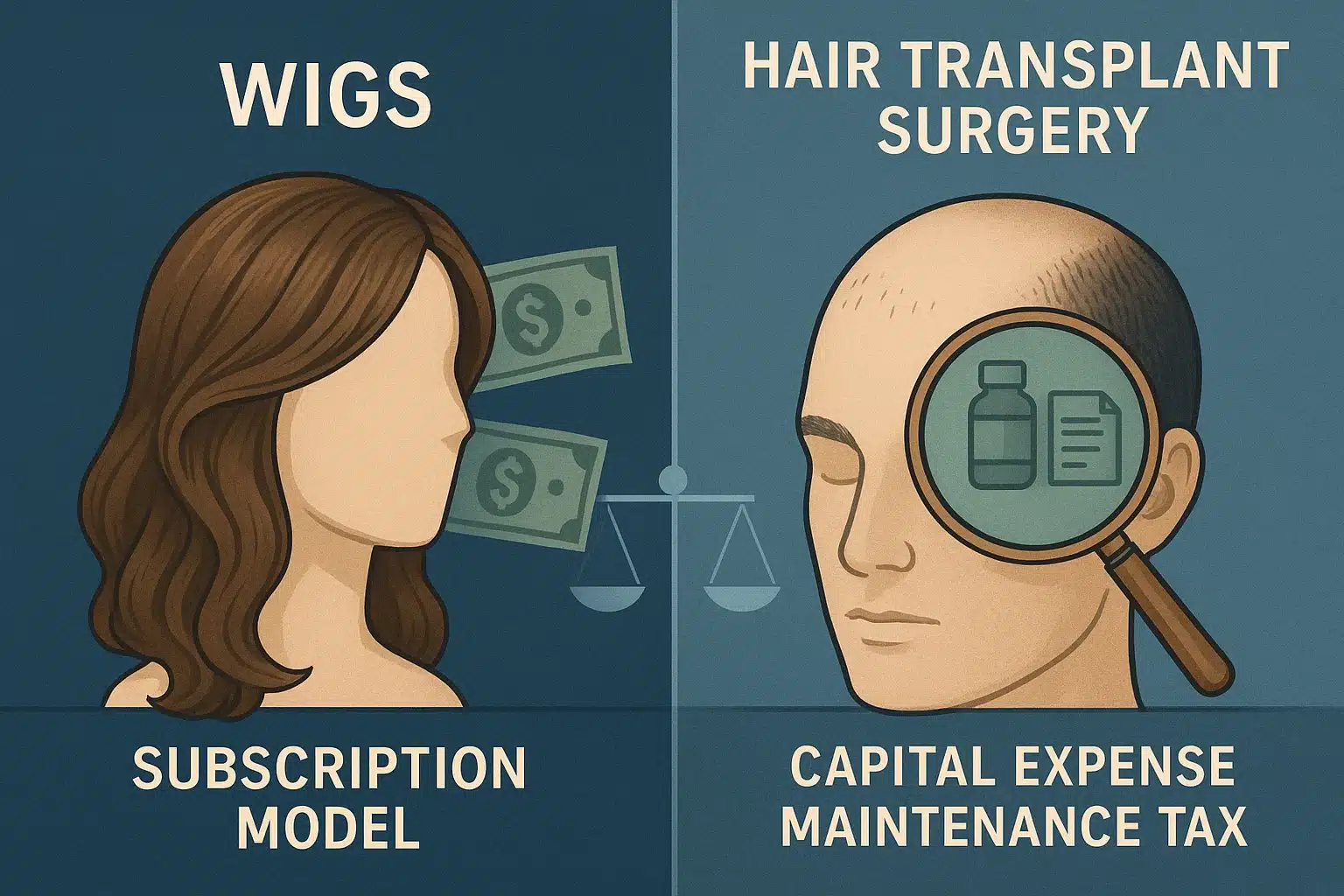
When analyzing the finances of hair loss solutions, it helps to view them through a business lens. High-quality wigs operate on a “Subscription Model.” You pay a recurring amount annually to maintain a consistent look, much like a lease.
Conversely, hair transplant surgery is often marketed as a “Capital Expense”—a massive upfront investment that supposedly eliminates future costs. However, data suggests this “one-and-done” narrative is often a myth. To get an accurate picture, we must compare the cumulative costs of both over a decade.
The Wig Economy: The Cost of Consistency
Choosing a wig offers immediate gratification and zero surgical risk, but it does require a commitment to replenishment. The “wear-to-cost” ratio depends heavily on the fiber quality and frequency of wear.
The Annual Investment
For a daily wearer investing in high-quality 100% human hair wigs, the lifespan of a unit is typically 9 to 12 months with proper care.
- Unit Cost: $2,000 – $4,000 per premium unit.
- Maintenance & Styling: Specialized shampoos, conditioners, and occasional professional styling.
- The 10-Year Math: Over a decade, relying solely on premium human hair can cost between $21,000 and $48,000.
While this number seems high, it buys you something surgery cannot: predictability. You know exactly what you will look like every day, you have total control over style changes, and you face zero risk of medical complications.
Managing the Investment
Many wearers lower this TCO by rotating between synthetic options for daily wear and saving human hair units for special occasions. Proper wig maintenance is also critical; extending the life of a unit by just three months can save thousands of dollars over a decade.
The Surgical Reality: The Hidden “Maintenance Tax”
Surgical clinics often lead with the “permanent solution” pitch, but they rarely discuss the lifetime maintenance required to protect that investment. A standard US-based transplant ranges from $12,000 to $25,000 upfront, but the spending rarely stops there.
The “One-Time” Myth
Hair transplants relocate hair from a donor area to a thinning area. However, your native hair—the hair that wasn’t transplanted—is still susceptible to genetic hair loss.
- The “Maintenance Tax”: To prevent the “island” effect (where transplanted hair stays but surrounding hair falls out), patients must often take medications like Finasteride or Minoxidil for life. This can add $500–$1,000 annually.
- The Second Surgery: Research indicates that 20-30% of patients require a second “density” procedure or touch-up within 10 years as native hair continues to thin. This essentially doubles the capital expense.
The Breakeven Point
From a purely mathematical standpoint, a successful hair transplant often “breaks even” against the cost of high-end wigs around Year 5 or 6. After that point, the surgery becomes the cheaper option if—and it is a big if—no further complications arise.
The Nuance Variables: It’s Not One-Size-Fits-All
The math changes drastically depending on your specific biology and risk tolerance. Two major factors often omitted from standard price lists are hair texture and the risks of medical tourism.
The Curly Hair Surcharge
If you have Type 3 or Type 4 curly hair, standard per-graft pricing models may be misleading. Curly hair follicles curl underneath the skin, making extraction significantly more difficult.
- Complexity Cost: Surgeons often charge a premium (20-50% more) for these procedures due to the time and expertise required.
- Transection Risk: There is a higher risk of damaging the follicle (transection) during extraction, which can lead to lower density results, potentially necessitating a second surgery sooner than expected.
The “Tragedy” Cost: Medical Tourism
The allure of a $2,500 “all-inclusive” transplant package in countries like Turkey is strong, especially when compared to US prices. However, this is a form of financial arbitrage that carries high risk.
- The Fix-It Bill: If a low-cost surgery fails—resulting in unnatural hairlines, over-harvested donor areas, or infection—the cost to repair it in the US is astronomical. Reconstructive hair surgery is far more complex and expensive than a primary procedure.
- The Peace of Mind Factor: Wigs carry a “Risk-Adjusted Cost” of zero. If you don’t like a wig, you take it off. If a surgery goes wrong, the physical and financial toll of correcting it is a heavy burden to bear.
Making the Decision: Value vs. Price
Ultimately, the choice between wigs and surgery isn’t just a hair wig surgery cost comparison; it is a lifestyle decision.
Choose Wigs If:
- You want immediate, guaranteed volume and density.
- You value the ability to change your style, color, and length instantly.
- You want to avoid medical risks and long-term medication use.
- You prefer a predictable, pay-as-you-go financial model.
Consider Surgery If:
- You have a stable donor area and your hair loss has plateaued.
- You are prepared for the “ugly duckling” post-op phase and a 12-month wait for full results.
- You are willing to commit to lifetime medication to maintain the results.
Frequently Asked Questions
Is a hair transplant actually permanent?
The transplanted hair behaves like the hair from your donor area (back of the head), which is resistant to balding. However, the non-transplanted hair on top of your head will continue to thin without medication. Therefore, the “look” is not permanent without ongoing maintenance.
Do wigs damage your biological hair?
Not if worn correctly. Modern caps are designed to be breathable and lightweight. In fact, wearing a wig can sometimes protect biological hair from heat styling and environmental damage, acting as a “protective style.”
Why are human hair wigs so expensive compared to synthetic?
Human hair is a finite resource that requires careful processing (bleaching, dyeing) to ensure the cuticles are aligned. The craftsmanship involved in hand-tying these wigs for natural movement adds to the cost. However, they last significantly longer than synthetic options, offering better long-term value.
Can I finance a wig or a transplant?
Most surgical clinics offer financing due to the high upfront cost. Similarly, high-end wig retailers often provide payment plans (like Affirm or PayPal Credit) to break up the purchase price, making the “subscription” model easier to manage monthly.
Understanding your options is the first step toward confidence. Whether you choose the versatility of a wig or the permanence of a procedure, the “right” choice is the one that makes you feel like yourself again.