Imagine buying a luxury sports car just because you liked the color, only to realize the seat is uncomfortable and the suspension is too stiff for your daily commute. This is exactly how many people approach buying a wig—they fall in love with a style or a specific shade of blonde, but they ignore the “chassis” underneath. In the world of alternative hair, the cap construction is that chassis. It dictates how the hair moves, how much volume it holds, and most importantly, how it feels against your scalp after eight hours of wear.
Among the myriad of options available, the Noriko collection has quietly established itself as the gold standard for durable, high-volume wearability. While other brands race to make caps as invisible as possible (often sacrificing durability in the process), Noriko has focused on engineering caps that balance realism with structural integrity. If you are currently navigating the vast options available, our Complete Guide to Noriko Wigs offers a broad overview of the styles, but here, we are going to look “under the hood.” We will explore how these caps have evolved from standard designs into sophisticated hybrids that solve the most common comfort complaints.
Beyond the “Basic” Cap: The Engineering of the Flower Net
In the industry, you will often hear the term “basic cap” or “machine-made cap.” For many brands, this implies a simple, entry-level construction. However, Noriko has elevated this category into something far more advanced, utilizing a specific feature known as the Flower Net Top.
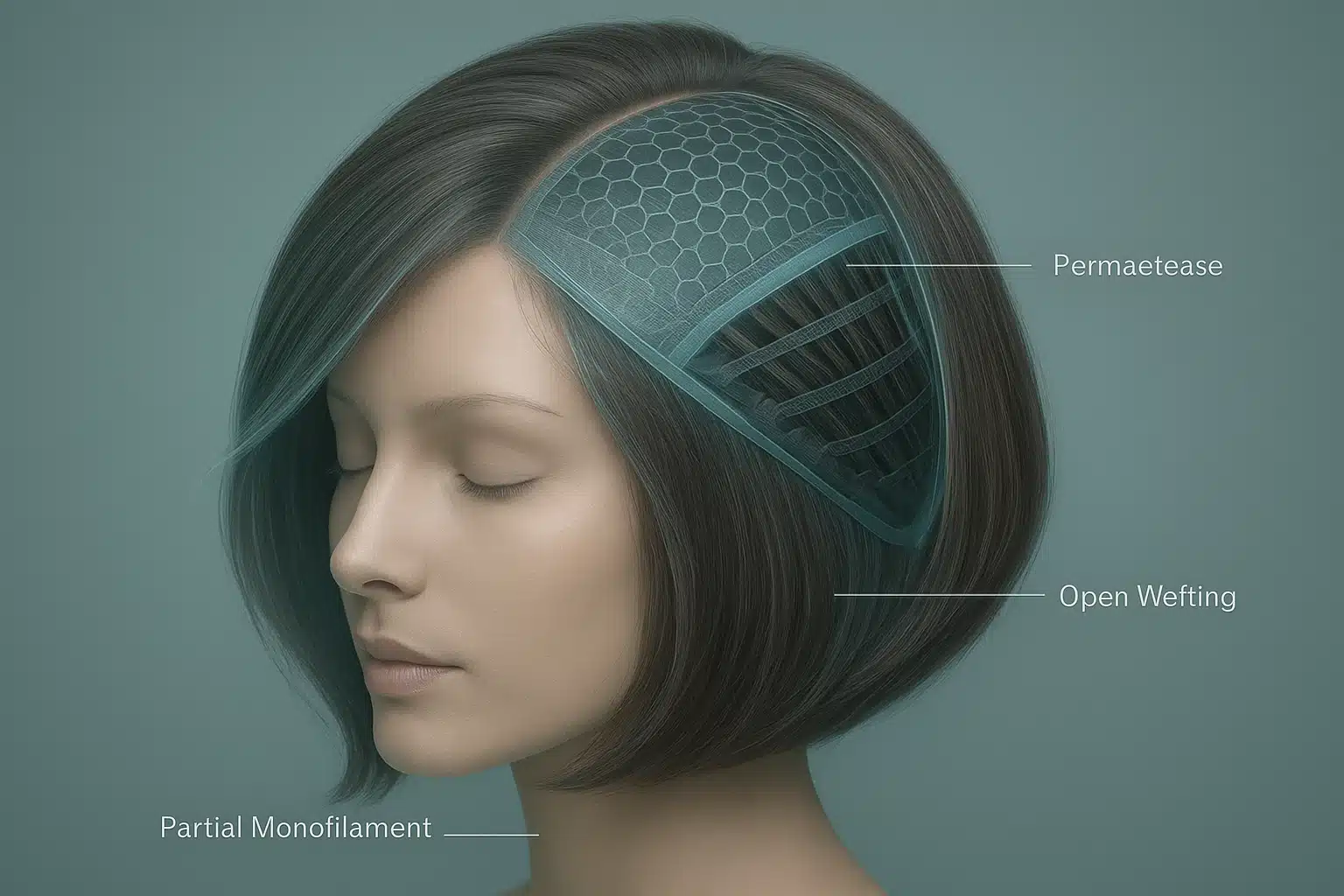
Unlike a standard closed lace top, which can trap heat and feel rigid, the Flower Net is a hexagonal, open-netting material used in the crown area of many Noriko styles. This design serves two distinct purposes:
- Durability with Stretch: The geometric structure of the netting allows for multi-directional stretch. This accommodates different head shapes—specifically varying occipital bone prominences—better than a rigid lace top.
- Built-in Lift: This netting is the foundation for Noriko’s signature volume. It provides a sturdy base for “Permatease” (short, crimped fibers at the root), allowing styles like the Jackson or Sky to maintain their lift without constant styling products.
The “Permatease” Paradox
Newcomers often ask, “Why does the root area look slightly fuzzy?” This is Permatease, and it is a feature, not a flaw. In Noriko cap construction, Permatease acts as a spacer. By lifting the hair fiber away from the cap material, it allows air to circulate more freely to the scalp. It also effectively conceals the wefting underneath, meaning you don’t need a heavy, thick cap to hide the construction.
The Evolution of Airflow: Open Wefting
Early synthetic wigs were often criticized for being hot and heavy. The industry response was the development of “capless” or “open wefted” construction. If you look at the back and sides of a modern Noriko wig, you will see rows of hair (wefts) sewn onto thin elastic strips rather than a solid fabric cap.
This evolution is critical for temperature regulation. The gaps between the wefts allow heat to escape from the scalp and cool air to reach it. When researching types of wig caps, you will find that this open-wefted design is superior for “active” wearers. It significantly reduces the weight of the wig, with many Noriko styles weighing under 3 ounces—light enough that you might forget you are wearing them.
The Hybrid Revolution: The Partial Monofilament (PM)
For years, customers had to choose between the durability/volume of a basic cap and the realistic scalp appearance of a full monofilament top. The trade-off was stark: monofilament looked real but was expensive and flatter; basic caps had volume but lacked a realistic part line.
Noriko bridged this gap with the Partial Monofilament (PM) collection. This innovation changed the landscape by placing a small, hand-tied monofilament area only where the natural part falls.
Why This Matters for You
Take the iconic Reese wig. The classic Reese features a machine-made top with Permatease for volume. The Reese PM, however, utilizes the same style but incorporates a monofilament part.
- The Benefit: You get the “poof” and fashion-forward volume of the standard cap, but when someone looks down at the top of your head, they see what looks like natural skin growth at the part.
- The Cost-Benefit: Because the hand-tied area is smaller than a full mono-top, the price point remains accessible while offering the most critical element of realism.
Troubleshooting Fit: Customizing Your Noriko Experience
Even the best-engineered cap needs to fit your specific head shape. A common misconception is that if a wig feels tight, it is too small. Often, it is simply a matter of adjustment. Learning how to use a wig cap correctly and adjusting the wig’s integrated tabs can transform the experience.
The Nape Adjustment Technique
Noriko caps typically use highly elasticized distinct pull-tabs or Velcro straps at the nape.
- The Four-Finger Rule: You should be able to fit four fingers comfortably under the nape of the wig. If you can’t, the tension may cause headaches.
- The Contour Check: The ear tabs should sit flat against your temple, not over the top of your ears. Noriko ear tabs contain a bendable metal stay; always mold this inward toward your face to secure the fit and conceal your bio hair.
While nothing replaces the experience of walking into a premium wig store in Dallas to be measured by a professional, understanding these mechanics allows you to achieve a near-custom fit at home.
Frequently Asked Questions About Noriko Caps
Q: Will the Permatease in the cap make my head hot?
A: Paradoxically, no. While Permatease adds density, it lifts the hair off the scalp. Combined with the open wefting in the back, Noriko caps are generally considered very breathable.
Q: Why does my new Noriko cap feel tighter than my old one of the same style?
A: Wigs stretch over time. Your old wig has likely relaxed to match your head shape perfectly. A new wig will always feel snugger (and the elastic more resilient) right out of the box. Give it a few wears to “break in.”
Q: Can I change the part on a standard Noriko cap?
A: Standard caps with the Flower Net top have a fixed part or a center point. You cannot change the direction of the hair at the root as freely as you can with a monofilament top. If styling versatility is your priority, look for the PM (Partial Mono) versions or styles explicitly labeled as Monofilament.
Q: Is the cap material itchy?
A: Noriko uses soft, velvet-lined ear tabs and nape bands to protect sensitive friction points. However, if you have total hair loss and a very sensitive scalp, wearing a bamboo or cotton liner underneath the cap can provide an extra layer of comfort against the Flower Netting.
The Next Step in Your Journey
Understanding the construction of a Noriko cap helps you move beyond choosing a wig based solely on a picture. If you are looking for “shake-and-go” volume that holds up to daily wear, the standard Flower Net cap is an engineering marvel. If you need that extra touch of realism at the part line without sacrificing lift, the PM collection offers the perfect hybrid solution.
As you explore the collection, look at the specifications listed for each wig. Pay attention to terms like “Open Wefted,” “Partial Mono,” and “Machine Made.” These aren’t just technical jargon—they are the blueprint for your comfort.