Have you ever stared at a digital wig color swatch, feeling like you’re trying to decode a secret language? You see a tiny one-inch square of hair and find yourself wondering: Is “Marble Brown” warm or cool? What on earth does “-R” mean? Is this going to look like a beautiful, expensive salon balayage, or an unnatural tiger stripe?
If you’re experiencing hair loss and navigating the world of alternative hair, you already have enough on your plate. Choosing a hair color shouldn’t require a master’s degree in cryptography.
Rene of Paris (often abbreviated as RoP) is widely considered one of the most sophisticated brands in the wig industry, known for delivering that coveted “salon-fresh” look. However, their vast color universe can be incredibly confusing for beginners. Official stock swatches rarely tell the whole story, leading to a common problem: customers buying the right shade, but the entirely wrong undertone.
Think of this guide as your “Visual Rosetta Stone.” We’re going to demystify the Rene of Paris color codes, break down their unique rooting system, and give you the tools to predict exactly how a shade will look on your unique complexion.
The “Secret Language” of Rene of Paris Wig Colors
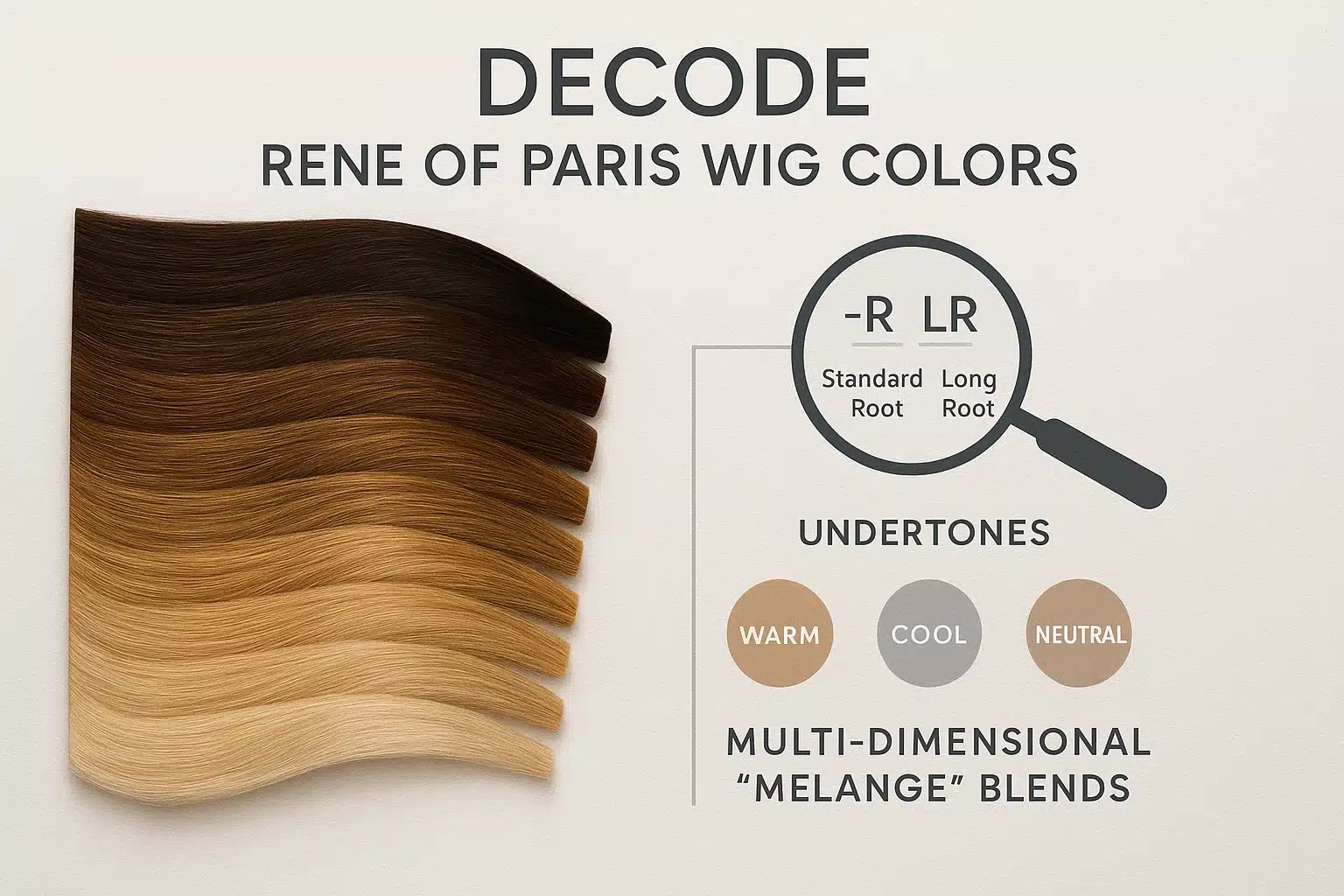
Most standard wigs rely on flat, single-tone colors. The reason Rene of Paris styles look so remarkably natural is that they rarely use just one color. Instead, they use a “Melange” process.
When you look closely at a premium RoP color, you aren’t just seeing “blonde” or “brunette.” You are seeing a meticulously blended base, a mid-tone, and a highlight. This three-dimensional depth creates a “shadow” effect within the hair, mimicking the way natural bio-hair grows and catches the light.
But to navigate their catalog, you need to understand their specialized terminology:
What are “-R” and “LR” Shades?
The letters attached to the end of a color name are your biggest clues to how the wig will look around your face.
- -R (Standard Root): This indicates a rooted color. The darker root typically extends about 1 to 2 inches from the base before transitioning into the main color. This mimics the look of natural hair growth between salon visits. If you’ve been looking into rooted wigs, the -R shades offer some of the most realistic scalp illusions on the market.
- LR (Long Root): This is a much deeper, dramatic root that extends further down the hair shaft, creating a modern “ombre” or heavily balayaged effect.
- Hybrant: You will often see colors labeled as “Hybrant Root” or “Hybrant Underlights.” This is RoP’s proprietary technology that pairs deeply rooted tops with vibrant, multi-dimensional highlighting techniques.
The “Aha!” Moment: An LR (Long Root) will change the perceived height of your forehead and frame your face with darker tones, whereas a standard -R keeps the lighter colors much closer to your face.
Decoding the “Big 3” Collections
A major point of confusion for buyers is the “Collection Cross-Over.” Rene of Paris is the parent brand, but underneath that umbrella, they produce three main collections: Hi-Fashion, Noriko, and Amore.
While you might find a color like Creamy Toffee-R available in all three collections, the application of that color can slightly differ.
- Amore: Known for its medical-grade monofilament caps, the rooting on Amore wigs tends to be incredibly delicate and nuanced to match the realistic scalp.
- Noriko: Famous for its voluminous, heavily layered styles, Noriko blends often have a slightly denser, bolder color application to accentuate the chunky layers.
- Rene of Paris Hi-Fashion: Trend-forward and edgy, these colors often feature higher contrast and dramatic transitions.
When you are investing in synthetic wigs, knowing which sub-collection your style belongs to helps you anticipate how bold or subtle the color blend will be.
The Rene of Paris Undertone Matrix
The biggest mistake first-time buyers make is shopping by shade instead of undertone. You might know you want a “light brown,” but if you have cool, pink-leaning skin and buy a light brown with a golden-yellow base, the wig will look unnatural on you.
To help you navigate, we’ve categorized some of the most popular RoP blends by their temperature. This matrix is your cheat sheet for matching wigs to your skin tone:
Warm Undertones (Golden, Honey, Red, Caramel bases)
Best for: Skin that tans easily, has olive/yellow undertones, and looks best in gold jewelry.
- Creamy Toffee-R: A warm, golden blonde blend with a dark blonde root.
- Macadamia-LR: A rich, warm brunette base melting into golden blonde tips.
- Marmalade-LR: A fiery, warm copper with strawberry blonde tipping.
- Spring Honey-R: A very warm, sunny honey-blonde with golden brown roots.
Cool Undertones (Ash, Platinum, Violet, Blue bases)
Best for: Skin that burns easily, has pink/blue undertones, and looks best in silver jewelry.
- Iced Mocha-R: A cool, ashy dark brown heavily frosted with cool blonde highlights.
- Champagne-R: A cool, platinum/ash blonde blend with a soft brown root.
- Plumberry Jam-LR: A cool, deep plum red with vibrant violet/fuchsia undertones.
- Moonstone: A beautifully cool, silvery-grey blonde.
Neutral Undertones (Balanced Beige, Mushroom, Chocolate)
Best for: Those who have a mix of warm and cool tones, or those who want a universally flattering shade.
- Marble Brown-R: A perfectly balanced medium brown with subtle, non-brassy highlights.
- Mochaccino-R: A neutral beige-blonde that perfectly straddles the line between ash and gold.
- Rose Gold-R: While it sounds warm, RoP’s Rose Gold is remarkably balanced with cool pinky-beige undertones.
The Lighting Lab: Why “Real-Light” Matters
Never trust a single stock photo. One of the industry’s best-kept secrets is that synthetic hair fibers behave like tiny prisms. A color like Chocolate Frost (a dark brown with blonde highlighting) can look like a subtle, rich brunette under soft indoor lighting. But step outside into direct sunlight, and the high-contrast golden highlights will suddenly leap out, making the wig appear much lighter and bolder.
The “Don’t Get Burned” Rule: If you are looking at a “frosted” or highly highlighted blend, always assume the contrast will be 20% brighter in natural daylight than it appears on a computer screen.
Practical Tips for Your First Rene of Paris Wig
- The Four-Finger Rule: When looking at rooted styles, hold four fingers horizontally against your forehead. If you are buying an “LR” (Long Root) style, the dark root will typically extend down past those four fingers, meaning the darkest part of the wig will frame your eyes and cheekbones. If you want the bright highlights to frame your face, stick to a standard “-R”.
- Invest in a Color Ring: If you are torn between two shades, borrowing or purchasing a Rene of Paris color ring is the safest way to see the “Melange” blending in person before committing to a style.
- Check Your Measurements: Color is only half the battle. Fit is just as crucial for a natural look. If you’re wondering, do rene of paris wigs run small, it’s highly recommended to consult a sizing guide, as different collections within the Aderans family can have slightly different fits.
Frequently Asked Questions (FAQ)
What does the -R stand for in Rene of Paris colors?
The “-R” stands for “Rooted.” This means the wig features a darker color at the base (closest to the scalp) that transitions into a lighter or different color for the rest of the hair. It provides a highly realistic look, mimicking natural hair regrowth.
What is the difference between Rooted (-R) and Long Rooted (LR)?
A standard root (-R) usually drops about 1 to 2 inches down from the crown. A Long Root (LR) drops significantly further down the hair shaft—sometimes 3 to 4 inches or more—creating a dramatic, modern ombre or heavily “lived-in” balayage effect.
Will a Noriko color look exactly the same on a Rene of Paris Hi-Fashion wig?
Not exactly. While they use the same color codes, the density and placement of the rooting and highlights can vary based on the haircut. A heavily layered Noriko style might expose more of the mid-tones and highlights than a sleek, straight Hi-Fashion bob in the exact same color.
Which blends have the least ‘shine’ in synthetic fiber?
Generally, highly textured, rooted, and ashy/cool-toned shades (like Iced Mocha-R or Champagne-R) tend to reflect less light, making them look slightly more matte and natural right out of the box compared to solid, dark, warm colors.
Next Steps: Continuing Your Color Journey
Choosing a wig color is a highly personal journey, especially when you are navigating the emotional landscape of hair loss. You don’t have to figure it out all on your own.
Now that you have the tools to decode Rene of Paris colors, start looking at wearer-submitted photos online, paying close attention to whether the wearer is indoors or outdoors. Consider your skin’s undertone, decide whether you want the subtlety of a standard root or the drama of a long root, and trust the process.
At Wig Superstore, we believe that education is the key to confidence. If you’re ready to continue exploring and find the exact shade that makes you feel like you again, take your time, browse carefully, and remember that we are always here to help you navigate your options with compassion and expertise.