If you’ve ever unboxed a brand-new Rene of Paris wig, you know the feeling. The fibers are impossibly smooth, the style bounces with life, and the color catches the light just right. It’s a moment of renewed confidence and effortless beauty.
But if you’ve worn wigs for a while, you also know what happens next. A few months down the road, the hair at the back of your neck might start to feel a little rough. The bounce settles. You find yourself wondering, “Is this normal? How long is this actually supposed to last?”
At Wig Superstore, we’ve spent almost two decades supporting women through their hair-loss journeys with compassionate care and premium synthetic wigs. If there is one question we hear more than any other, it’s about lifespan. The industry standard often quotes a generic “4 to 6 months” for daily wear. But simply knowing a timeline doesn’t help you maximize your investment.
Instead of just telling you how long your wig will last, this guide will teach you how to manage its lifecycle. By understanding the unique science behind Rene of Paris fibers, you can transform the way you wear, care for, and eventually replace your favorite styles.
The Reality of Synthetic Lifespans: Beyond the 4-6 Month Rule
Not all synthetic fibers are created equal. Rene of Paris is a powerhouse brand encompassing several distinct collections, each with its own unique fiber denier (thickness), construction, and expected durability.
Collection Comparison: Durability by Design
- Hi-Fashion Collection: The gold standard for standard synthetic styles. These fibers are incredibly resilient when it comes to holding their shape. They are practically bulletproof for style retention but can be prone to “friction-frizz” over time due to their specific texture.
- Noriko Collection: Known for its signature “permatease” (the short, crimped hairs at the base that provide lasting volume). This structural design actually helps the wig maintain its silhouette longer than standard flat-sewn wigs, though the ends require the same diligent care.
- Amore Collection: Designed specifically for medical hair loss, these wigs feature a double-layer monofilament top. This premium wig cap construction is incredibly gentle on the scalp and allows the fibers to pivot naturally, reducing stress on the hair knots and potentially extending the wig’s vibrant lifespan.
- The Heat-Friendly Paradox (Muse Collection): Here is an industry secret most won’t tell you. While “heat-friendly” fibers sound more durable, they actually have a shorter average lifespan (typically 2 to 4 months of daily wear). Heat-friendly fibers are much finer than standard synthetics. This makes them look incredibly realistic, but it also makes them highly prone to “clumping” and tangling from everyday movement.
The “Silent 3” Lifespan Killers (And How to Stop Them)
If you want your Rene of Paris wig to make it past the six-month mark, you need to defend it against the “Silent 3″—the everyday factors quietly degrading your wig’s fibers.
1. Nape Friction Physics (The Scarf Warning)
The nape of your neck is “ground zero” for wig decay. Why? It’s a perfect storm of body heat, skin oils, and constant friction against your clothing.
Winter is especially dangerous. We call this “The Scarf Warning.” Thick winter coats, high collars, and wool scarves act like sandpaper against synthetic fibers. A single month of winter wear can cause more damage to a wig than three months of summer wear. Pro Tip: Whenever you wear a scarf or high collar, gather your wig into a low ponytail or sweep it over one shoulder to prevent it from rubbing against coarse fabrics.
2. Product Buildup and Wash Frequency Math
There is a persistent myth that you should wash your wig every week. Please don’t! Synthetic fibers have a specialized factory coating that gives them their realistic sheen and protective slip. Every time you wash the wig, a microscopic layer of that coating washes away.
Instead, embrace the 15-20 Wear Rule. Unless you’ve been in a heavy-odor environment (like a smoky restaurant), wait until you’ve worn the wig 15 to 20 times before washing. Proper synthetic wig care relies far more on gentle daily detangling than frequent submerging.
3. Improper Heat Exposure
Standard synthetic fibers will melt if exposed to high heat. But even heat-friendly fibers degrade faster if heat tools are used incorrectly or too frequently. Every time you apply a flat iron or curling wand to heat-friendly fibers, you alter the structural integrity of the plastic. Only use heat when necessary to smooth out tangles or change a style, and always keep your tools below 275°F (135°C).
The 3 Stages of Synthetic Wear
Understanding the “Synthetic Lifespan Lifecycle” helps you diagnose exactly what your wig needs and when.
- Stage 1: New and Vibrant (Months 1-2): The fibers are sleek, the style is factory-perfect, and the wig shakes right into place. Your goal here is protection.
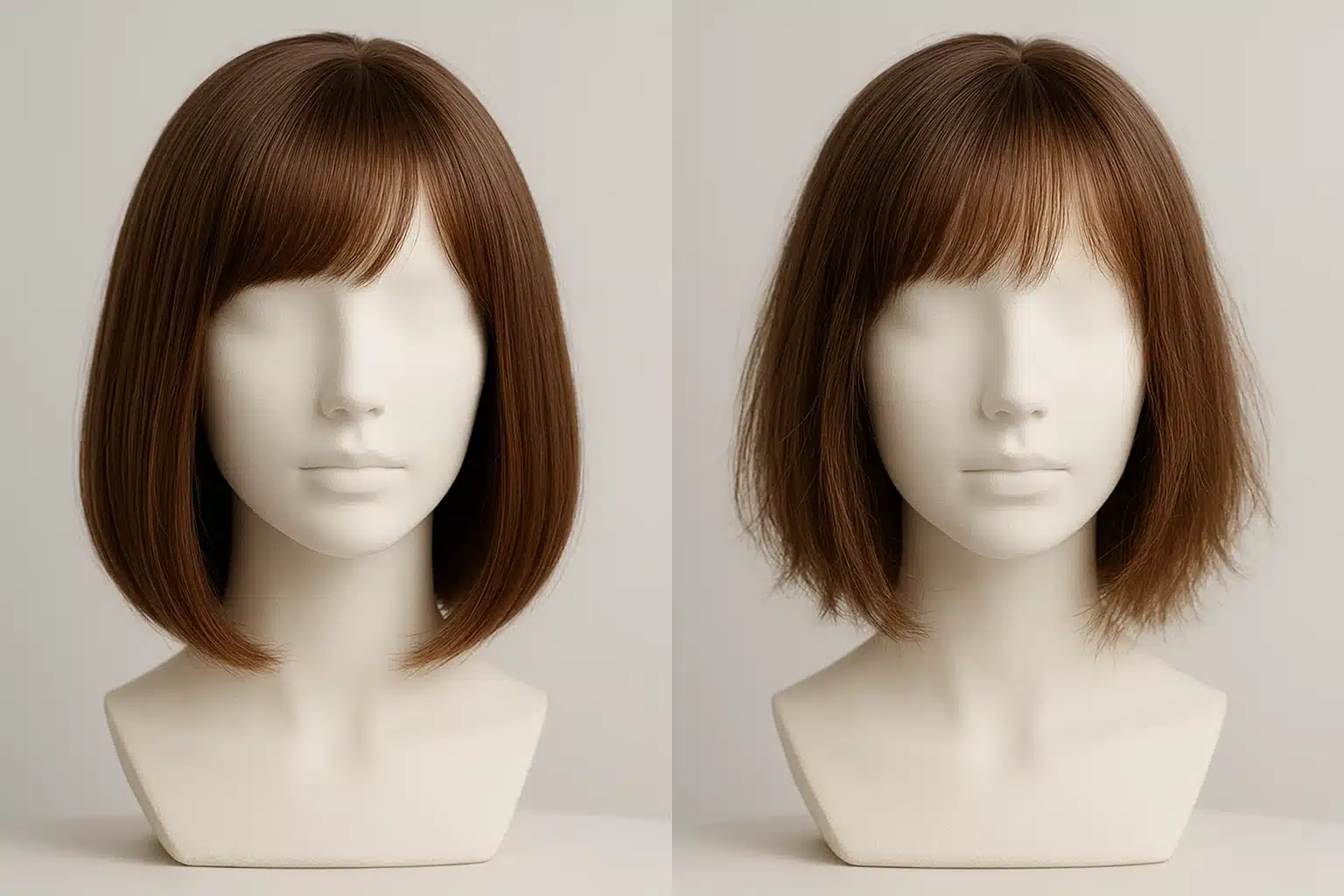
- Stage 2: The Friction Phase (Months 3-4): You’ll notice the ends feeling a bit dry, and the hairs at the nape begin to tangle easily. If you’ve ever typed “my synthetic wig is frizzy” into a search engine, you are in Stage 2. Your goal here is intervention.
- Stage 3: The Replacement Window (Months 5+): The fibers start to look dull. Tangles happen within an hour of brushing. The ends begin to resemble frayed fabric. Your goal here is transition.
The Fiber-Triage Checklist: Can This Wig Be Saved?
When you hit Stage 2 or 3, how do you know if your wig needs a spa day or a funeral? Run through this triage checklist:
Signs Your Wig Can Be Saved:
- The Tangle Test: If the tangles at the nape comb out easily with a wide-tooth comb and a silicone-based Revive Liquid, the fiber is still viable.
- The Elasticity Check: Gently pull a single frizzy fiber. If it feels smooth at the root but rough at the end, a professional steamer or hot-air brush (for heat-friendly wigs only) can smooth it back out.
- The Treatment Response: If applying the best conditioner for synthetic wigs restores its movement for more than a day, keep it in your rotation.
Signs It’s Time to Replace:
- “The Velcro Effect”: The fibers mat together at the nape mere minutes after brushing.
- Permanent Kinking: The ends of the hair look like tiny, zig-zagging crimps that do not smooth out with detangling spray.
- Loss of Factory Style: A Hi-Fashion or Noriko wig relies on its baked-in style. If the curls have permanently dropped or the permatease has flattened completely, the wig has exhausted its lifecycle.
The Strategy of Longevity: How to Triple Your Wig’s Life
If you want to stretch your budget and maintain a flawless look, standard wig care isn’t enough. You need strategy.
The most effective technique we teach our clients is “The Power of Two.”
If you wear a wig daily, buying two identical wigs and rotating them doesn’t just double their lifespan—it often triples it. Why? Because it gives the fibers time to “rest.” Synthetic memory fibers bounce back better when they aren’t subjected to continuous daily friction, body heat, and tension.
Furthermore, having a backup makes wig maintenance far less stressful. You can take your time properly washing and air-drying one wig while confidently wearing the other, completely eliminating the temptation to rush the drying process (which can permanently stretch the cap and warp the fibers).
Frequently Asked Questions (FAQ)
How often should I use detangling spray on my Rene of Paris wig?
For daily wearers, a light mist of a synthetic-safe leave-in conditioner or Revive Liquid specifically on the nape of the neck every 2-3 days is ideal. Focus only on the bottom few inches of the hair to prevent product buildup at the roots.
Can I sleep in my synthetic wig?
We strongly advise against sleeping in your wig. The friction between the wig fibers and your pillowcase will rapidly accelerate the “Friction Phase” of the synthetic lifecycle, matting the fibers and drastically reducing the wig’s lifespan.
Why do some hair colors seem to wear out faster?
“Rooted” colors or heavily highlighted synthetic blends sometimes undergo additional processing during manufacturing to achieve those beautiful, multidimensional tones. While the lifespan difference is minimal, extremely light blondes may show friction-frizz slightly faster than darker, solid brunettes.
Is it worth taking my synthetic wig to a stylist for revival?
Absolutely. If your wig is in late Stage 2, a stylist experienced with synthetic fibers can trim the frayed ends or use specialized professional steaming techniques to smooth out nape frizz, easily buying you another few months of wear.
Stepping Forward with Confidence
Navigating hair loss or simply stepping into the world of alternative hair is a deeply personal journey. Understanding how your wig behaves, why it changes over time, and how to properly care for it shouldn’t be a mystery.
By applying the 15-20 Wear Rule, protecting your wig from nape friction, and knowing exactly how to triage frizz when it happens, you empower yourself to get the absolute most out of your Rene of Paris wigs.
At Wig Superstore, our goal is to ensure that every time you look in the mirror, you see the beautiful, confident version of yourself you deserve to be. If you’re noticing the signs that your current wig has entered its “Replacement Window,” explore our collections today to find your next perfect style.