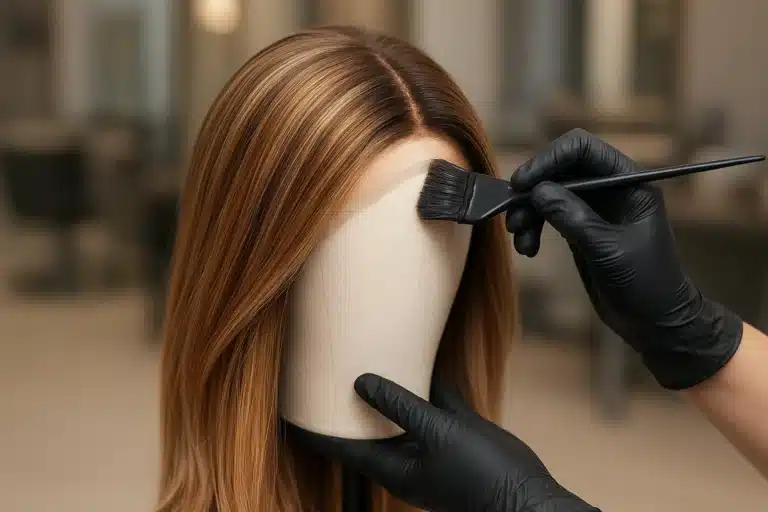
You’ve found the style you love. The cut is perfect, the length is exactly right, and the volume is just what you were looking for. Then, you scroll down to select a color, and you’re greeted with what looks like a secret password: 12FS8, RL19/23SS, or F27/613.
For many first-time wig buyers, this is the moment of hesitation. It’s easy to feel overwhelmed by the industry’s alphanumeric “shorthand,” but these codes are actually a precise roadmap designed to help you find your exact shade. Think of it as learning a new dialect—once you know the vocabulary, you can visualize exactly what that code represents. Before you can decipher the codes, Finding Your Perfect Wig Color: A Masterclass in Skin Tone Matching can help you narrow down the family of shades to look for, ensuring the color you decode will complement your complexion beautifully.
The Foundation: Understanding the Number System
While manufacturers often have their own unique artistic spin, the wig industry largely relies on a standardized numbering system to indicate color depth (how light or dark a shade is). This scale typically runs from 1 (the darkest black) to 60 (the lightest white or platinum blonde).
Think of the number as the “base” note of the color. Here is a general breakdown of the universal color families:
- 1 – 4 (The Darkest Darks): 1 is usually Jet Black, while numbers 2 through 4 range from Darkest Brown to Dark Brown.
- 6 – 12 (The Browns): This range covers everything from Chestnut and Medium Brown (6-8) to Light Golden Brown (10-12).
- 14 – 26 (The Blondes): Starting from Dark Honey Blonde (14) and moving up to Golden and Beige Blondes.
- 27 – 33 (The Reds): 27 is the standard for Strawberry Blonde, while 30-33 indicates darker Auburns and Coppers.
- 44 – 60 (Greys and Platinums): Higher numbers indicate a higher percentage of grey or white hair mixed in.
If you see a solid number like “6,” you are looking at a uniform, Medium Brown wig. However, most modern wigs use multiple colors to create dimension, which is where the letters and symbols come into play.
The Grammar of Color: Letters and Symbols
Real biological hair is rarely one solid block of color; it has dimension, movement, and variation. To mimic this, manufacturers blend specific colors together. The symbols between the numbers tell you how those colors are mixed.
The Slash (/) and The Blend
When two numbers are separated by a slash (e.g., 14/24), it indicates a blend. The colors are mixed evenly throughout the wig. A 14/24 would be a mix of Dark Honey Blonde and Pale Golden Blonde distributed equally. This technique is often used in a blend hair wig, where synthetic and human fibers might be mixed, or simply to create a soft, natural multi-tonal look using a single fiber type.
The Hyphen (-)
A hyphen usually indicates a front-to-back blend. For example, a color marked 14-24 might be darker (14) at the nape of the neck and gradually lighten to (24) near the face.
The “F” (Frosted)
If you see a code like F18/22, the “F” stands for Frosted. This is a specific type of blend that is usually more defined than a standard mix. Typically, a frosted color consists of about 80% of the base color and 20% of a lighter highlight color, giving a sun-kissed appearance without distinct streaks.
The “H” (Highlights)
Codes containing “H” indicate traditional highlighting. Unlike a blend where colors are mixed, highlight wigs feature distinct streaks of lighter color against a darker base. For example, a 12H24 would be a Light Golden Brown base with distinct Pale Golden Blonde highlights.
The “T” (Tipped)
The letter “T” signifies that the ends of the hair are a different color than the top. A code like T12/26 means the hair is Light Golden Brown at the top and transitions into a Platinum Blonde at the tips. This was a precursor to the modern ombré look.
Reading the Roots: What S, SS, and R Mean
One of the biggest innovations in making wigs look realistic is the “rooted” color. By keeping the hair darker at the base (the cap) and lighter through the length, manufacturers mimic natural hair growth, eliminating the tell-tale sign of a wig sitting “too perfectly” against the scalp.
Different brands use different shorthands for this effect, which is often where confusion arises:
- R (Rooted): A standard root, usually in a shade matching the user’s natural brow color. Example: 12/26R.
- SS (Shadow Shade): Frequently used by brands like Raquel Welch and Gabor. This indicates a softer, often slightly longer dark root that creates a “shadow” for depth.
- S (Shaded): Often used by Jon Renau to indicate their shaded colors, which provide a gradient effect similar to a sombre (soft ombré).
Advanced Class: Decoding Real-World Examples
To truly understand how this works, let’s deconstruct a few complex, popular color codes you might encounter while browsing.
Example 1: 12FS8 (Jon Renau)
This is one of the industry’s most popular blonde shades. Let’s break it down:
- 12: The primary base color is Light Golden Brown.
- FS: This stands for “Fashion Syrup,” Jon Renau’s proprietary code for a bold, modern highlight style.
- 8: The last number indicates the color of the root. In this case, the root is a Medium Brown (8), providing a natural contrast to the lighter blonde body.
Example 2: RL29/25 (Raquel Welch)
- RL: This stands for “Raquel Luminous,” indicating the specific heat-friendly synthetic fiber collection.
- 29: A Glazed Strawberry base.
- 25: A Golden Blonde highlight.
- The Slash (/): Indicates these two colors are evenly blended for a warm, reddish-blonde finish.
Why Fiber Matters in Color Coding
It is important to note that the same color code can look slightly different depending on the hair fiber. A color 613 (Platinum Blonde) in a synthetic wig may appear slightly shinier and more vibrant than a color 613 in a human hair wig. Synthetic fibers reflect light differently, often “cooling down” the color perception, while human hair absorbs light, sometimes making the color appear warmer or richer.
Frequently Asked Questions
Q: Are color codes the same for every brand?
A: The numbering system (1-60) is largely universal, but the specific tone can vary. A “4” from one manufacturer might have slightly warmer undertones than a “4” from another. The letter codes (like FS, SS, RL) are often brand-specific.
Q: What does it mean if a code has three numbers, like 33/32C?
A: This usually indicates a specific blend of three distinct shades. In this Cherry Cola example, it mixes Dark Auburn (33) and Copper Red (32) to create a deep red hue.
Q: How do I know if a color is warm or cool?
A: Generally, Goldens (12, 14, 24) and Auburns (27, 30, 33) are warm. Ashes (often denoted with an ‘A’ or codes like 101, 14/88) and Platinums (60, 613) tend to be cool or neutral.
Finding Your Match
Understanding these codes transforms the shopping experience from a guessing game into a precise selection process. Instead of wondering what a wig might look like, you can read the “recipe” of the color: seeing the base, the highlight, and the root structure in the numbers.
As you continue your journey, remember that while codes are helpful, seeing the color on a similar skin tone is invaluable. If you are ready to explore how these colors translate to different textures and styles, browsing our collections with your new “decoder ring” knowledge will help you spot the difference between a Frosted look and a Shadow Shade instantly. Happy hunting!