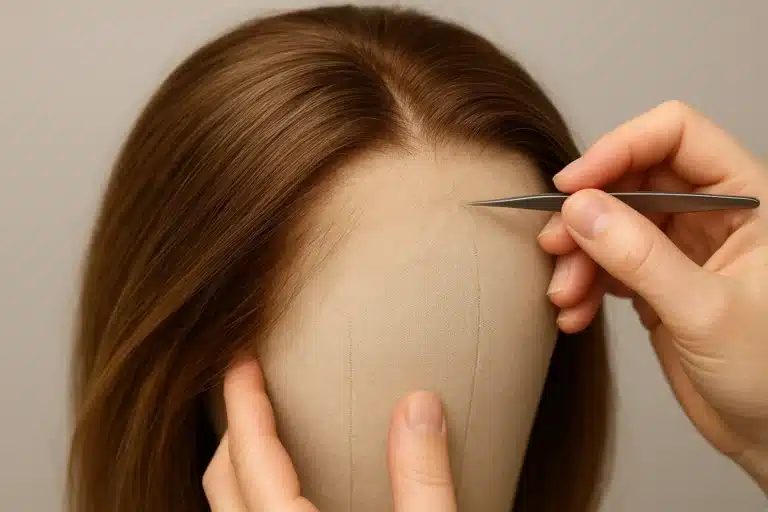
Picture this: You are out at lunch with friends, laughing at a joke, and you tilt your head back a little too enthusiastically. Suddenly, you feel it—that subtle, cool sensation of movement near your hairline or the nape of your neck. The panic is instantaneous. You freeze, wondering if everyone is staring at your hairline.
This specific anxiety is incredibly common among new wig wearers. Maintaining wigs and social confidence: interacting with the world requires feeling absolutely secure in your appearance, but unexpected shifts can happen to anyone. The good news? That “slide” often feels much more dramatic to you than it looks to anyone else. More importantly, there are proven techniques to correct it right there at the table without drawing a single eye to your hair.
The “Emergency Fix” Framework: Handling the Shift in Real-Time
When a shift happens, the natural instinct is to grab the wig with both hands and yank it back into place. Resist this urge. That movement signals to the room that something is “wrong.” Instead, use these natural, everyday gestures to make corrections invisible to the untrained eye.
1. The Head-Scratch Nudge
This is the most versatile move in your arsenal. If you feel your wig has slid back slightly, simply raise your hand to “scratch” an itch at your hairline or temple.
- How to do it: Place your fingertips on the edge of the wig cap (the hard edge, not just the hair). As you mimic a scratching motion, use your thumb or palm to apply gentle, upward or forward pressure to nudge the cap back to its original position.
- Why it works: It’s a universally understood body language cue. No one questions an itch, and it gives you cover to apply the necessary friction to move the unit.
2. The Hair-Tuck Readjustment
This technique is perfect for side-to-side shifts and utilizes the “ear tabs”—the structural pieces of the wig that sit just in front of your ears.
- How to do it: Use a sweeping motion to tuck your hair behind your ears. As your hand passes your ear, locate the ear tab. Firmly grip the tab with your thumb and forefinger and give it a micro-tug downward and toward the center to re-center the wig.
- Why it works: Tucking hair is a grooming habit many people do dozens of times a day. It looks entirely passive but allows you to access the wig’s structural anchor points.
3. The “Reflection Check”
If the shift feels significant and you aren’t confident doing it by feel, do not rush to the bathroom immediately, as abrupt exits can draw attention. Instead, use your environment.
- How to do it: Glance at a shop window, a powered-off TV screen, or calmly check your phone’s selfie camera (pretending to check a text).
- Why it works: It confirms whether the shift is actually visible. 90% of the time, the “shift” is a sensory illusion caused by a change in temperature or sweat, and the wig hasn’t actually moved visually. Confirmation calms the panic.
The “Why” Phase: Understanding the Slide
Once you are back in a safe space, it is crucial to understand why the shift happened so you can prevent it. While many beginners blame the size of their head or the quality of the wig, the culprit is usually much simpler.
The 70% Rule
Industry research suggests that up to 70% of wig slippage is caused by improperly adjusted internal straps.
Inside the nape of almost every high-quality wig, there are adjustable straps (usually Velcro or hook-and-eye). Many wearers assume the wig comes “ready to wear” out of the box, but these straps are designed to be customized. If they are too loose, the wig lacks the tension needed to grip the occipital bone (the bone at the base of your skull). If they are too tight, the wig will “pop” up like a rubber band snapping back. Finding that “Goldilocks” zone of tension is the single most effective way to prevent public slippage.
Building Your Security System
If you have adjusted your straps and still feel insecure, especially on windy days or during active events, you may need to introduce a “security layer” between your biological scalp and the wig cap.
- Wig Grips: These are velvet or silicone bands worn under the wig. The friction of the velvet against the wig cap creates a nearly slip-proof bond without using any chemicals. For many, this is the “magic bullet” for comfort and security.
- Wig Tape: Double-sided medical-grade tape can be applied to the polyurethane tabs inside the wig (never directly on the delicate lace/monofilament unless specified). A small piece at the hairline and behind the ears provides an anchor that withstands movement.
- Proper Hair Prep: If you have biological hair underneath, how flat it lays matters. If your hair is bunched up unevenly, the wig sits on a “hill,” making it prone to sliding. distributing your hair evenly using a wig cap ensures the wig sits flush against your head shape.
The Pre-Flight Checklist
To ensure you never have to use the “Head-Scratch Nudge” again, run through this mental checklist before leaving the house:
- The Shake Test: Before putting the wig on, hold it and ensure the hair moves freely. After putting it on, shake your head vigorously from side to side. Does it move? If yes, tighten the straps.
- The Ear Tab Check: Are the ear tabs level? If one is higher than the other, your wig is crooked.
- The Friction Check: If you aren’t using tape, do you have a wig grip or sufficient tension at the nape?
Frequently Asked Questions
Can I fix my wig without a mirror?
Yes. The best reference points are your eyebrows and ears. Place four fingers on your forehead; your hairline should typically start where your top finger ends. For centering, ensure the ear tabs are equidistant from your eyes.
What if my wig feels loose but the straps are fully tightened?
If the straps are maxed out and the wig still slides, the cap size is likely too large for your head measurements. You may need a petite cap size or a professional alteration to take in the excess material.
Will wind blow my wig off?
A properly fitted wig is surprisingly aerodynamic. While wind can blow the hair around (messing up the style), it is very unlikely to lift the cap off your head unless the wig is significantly too big or completely unsecured.
Is it okay to touch my wig in public?
Absolutely. People touch their biological hair constantly—twirling it, smoothing it, scratching their scalp. The key is to touch it with confidence. If you touch it nervously, people notice. If you touch it casually, it’s just hair.
Confidence comes from preparation. By understanding the mechanics of how your wig fits and having a few subtle adjustment tricks up your sleeve, you can focus on your life, your conversations, and your experiences—not your hairline.