You’ve likely experienced that specific moment of anticipation: you unbox a beautiful new wig, shake it out, and place it on your head, only to feel it looks a bit… heavy. Perhaps it feels like there is too much hair around your eyes, or the style sits like a “helmet” rather than flowing naturally. This is a nearly universal experience for wig wearers, yet it often leads to unnecessary disappointment.
Here is the secret most retailers won’t tell you upfront: high-quality wigs are often manufactured with extra density and length specifically to allow for customization. That heavy feeling isn’t a defect; it’s a blank canvas. Turning that “out of the box” density into a style that feels like you requires understanding advanced wig cutting and layering techniques. By mastering a few key principles of face-framing, you can transform a standard wig into a bespoke piece that highlights your best features.
The Psychology of the Cut: Why Layers Matter
Before you pick up a pair of shears, it is vital to understand the “why” behind face-framing layers. Layers are not simply about shortening hair; they are about creating optical illusions and visual balance.
A wig without layers has a “solid form,” meaning all the hair falls to the same perimeter line. This creates weight at the bottom, which can drag down facial features and make the wig look artificial. Soft layers around the face break up this solid line. They create movement, allowing the hair to sweep away from the eyes and cheekbones, imitating the natural growth patterns of biological hair. This feathering effect is what bridges the gap between wearing a wig and “owning” a style.
The Toolkit: Preparation is Everything
One of the most common mistakes beginners make is using the wrong tools. Cutting wig fiber—whether synthetic or human hair—requires precision. Standard kitchen scissors push the hair before cutting it, leading to jagged, uneven lines.
To achieve a professional finish, you need a specific toolkit:
- Sharp Hair Shears: For the primary structure and length removal.
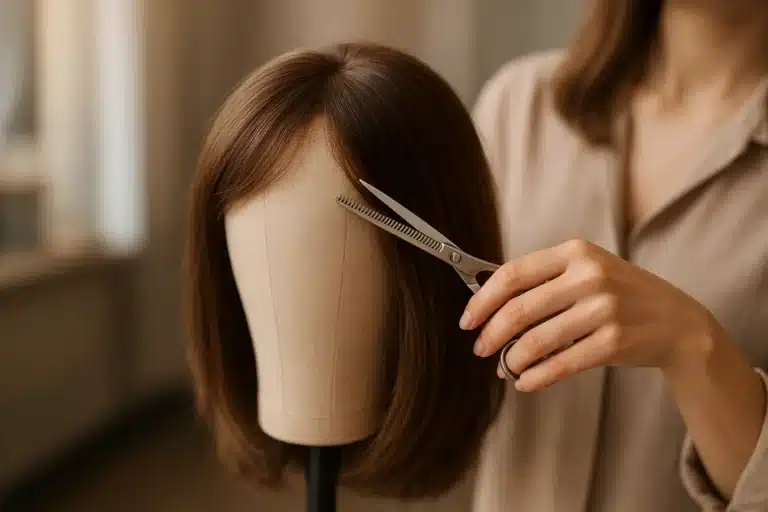
- Thinning Shears: The MVP of wig customization. These remove bulk without removing length, essential for blending layers.
- A Razor Comb: Excellent for synthetic wigs to create tapered, soft ends rather than blunt, chunky lines.
- Sectioning Clips: To keep your workspace clean and organized.
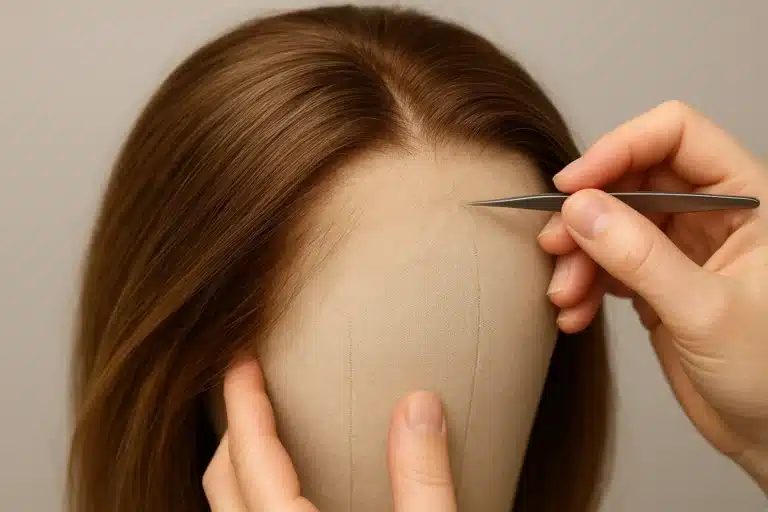
- A Canvas Block Head: While you can cut a wig on your own head, a block head allows you to see the symmetry from all angles.
Decoding Your Face Shape: The “How-To-For-You”
Not all layers are created equal. The most flattering cut depends entirely on the geometry of your face. The goal of face-framing is to create an oval silhouette, generally considered the most balanced shape.
The Round Face Strategy
If you have a round face, your goal is elongation. You want to avoid layers that end right at the chin, as this widens the face. Instead, aim for long, sweeping layers that start below the jawline. This draws the eye downward, creating a vertical line that slims the cheeks.
The Square Face Strategy
Square faces have strong, beautiful jawlines that can sometimes look severe with a blunt cut. The objective here is softening. You want curved, textured layers that feather in around the cheekbones and jaw. Avoid sharp, straight lines; think wispy and graduated.
The Heart Face Strategy
Heart-shaped faces are wider at the forehead and narrower at the chin. To balance this, you want layers that add volume and width around the jawline. Medium length hair with layers that kick out slightly at the bottom can be incredibly flattering, filling in the space around the chin.
The Oval Face Strategy
If you have an oval face, you have the most versatility. You can pull off dramatic face framing layers that start as high as the lip or as low as the collarbone. Your focus should be on highlighting your favorite feature—start the layers at the cheekbone to accentuate your eyes, or at the chin to define your jaw.
The Technique: Graduation and Slide Cutting
The difference between a choppy, amateur cut and a seamless style lies in the cutting technique. Never cut a wig straight across horizontally. This creates “steps” in the hair that look unnatural and are difficult to blend.
The Slide Cut Method
The industry standard for face-framing is “slide cutting.”
- Sectioning: Isolate the front one inch of the hairline on both sides. Clip the rest of the hair back.
- The Guide: Determine your shortest point (e.g., the chin).
- The Motion: Hold the shear blades partially open. Instead of opening and closing the blades, slide them down the shaft of the hair from your starting point toward the ends.
- The Result: This removes hair gradually, creating a tapered point rather than a blunt end.
If you are styling a curly hair shag or a wavy wig, be mindful of the “bounce factor.” Curly hair sits shorter when dry and styled than it does when pulled taut. Always cut curly wigs dry and in their natural formation to avoid cutting them too short.
Color and Dimension Considerations
Layers do more than just shape the hair; they reveal the architecture of the wig’s color. This is particularly true for rooted colors or highlighted styles. When you cut layers into a short bronde balayage, for example, you expose the lighter ends against the darker interior or roots. This adds immense depth and makes the wig look denser and more luxurious.
However, be cautious with highlighted wigs. Ensure your layers don’t chop through a highlight in a way that makes it look like a spot or a stripe. Check the color placement before you make your cut.
Troubleshooting Common Mishaps
Even with careful planning, mistakes happen. The good news is that most wig cutting errors are fixable.
- Problem: The layers look “blocky” or “shelf-like.”
- Solution: Use thinning shears on the ends of the layers (the last 1 inch). Cut vertically into the hair, not horizontally. This diffuses the hard line.
- Problem: One side is shorter than the other.
- Solution: Don’t keep cutting the longer side to match; you risk going too short. Instead, visually balance the longer side by increasing the texture/thinning, which makes the length discrepancy less unmatched to the naked eye.
- Problem: The ends look frayed (Synthetic only).
- Solution: Synthetic fiber can frizz if cut with dull scissors. Use a steamer on the ends to smooth the fiber back down after cutting.
Frequently Asked Questions
Can I use regular paper scissors on my wig?
No. Paper scissors are not sharp enough to slice through hair fibers cleanly. They will bend the hair before cutting it, resulting in frayed ends that tangle easily and look damaged.
Should I cut my wig wet or dry?
Always cut wigs dry. Unlike biological hair, synthetic fiber does not stretch when wet, but the weight of water can distort the curl pattern. Cutting it dry allows you to see exactly how the style will sit instantly.
How do I know where to start my first layer?
A safe “rule of thumb” is the chin. It is easier to go shorter later, but you cannot add hair back. Start your shortest layer at the chin, and if you feel comfortable, you can graduate it up to the cheekbone or lip line.
Will cutting layers ruin the fiber of a synthetic wig?
Not if done correctly with sharp tools. In fact, removing bulk from the ends can actually reduce friction against your clothing, potentially extending the lifespan of the wig by preventing nape tangles.
Taking the Next Step
Customizing your wig is a journey of confidence. It shifts your mindset from “wearing a wig” to “styling your hair.” If you are new to this, practice on an older wig that you are ready to retire. Get a feel for how the fiber responds to your shears.
Remember, the goal of face-framing layers is not perfection; it is personalization. By tailoring the hair to your unique bone structure, you create a seamless integration that makes the wig undetectable and uniquely yours.
For more insights on maintaining your customized style, explore our guide on wig maintenance to keep your layers looking fresh and defined.