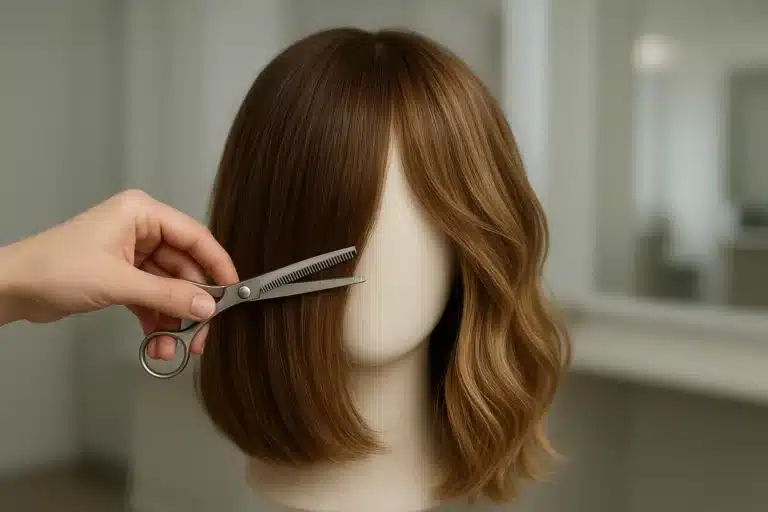
We have all experienced that specific moment of hesitation: you are looking at a wig that used to be your absolute favorite. It has carried you through confident workdays and elegant evenings, but now, the ends are looking a bit frayed, or the style feels slightly dated compared to current trends. Or perhaps you have just unboxed a new piece that is stunning but feels just a little too heavy around the face.
Instead of retiring that beloved hairpiece or settling for a “good enough” fit, consider the transformative power of customization. With the right approach and a bit of courage, you can use advanced wig cutting & layering techniques to completely transform an old piece, breathing new life into fibers you thought were past their prime. Learning to reshape and restyle is not just about maintenance—it is about reclaiming your confidence and making a style uniquely yours.
The Art of Revitalization: Why Customize?
Many wig wearers assume that once a wig begins to show signs of wear—specifically the “friction fizz” at the nape of the neck or dry ends—it is time to discard it. However, viewing your wig as a renewable resource changes everything. By removing damaged ends or adding layers to change the silhouette, you can extend the lifespan of a wig by months or even years.
Furthermore, most wigs come with a “factory density.” While high quality, this density is often uniform. Natural biological hair, however, varies in density and length. Customizing a wig removes that “heavy” look, allowing the hair to move more naturally and frame your specific facial features.
The 5 Golden Rules of Wig Cutting
Before you pick up a pair of shears, it is vital to understand that cutting a wig is fundamentally different from cutting biological hair growing from a scalp. Biological hair grows back; wig fiber does not. This high-stakes reality requires a specific set of rules to ensure success.
1. Know Your Fiber: Synthetic vs. Human Hair
This is the most critical distinction in your revitalization journey.
- Synthetic Hair: These fibers are essentially fine plastic filaments. They are incredibly durable but unforgiving to dull blades. You must use sharp, high-quality shears designed for hair. Standard craft scissors will “chew” the fiber, leading to frayed ends that tangle instantly.
- Human Hair: This offers more flexibility and moves like your own hair. While it is more forgiving of cutting techniques, it requires the same respect you would give a salon cut.
2. The Dry Cut Rule
Never cut a wig while it is wet. Biological hair stretches when wet and shrinks when dry. Synthetic fibers do not behave exactly the same way, but the weight of water distorts the shape and length. To see exactly how the style will fall, you must cut the wig while it is completely dry and styled in the texture you intend to wear (straight, wavy, or curly).
3. The Tool Kit
You cannot achieve a professional result with kitchen tools. Your restoration kit should include:
- Stainless Steel Hair Shears: For the main length.
- Thinning Shears: To debulk heavy areas without losing length.
- A Canvas Block Head & T-Pins: You need to see the wig in 3D, not lying flat on a table.
- Wide-Tooth Comb: For sectioning without stretching fibers.
4. Stability is Key
Trying to cut a wig while it is on your own head is a recipe for disaster. It is nearly impossible to get the angles right at the back. Secure your wig to a canvas block head using T-pins (place them through the velvet ear tabs and the nape, avoiding the delicate lace front). This allows you to walk around the wig and view the style from every angle.
5. The “Less is More” Philosophy
You can always cut more, but you can never add it back. When revitalizing an older wig, start by taking off only a quarter of an inch. Often, removing just the micro-frizz at the very tips is enough to make the hair move fluidly again.
Advanced Techniques to Modernize a Style
Once you have mastered the basics, you can move from simple trimming to actual restyling. These techniques are the difference between a wig that looks “cut” and one that looks “styled.”
Point Cutting for Soft Edges
If you cut a section of hair straight across (blunt cutting), you will create a hard, chunky line that looks artificial—especially on synthetic wigs.
- The Technique: Hold a section of hair between your fingers. Instead of holding the scissors horizontally, hold them vertically, pointing up into the hair. Snip small “V” shapes into the ends.
- The Result: This diffuses the line, creating a soft, feathered edge that mimics natural hair growth.
De-Bulking with Thinning Shears
Does your wig look like a “helmet”? This often happens because there is too much density at the crown or mid-lengths.
- The Technique: Lift the top layer of hair and pin it away—never use thinning shears on the very top layer, or you will see short, spiky hairs. Work on the layers underneath. Take a section, place the thinning shears about 2 inches from the ends, close them once, and glide out.
- The Result: The wig lies flatter against the head and looks significantly more realistic.
Face-Framing Layers (Slide Cutting)
This is the secret to making a generic style look like it was made for you.
- The Technique: Determine where you want the shortest layer to hit (usually cheekbone or chin). Open your shears slightly and, without fully closing them, gently slide them down the hair shaft from that point toward the ends.
- The Result: A seamless cascade of hair that highlights your bone structure.
Troubleshooting: The Wig ER
Even with the best intentions, mistakes happen. Or perhaps you are inheriting a wig that was poorly cut by someone else. Here is how to salvage the situation.
The Issue: Chunky, Uneven Layers.
- The Fix: Do not try to cut them straight to match. Use the Point Cutting technique mentioned above to soften the blunt edges of the short layers. Then, use a curling iron (if heat-friendly) or steam to curl the hair. Curls hide a multitude of cutting sins by blending the lengths together.
The Issue: You Cut the Bangs Too Short.
- The Fix: You cannot grow them back, but you can change the style. Use steam or low heat to sweep the bangs to the side. A “side-swept” bang can be much shorter than a full fringe and still look intentional and chic.
The Issue: Frayed Ends on an Old Favorite.
- The Fix: This is the most common aging issue. The friction from collars causes the nape fibers to kink. Be brave—transform that long style into a sleek, long bob (lob). By cutting off the bottom 2-3 inches where the damage is concentrated, you effectively get a brand new wig.
Frequently Asked Questions
Q: Can I use regular craft scissors if they are sharp?
A: We strongly advise against it. Paper scissors have a different blade bevel that crushes the hair fiber rather than slicing it. This leaves a jagged edge on the fiber that leads to rapid tangling and frizz, effectively ruining the wig faster.
Q: How do I know if my old wig is worth saving?
A: Check the cap construction first. If the lace front is torn or the wefts are unraveling, cutting the hair won’t fix the structural integrity. However, if the cap is solid and the fiber is just frizzy or dry at the ends, it is an excellent candidate for a restorative cut.
Q: Will cutting the fiber make it unravel?
A: No. Wig fibers are individually tied or sewn into wefts. Cutting the fiber length does not affect the knot or the weft attachment. However, be careful not to cut into the actual cap material or the threads holding the wefts together.
Q: I’m nervous. What is the safest cut to start with?
A: Start with “dusting.” This involves taking only 1/8th of an inch off the very bottom ends. It removes the driest part of the fiber and instantly improves how the hair combs through, with almost zero risk to the style.
Conclusion
Re-cutting and styling your wig is a journey of creativity. It shifts your perspective from being a passive wearer to an active stylist of your own look. Whether you are rescuing a beloved piece from the back of the closet or customizing a new purchase to perfection, the goal is always the same: to feel beautiful, comfortable, and undeniably you.
Remember, every expert started as a beginner. Take your time, use the right tools, and trust your eye. Your perfect style is just a few snips away.