We’ve all had that moment in front of the mirror. The wig is perfectly styled, the color is radiant, but a knot of anxiety tightens in your stomach. It’s the “threshold moment”—that split second before you step out the door where the fear of the unknown creeps in. Will it slip? Will they notice? Do I look like myself?
These feelings are valid and universally shared among wearers, from beginners to veterans. While a high-quality wig provides the aesthetic solution, true confidence requires a different kind of preparation. It requires cultivating holistic well-being beyond the wig, grounding yourself in strategies that support your mental and emotional health just as much as your physical appearance.
The Psychology of the “Confidence Gap”
Why do these days happen? Psychologists often refer to the “spotlight effect”—the phenomenon where we believe people are paying far more attention to our appearance than they actually are. When you are wearing a wig, this effect can feel amplified.
Research indicates that hair loss is not merely a cosmetic issue; it significantly impacts psychological quality of life. A study published by the National Institutes of Health (NIH) highlights that for many, wigs are a crucial coping mechanism that restores social functioning. However, the gap between owning a wig and feeling comfortable in it—the “Confidence Gap”—can only be bridged with intentional mental and practical preparation.
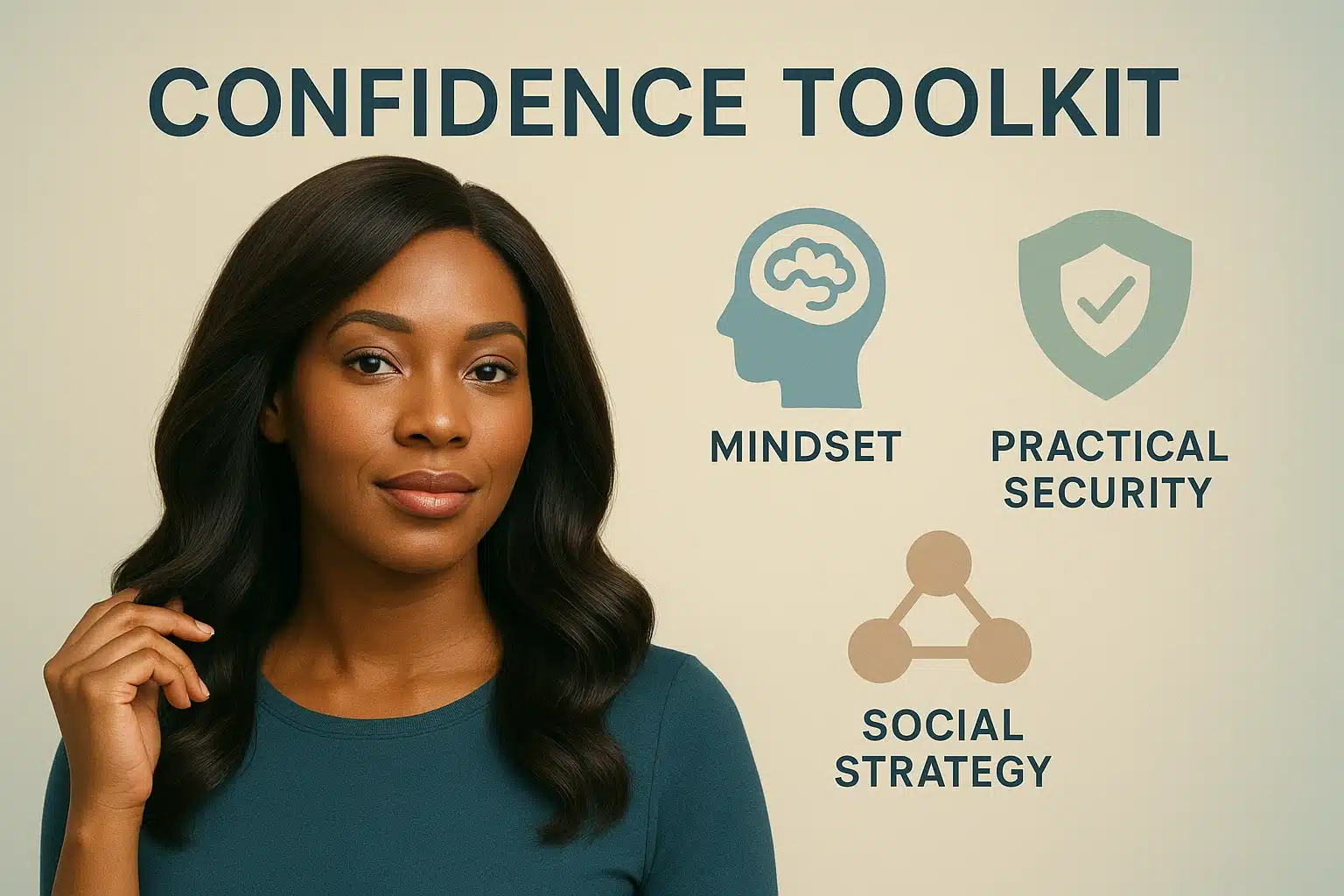
That is where your Confidence Toolkit comes in. This isn’t just a metaphor; it is a structured system comprising three pillars: Mindset, Practical Security, and Social Strategy. By assembling this toolkit, you turn a vague hope for a “good hair day” into a repeatable plan for resilience.
Pillar 1: Mindset Preparation (The Internal Anchor)
Confidence starts before you even put the wig on. Your mindset preparation is about cognitive reframing—shifting your narrative from fear to agency.
The “Why” Visualization
Before reaching for your wig, take two minutes to visualize your “Why.” Are you wearing this to feel professional at work? To feel elegant at a dinner? To feel like you again?
- The Exercise: Close your eyes and picture yourself moving through your day successfully. See yourself smiling, engaging in conversation, and forgetting about your hair entirely. Athletes use this visualization technique to improve performance; you can use it to improve comfort.
Affirmations that Resonate
Generic affirmations often fall flat. Instead, create specific mantras that address your fears directly:
- Instead of: “I am beautiful.” (Which you might not believe on a hard day).
- Try: “I am taking care of myself today.” or “My comfort is my priority, and I am in control of my appearance.”
Pillar 2: Practical Security (The Physical Anchor)
Anxiety often stems from mechanical fears: the fear of shifting, slipping, or unnatural movement. Your toolkit must include practical checks that eliminate these “what-ifs.”
The Security Checklist
Eliminate the variables that cause doubt. Create a mental or physical checklist for every application:
- The Grip Check: Have you adjusted the velvet nape tabs? If you use a wig grip band, is it positioned exactly at the hairline?
- The Shake Test: Once applied, give your head a gentle shake. If the wig moves independently of your scalp, adjust the tension. If it moves with your scalp, it is secure.
- The “Emergency” Kit: Confidence comes from knowing you can handle a malfunction. Carry a small pouch with:
- A travel-sized wide-tooth comb.
- Fashion tape or extra adhesive (if you use it).
- A chaotic-day backup (a stylish headscarf or halo hairpiece) just in case you need to remove the wig entirely.
Pillar 3: Social Strategy (The Interaction Anchor)
Perhaps the biggest hurdle is the social element. What if someone compliments me? What if someone asks? Being caught off guard can trigger anxiety. The solution is pre-scripted responses.
The Script Menu
Prepare responses for different scenarios so you never have to improvise under pressure.
Scenario A: The Compliment (“I love your hair!”)
- The Deflector: “Thank you! I just had it styled.” (True, effective, and moves the conversation along).
- The Owner: “Thanks! It’s one of my favorite wigs. It makes getting ready so easy.” (Confident and honest).
Scenario B: The Intrusive Question (“Is that a wig?”)
- The Short & Sweet: “Yes, it is.” (Delivered with a smile and immediate subject change).
- The Educational: “Yes, I’m dealing with some hair loss, and wearing this helps me feel like myself. Thanks for asking.”
Having these scripts ready acts as a shield. You aren’t worried about what to say because the lines are already written.
The ‘Graded Exposure’ Method: Your Training Missions
If you are new to wigs, or returning after a break, don’t aim for a wedding or a high-stakes presentation as your first outing. Psychologists use “graded exposure” to overcome anxiety—starting small and building up.
Treat your early outings as training missions for your Confidence Toolkit:
- Level 1: The Solo Mission. Wear your wig around the house for 2 hours. Get used to the reflection in the mirror.
- Level 2: The Low-Stakes Errand. Go to a grocery store or gas station in a different neighborhood. These are brief interactions with strangers you likely won’t see again.
- Level 3: The Trusted Friend. Meet one supportive person for coffee. This tests your social comfort in a safe environment.
- Level 4: The Debut. Work or a larger social gathering. By the time you reach this stage, you have proven to yourself that the wig stays on and the world keeps turning.
In-the-Moment Rescue Strategies
Even with the best toolkit, waves of self-consciousness can hit. When you are out and feel the panic rising, use these grounding techniques:
- The 5-4-3-2-1 Method: Acknowledge 5 things you see, 4 you can touch, 3 you hear, 2 you smell, and 1 thing you taste. This snaps your brain out of internal anxiety and back into the external reality.
- The Mirror Check: Find a restroom. Look in the mirror—not to critique, but to validate. Usually, the wig looks perfectly normal, and the anxiety was a false alarm. Re-center your wig if needed, take a deep breath, and reset.
Frequently Asked Questions
What if I just can’t get comfortable today?
That is okay. Listen to your body. Some days are “hat days” or “scarf days.” Forcing confidence when you feel fragile can lead to negative associations with your wig. Respect your emotional bandwidth.
Will people know I’m wearing a wig?
Modern synthetic and human hair wigs are technologically advanced, often featuring monofilament tops and lace fronts that mimic natural hair growth. Unless someone is a professional stylist standing inches away, it is highly unlikely they will notice anything other than great hair.
How long does it take to stop feeling self-conscious?
It varies for everyone. For some, it’s a few weeks; for others, a few months. Consistent wear and using the “Graded Exposure” method described above will speed up this process significantly.
Your Journey, Your Pace
Building a Confidence Toolkit isn’t about becoming a different person; it’s about equipping the person you are to navigate the world with your head held high. Whether you are wearing a wig for medical reasons or fashion, remember that the most beautiful thing you wear is your resilience.
Start small. Build your scripts. Check your security. And remember, we are here to support you every step of the way.