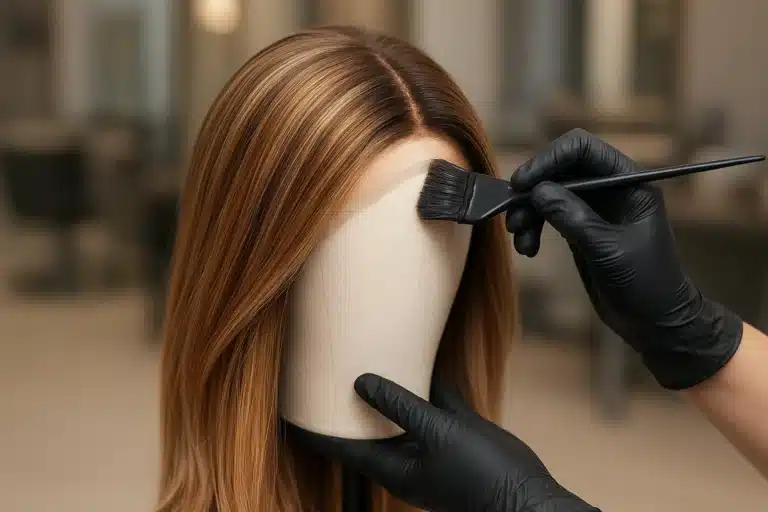
If you have ever found yourself staring at a diagram of geometric shapes—trying to decide if you are a “heart,” a “diamond,” or a “square”—only to feel more confused than when you started, you aren’t alone. Most beauty advice forces you into a box, but real faces have unique nuances that don’t always fit into a single category. Perhaps you love your prominent cheekbones but feel self-conscious about a higher hairline, or maybe you have a strong, sculpted jawline that you want to soften just a touch.
Finding the right hair system isn’t about changing who you are; it is about understanding the art of balance. While we created our complete Wig Styling for Your Face Shape: The Definitive Guide to cover the basics, sometimes you need advice tailored to specific features rather than general categories. By focusing on your unique traits, you can select a wig that creates immediate harmony, framing your face in a way that feels natural and authentically you.
The “Rule of Opposites”: The Secret to Visual Balance
Before diving into specific features, it helps to understand the one fundamental principle used by professional stylists: the Rule of Opposites.
The concept is simple: if you have a “hard” feature (like an angular jaw), you balance it with a “soft” style (like waves). If you have a “long” feature (like a high forehead), you balance it with a “shortening” element (like bangs or volume at the sides). When you stop looking for the “perfect” wig and start looking for the style that provides a counter-balance to your specific features, the overwhelming number of choices suddenly becomes manageable.
Styling for a High Forehead
A high forehead is a common concern for many looking into wigs, but it is also one of the easiest features to balance. The goal here is twofold: to visually shorten the distance between the hairline and eyebrows, and to ensure the wig hairline looks undetectable.
The Power of the Fringe
Bangs are the ultimate tool for high foreheads. They instantly create a new frame for the face. However, you don’t need to commit to heavy, blunt bangs, which can sometimes look severe or “wiggy” if they are too dense.
- Wispy, Side-Swept Bangs: These cut across the forehead diagonally, breaking up the vertical space without covering it completely. This creates a soft, romantic look.
- Curtain Bangs: Trending heavily in recent years, these part in the middle and drape down the sides of the face, effectively narrowing the forehead while keeping the face open.
The “Four-Finger” Placement Rule
A common mistake beginners make is pulling the wig too far down to “hide” their forehead. This actually has the opposite effect—it distorts your facial proportions and makes the wig look unnatural.
A good rule of thumb is the Four-Finger Rule: place four fingers horizontally above your eyebrows. Your wig’s hairline should generally sit just above your top finger. If you prefer a style without bangs, front lace wigs are essential. The sheer lace material blends with your skin, creating the illusion of natural hair growth, allowing you to sweep the hair back confidently without a harsh transition line.
Softening a Strong Jawline
A strong, square, or angular jawline is a striking feature—think of the classic Hollywood structures. However, if your goal is to soften that angle to create a gentler aesthetic, the texture of the hair becomes your best friend.
Texture Over Length
The worst enemy of a strong jawline is a blunt cut that hits exactly at the chin. This draws a horizontal line right across the widest part of the jaw, emphasizing the width. Instead, look for:
- Soft Waves and Curls: Waves add movement and curve, which visually breaks up the straight lines of a square jaw.
- Long Layers: Layers that begin below the chin draw the eye downward, elongating the neck and softening the face’s lower corners.

As seen in the style above, long, loose waves act as a diffuser. They create a shadow play around the face that blurs sharp edges, providing a feminine, effortless look.
Balancing Broad Cheeks
If your cheekbones are the widest part of your face, you might feel that certain wigs make your face look “round” or fuller than it is. The objective here is elongation—drawing the eye vertically rather than horizontally.
Volume at the Crown
To counter width, you need height. Wigs with a little bit of “lift” or volume at the crown (the top back part of the head) subtly lengthen the appearance of the face.
- The Long Bob (Lob): A sleek, straight lob that ends at the collarbone is fantastic for broad cheeks. The straight vertical lines act like curtains, slimming the sides of the face.
- Avoid “Ear-Muff” Volume: Be careful with styles that have excessive volume right at the ear level, as this adds width exactly where you already have it.
The “Big Head” Fear: Why It Happens and How to Fix It
One of the most common anxieties for beginners is the fear that a wig will look bulky or make their head look unnaturally large. This is rarely about your face shape and almost always about density (how thick the hair is) and fit.
Understanding Density and Realism
Many synthetic wigs are made with 130% to 150% density, which is thicker than the average biological head of hair. If you have delicate facial features, a high-density wig can overpower you.
- Look for “Light” Density: Some collections are specifically designed with lower density for a more realistic drape.
- Customization is Key: Just like a tailored suit, a wig often needs adjustment. Learning how to make wigs look real often involves taking the piece to a stylist who can thin out the bulk, ensuring the hair lays flat against the head rather than puffing out “helmet-style.”
Practical Adjustments
If a wig feels too “poofy” at the top:
- Use Heat (Carefully): For heat-friendly synthetic wigs, using a hot comb or the warmth of your hands can help flatten the hair at the part line.
- Check Your Foundation: Ensure your biological hair is wrapped as flat as possible underneath. A bulky wig cap setup will create uneven bumps.
Continuing Your Journey
Understanding your facial features is the first step toward wig confidence. Remember, these are guidelines, not laws. If you love a style that “breaks the rules” but makes you feel beautiful, that is the right style for you. Confidence is the ultimate beauty filter.
As you explore different styles, you may find you want to alter a wig to better suit your specific needs. Whether it’s trimming bangs for a high forehead or adding face-framing layers for a strong jaw, advanced wig cutting layering techniques can transform a standard wig into a custom piece. Furthermore, proper wig maintenance ensures that the volume and texture you chose to balance your features stay intact over time.
Frequently Asked Questions
Q: Can I wear a ponytail if I have a high forehead?
A: Absolutely. The key is using a lace front wig. The lace creates a seamless transition at the hairline. To balance the forehead, try pulling the hair back loosely and leaving a few wispy strands or “baby hairs” pulled out around the temples to soften the look.
Q: Will a wig with bangs look fake?
A: Actually, bangs are often the most realistic option for beginners! Because they cover the hairline (the hardest part of a wig to make look natural), they require less work to disguise.
Q: I have a strong jaw, but I want short hair. What should I do?
A: You can definitely wear short hair. Instead of a blunt bob, try a textured pixie cut with some height at the crown and longer, side-swept bangs. The volume on top elongates the face, balancing the jawline without hiding it.
Q: How do I know if a wig is too dense for my face?
A: Put the wig on and look at the part line. If the hair seems to stand straight up or creates a “mushroom” effect, it may be too dense. Also, touch the hair—if it feels significantly thicker than your biological hair used to be, you might benefit from having a professional thin it out.