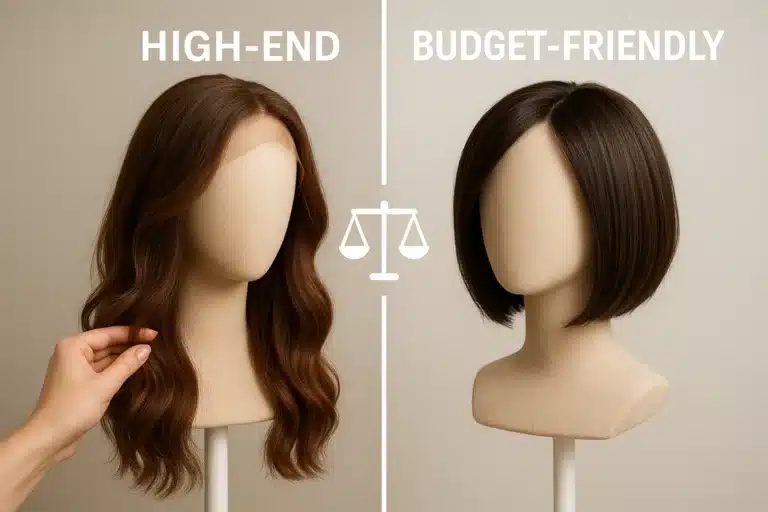
Have you ever looked at a wig online, loved the style, but felt that something about the hairline just looked… “wiggy”? It’s a common frustration. You see a dense, straight line across the forehead that looks more like a helmet than a hairstyle. Then, you find a unit that looks completely natural—as if the hair is growing directly out of the scalp—but the price tag is significantly higher.
This price difference often comes down to the invisible labor of customization. High-end wigs aren’t just manufactured; they are sculpted. Understanding the value behind a premium unit often requires decoding wig pricing and a granular analysis of cost factors to see where your money is actually going. It isn’t just about the hair quality; it is about the hours of skilled artistry required to mimic nature.
In this guide, we will pull back the curtain on the three “invisible” features that drive up the cost—and realism—of your wig: bleached knots, pre-plucked hairlines, and baby hairs.
The High Price of “Invisibility”
In the world of premium wigs, you are often paying for what you don’t see. A standard, machine-made wig focuses on durability and volume. A hyper-realistic wig, however, focuses on “negative space”—creating the illusion of skin, scalp, and natural growth patterns.
Achieving this requires a transition from factory manufacturing to artisanal craftsmanship. It turns a standard hairpiece into a bespoke prosthetic. Let’s break down exactly what happens in the workroom to justify that premium.
Bleached Knots 101: From Black Dots to Scalp Melt
To make a lace wig, individual strands of hair are tied onto a mesh base using a tiny knot. This process is called “ventilation.” If the hair is dark, that knot appears as a tiny black dot against the lace. When you have thousands of these dots gridlocked together, it creates a visible “screen door” effect that screams “this is a wig.”
The solution is bleaching the knots, a chemical process that lightens the knot so it blends with the lace and your skin tone.
The “Toothpaste” Technique and Risk
This isn’t as simple as applying hair dye. Wig artisans must mix bleach and developer to a very specific, thick consistency—industry pros often compare it to toothpaste. This thickness is crucial because if the mixture is too runny, it will seep through the lace and bleach the hair roots (creating “hot roots”).
The technician applies this mixture delicately to the underside of the lace, letting it sit just long enough to lift the color of the knot without damaging the structural integrity of the tie.
The Realism vs. Durability Trade-Off
Here is the “aha moment” that most product descriptions leave out: Bleaching is a controlled damage process.
To make the knot invisible, we have to strip its pigment using a strong chemical (often a 40-volume developer). While this creates that flawless “scalp melt” look, it also weakens the knot slightly.
- Light Bleaching: Leaves some pepper-like dots but preserves the wig’s lifespan.
- Deep Bleaching: Offers 100% realism (invisible knots) but reduces the durability of the lace, leading to shedding faster than an unbleached unit.
This is the hidden economy of wigs: you are trading a percentage of longevity for maximum realism.
The Art of the Hairline: Why “Pre-Plucked” Is Manual Labor
If you look at your natural hairline in a mirror, you’ll notice it isn’t a solid wall of hair. It’s a gradient. It starts with fine, sparse hairs and gradually gets thicker further back.
Factory wigs, by default, are ventilated with a high density right up to the edge to ensure longevity. This creates that tell-tale “box” shape on the forehead. To fix this, a stylist must perform a “pre-pluck.”
“Your Hairs Are Numbered”
Plucking a hairline is not just about thinning it out; it is an anatomical reconstruction. A stylist spends 45 to 90 minutes manually removing individual strands with tweezers. They aren’t just pulling random hairs; they are sculpting a gradient density.
Think of it like a sculptor chipping away at marble to reveal the statue inside. If they pluck too much, they create a bald spot or a hole in the lace. If they pluck too little, the wig looks bulky. The cost you see for a “pre-plucked” unit is the cost of that skilled labor and the risk involved in doing it by hand.
Baby Hairs: Style vs. Necessity
Baby hairs have become a massive trend in hair styling, but in the world of wigs, they serve a functional purpose beyond just aesthetics.
When a wig is installed, there is always a microscopic ridge where the lace meets the skin. Even with the best HD lace, this line can be visible upon close inspection. “Baby hairs” are shorter, finer strands purposely cut and styled along the perimeter.
When these soft hairs are swept down or swirled along the hairline, they act as a visual buffer. They soften the harsh edge of the lace, distracting the eye and covering the transition point between the wig and your forehead. While some view them as a style choice, they are often a technical necessity for that undetectable finish.
The Customization Economics
Why does a customized wig cost $150 to $300 more than a standard unit? It comes down to time and risk.
- Labor Hours: Between bleaching knots, washing, conditioning (often using purple shampoo to tone down brassiness), and meticulously plucking the hairline, a single unit can require 3 to 5 hours of focused manual labor before it even ships.
- Risk Management: One slip with the bleach or one over-zealous pluck can ruin a unit instantly. You are paying for the expertise of a professional who knows exactly how far to push the materials without breaking them.
When you browse different wig price range options, consider that the higher tier often represents hours of skilled craftsmanship that saves you from having to mix chemicals in your own bathroom.
Frequently Asked Questions
Q: Can I bleach the knots myself to save money?
A: You can, but it is high-risk. If the bleach consistency is wrong, it can bleed onto the hair, turning your roots orange. If left on too long, it can eat through the lace. We usually recommend beginners start with pre-customized units or trust a professional.
Q: Does bleaching knots cause shedding?
A: It can. Because the bleach weakens the knot to make it invisible, these wigs may shed sooner than unbleached ones. This is the trade-off for a realistic look. Using a knot sealer spray can help extend the life of the wig.
Q: What are “fairy knots”?
A: In the natural hair community, fairy knots are single-strand knots that cause breakage. In wigs, people sometimes confuse this term with the actual knots used to tie the hair to the lace. However, if a wig is over-bleached, the knots can snap, leading to shedding—this is the type of “knot failure” you want to avoid.
The Verdict
Choosing between a standard wig and a fully customized, hyper-realistic unit is a personal choice based on your lifestyle and budget. If you want a “throw on and go” unit that lasts for years, a standard durability focus might be best. But if your goal is an undetectable hairline that looks like it is growing from your scalp, the investment in bleached knots and plucking is the price of that magic.
Knowledge is your best tool in this journey. Now that you understand the mechanics, you can look at wig listings with a new eye, appreciating the artistry that goes into every single strand.