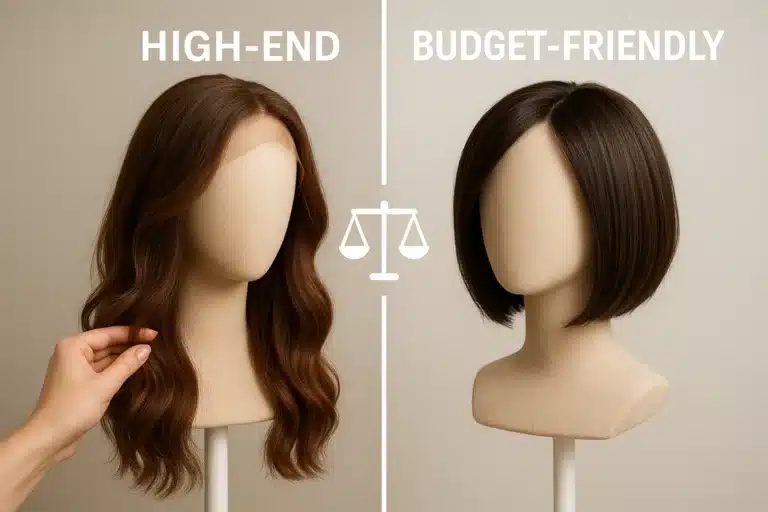
It is a common moment of confusion for anyone new to the world of alternative hair. You see a voluminous, red-carpet-ready wig listed at a premium price, and right next to it, a delicate piece with significantly less hair listed for the exact same amount—or sometimes even more. If you have been spending time Decoding Wig Pricing: A Granular Analysis of Cost Factors, you might intuitively expect the cost to drop as the amount of hair decreases. However, the reality of wig manufacturing follows a surprising set of rules.
Pricing in the wig industry often follows a “U-Curve.” The standard density wigs (around 130%) typically sit at the bottom of the curve where price points are most moderate. But as you move toward the extremes—either the ultra-light densities often required for medical realism or the ultra-heavy densities seen in high-fashion editorial looks—the prices climb. Understanding why requires us to look beyond the strands and examine the invisible engineering, specialized labor, and material economics that define these premium pieces.
The Paradox of Ultra-Low Density (60-90%)
When you are browsing for a wig, your instinct might be to equate value with volume. “More hair equals more money” seems logical. However, for individuals experiencing total hair loss or those seeking the most undetectable look possible, “less” is often much more difficult to create than “more.”
The Cost of Realism
Ultra-low density wigs, typically ranging from 60% to 90% density, are designed to replicate the natural spacing of hair as it grows from a human scalp. In a standard wig, manufacturers can use “double knots” (tying two or more hairs at once) and overlapping tracks to build coverage quickly. This is efficient and durable, but it doesn’t look like hair growing from skin.
To achieve a realistic low-density look, artisans must use single-knot ventilation. This is a painstaking manual process where individual strands are tied one by one into the lace base. This technique prevents the “doll head” appearance where hair plugs look too thick, but it exponentially increases the labor hours required to finish a single unit. You aren’t paying for the volume of hair; you are paying for the skilled labor required to make the wig disappear against your skin.
The “Nowhere to Hide” Factor
In a thick wig, the volume of hair can hide the cap construction underneath. If a weft is slightly uneven or a knot is a bit large, the surrounding hair covers it. In an ultra-low density unit, there is nowhere to hide. The cap materials must be premium—often utilizing fine Swiss lace or monofilament tops—because they are much more visible. This demand for perfection in the base construction drives up the price.
For those prioritizing realism, specifically when looking for natural hairlines, the investment in low-density craftsmanship ensures that the transition from forehead to wig is virtually undetectable.
The Economics of Ultra-High Density (180-300%)
On the other end of the spectrum lies the ultra-high density wig. These are the units often popularized by social media influencers and drag performers, boasting 180%, 200%, or even 250% density. Here, the cost drivers shift from labor skill to raw material economics and structural engineering.
Material Scarcity and Weight
The primary cost factor here is simple physics: human hair is sold by weight. A 250% density wig requires nearly double the raw bundles of a standard 130% unit. If you are looking for the best human hair wigs with significant length (22 inches or more), the price compounds. Long, healthy human hair is a finite resource, and sourcing enough matching bundles to create a high-density unit without compromising quality commands a premium market rate.
Structural Reinforcement
You cannot simply sew three times the amount of hair onto a standard wig cap and expect it to hold. The sheer weight of an ultra-high density unit puts immense tension on the lace and the cap structure. High-density wigs require:
- Reinforced Wefting: To prevent shedding under the weight of the hair.
- Heavy-Duty Construction: Stronger stitching and specialized cap materials that can support the drag of the hair without tearing the lace or causing the cap to lose its shape over time.
- Counter-Balancing: Engineering the fit so the heavy hair doesn’t cause the wig to slide back on the head.
The Engineering of the Cap
Whether the wig is sparse or dense, the cap is the chassis that holds everything together. The “U-Curve” of pricing is also a reflection of the specialized technology used in these caps.
For ultra-low density medical wigs, comfort is paramount. These caps are often hand-tied on soft, stretchable bases designed for sensitive scalps that may have no biological hair for cushioning. This soft, hand-tied construction is significantly more expensive to produce than machine-wefted caps.
Conversely, high-density units often utilize a glueless lace front wig construction that relies on friction and precise molding to stay in place, as the weight of the hair makes traditional adhesives tricky to manage for everyday wear.
Which Density is Right for You?
Understanding the price is the first step; knowing which investment serves your needs is the second.
Choose Ultra-Low (60-90%) If:
- You are experiencing medical hair loss: If you have lost your hair due to chemotherapy or alopecia, a standard 130% density wig can feel heavy, hot, and visibly “wiggy.”
- You are petite: Sometimes the best wigs for small heads are lower density, as too much volume on a smaller frame can look overwhelming and unnatural.
- You value undetectability over glamour: You want people to think you have healthy hair, not necessarily “done” hair.
Choose Ultra-High (180%+) If:
- You are performing or on camera: bright lights and flash photography tend to “blow out” hair, making it look thinner. High density counteracts this.
- You plan to customize heavily: If you want intricate braids, updos, or plan to have a stylist thin the wig significantly to frame your face, starting with extra bulk gives you the creative freedom to do so.
Frequently Asked Questions
Can I buy a high-density wig and thin it out to save money?
While possible, it is rarely cost-effective. You are paying a premium for the extra hair weight, only to pay a stylist to remove it. Furthermore, high-density caps are constructed differently; thinning the hair won’t change the heavier structure of the cap itself, which might be less comfortable than a wig designed to be light from the start.
Why do some low-density wigs look “pluggy”?
If a low-density wig looks like “doll hair,” it is likely a lower-cost unit where the manufacturer used standard double-knots but just spaced them further apart. High-quality low-density wigs avoid this by using single-knot ventilation, which mimics the randomness of natural growth.
Does higher density mean the wig will last longer?
Not necessarily. While high density means you have more hair to spare if shedding occurs, the weight of the hair places more stress on the knots and the lace. A well-maintained standard or low-density wig often has a similar lifespan to a high-density one, provided it is cared for correctly.
Conclusion
When you look at the price tag of a wig, remember that you aren’t just buying strands of hair. You are buying the architecture that holds them. Whether you need the delicate, hand-tied artistry of a low-density piece for medical recovery, or the robust, material-heavy glamour of a high-density unit, the price reflects the specialized approach required to create that specific experience.
By understanding these factors, you can move past the sticker shock and focus on what matters most: finding the hair that makes you feel like yourself. If you are ready to explore these options further, take your time browsing collections that prioritize construction quality as much as aesthetic appeal.