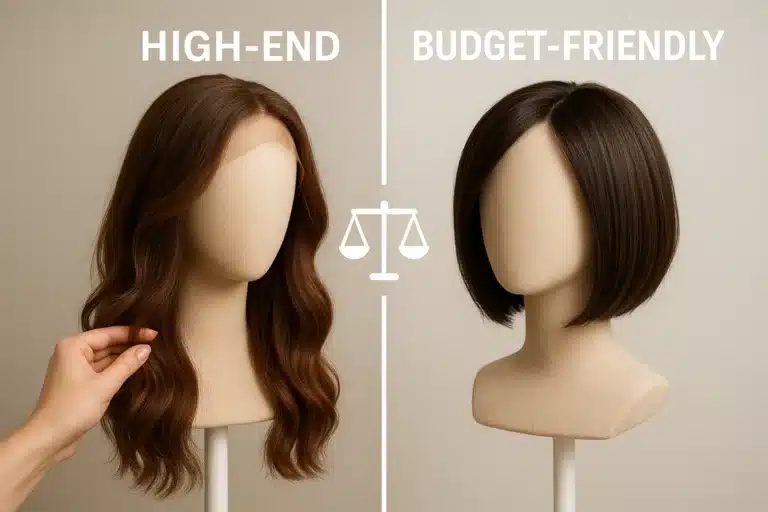
Imagine walking into an art gallery. You see a blank canvas priced at $50, and next to it, a masterpiece painted on the same material priced at $5,000. You intuitively understand that you aren’t paying for the canvas and the frame; you are paying for the vision, the technique, and the hours of labor that transformed raw materials into art.
The world of premium human hair wigs operates on a remarkably similar principle. When you see a price tag, you are looking at the baseline “canvas.” However, when that unit has been customized with multi-tonal balayage, root smudging, or textural treatments, the value proposition changes entirely. For those currently decoding wig pricing, it is essential to look beyond the initial cost of the hair and understand the “invisible” expenses—chemistry, time, and risk mitigation—that dictate the final price of a customized piece.
The Canvas Concept: Understanding Base Cost vs. Potential
To truly understand customization costs, we must first look at the hair as a raw material. In the wig industry, a high-quality human hair wig (often a 613 Platinum Blonde or a natural 1B Black) serves as the foundation.
A common misconception is that all hair is equal when it comes to dyeing. This isn’t the case. A wig that starts as a “613 Blonde” is essentially a pre-bleached canvas. It commands a higher initial price because the manufacturer has already done the heavy lifting of removing pigment, leaving a clean slate for vibrant colors or soft pastels. Conversely, taking a dark wig and lightening it requires significantly more chemical processing, labor, and risk, which we will explore below.
The Chemistry of Color: Why “Painting” Hair is an Investment
When you pay for professional wig coloring, you are paying for a complex chemical service performed on a non-regenerative surface. Unlike biological hair growing from a scalp, the hair on a wig cannot repair itself. Once the cuticle is damaged, it stays damaged. This fragility drives the cost of professional services significantly higher than standard salon visits.
The Cost of Lifting vs. Depositing
One of the most frequent questions we encounter is, “Can I change the color of my wig?” The answer depends entirely on direction:
- Depositing (Going Darker): Taking a blonde wig and dyeing it brown or black is chemically simpler. It involves adding pigment to the hair shaft. While it still requires skill to ensure even coverage, it is generally less risky and less expensive.
- Lifting (Going Lighter): Turning a dark brunette wig into a blonde bombshell is a high-stakes process. It requires bleach (lightener) to strip natural pigment. This damages the hair cuticle. A professional stylist must work slowly, often over multiple sessions, using lower-volume developers to lift the color without turning the hair into “straw.” This time intensity is why “lifting” services command a premium price.
The Balayage Premium
You may notice that a solid-color wig is significantly more affordable than a balayage wig. This price difference is almost entirely labor-based.
A single-process color (all one shade) can often be applied relatively quickly. Balayage, however, is an artistic technique where a stylist hand-paints highlights onto the hair to create a natural, sun-kissed gradation. On a high-density wig, a stylist is essentially painting over 100,000 individual strands. This process can take anywhere from 3 to 6 hours. You are paying for the stylist’s artistic eye and the sheer manual labor required to create dimension that mimics natural hair growth.
Texture and Structure: The Perming and Straightening Equation
Beyond color, texture treatments like perms or professional straightening add another layer to the pricing matrix.
The Chemical Risk Factor
Perming a wig is more difficult than perming hair on a human head. On a person, body heat helps process the chemicals. On a wig block, the stylist must artificially manage temperature and timing with surgical precision.
If a stylist over-processes a client’s natural hair, it is unfortunate, but it will grow back. If a stylist fries a $2,000 human hair wig, the unit is ruined forever. Therefore, the price of these services includes a “risk premium.” You are hiring a specialist who knows exactly how much tension to apply to the rods and the exact pH balance required to alter the hair’s structure without destroying its integrity.
The Hidden Skill Premium: Protecting the Infrastructure
The most critical—and often overlooked—factor in the price of customization is the protection of the wig cap itself.
The Knot Integrity Factor
On a hand-tied lace front wig, each hair is tied to the lace mesh with a tiny knot. When customizing a wig, particularly when bleaching the knots to make them invisible (a technique that makes the hair look like it’s growing from your scalp), there is a danger zone.
If bleach touches the knot for too long, it weakens the point of attachment. This leads to premature shedding. A master wig colorist charges more because they use protective creams and precise application techniques to ensure the chemicals color the hair without compromising the knot. This “Skill Premium” is the difference between a wig that lasts two years and one that starts shedding in two months.
Calculating the ROI of Professional Customization
It is tempting to look at a box of drugstore hair dye for $15 and wonder why professional wig customization costs hundreds. The answer lies in the concept of “Replacement Cost Risk.”
- The DIY Scenario: You spend $15 on dye. If the color goes wrong, or the bleach melts the lace, you have lost the entire value of the wig (potentially $1,000+).
- The Professional Scenario: You pay $300+ for customization. You receive a guaranteed result, preserved hair health, and a unit that looks indistinguishable from biological hair.
When you view the cost through this lens, professional services are not just an expense; they are an insurance policy for your investment.
Maintenance: Protecting Your Custom Investment
Once you have invested in a custom-colored or textured piece, the focus shifts to preservation. Chemically treated human hair wigs are more prone to dryness because they lack the natural oils from the scalp.
To ensure your investment holds its value, you must use products specifically formulated for processed hair. Neglect can lead to tangling and matting. If you find your unit becoming unmanageable, learning how to fix a frizzy human hair wig through deep conditioning and proper detangling techniques can restore the texture you paid for.
Frequently Asked Questions
Q: Can I dye a synthetic wig to save money?
A: generally, no. Synthetic fibers are essentially plastic and will not absorb standard hair dye. While some DIY enthusiasts use fabric dyes, the results are often patchy and can damage the fiber’s sheen. Custom color is largely the domain of human hair.
Q: Why is “Root Smudging” an extra charge?
A: Root smudging involves applying a darker dye just at the base of the hair to mimic regrowth. This creates a hyper-realistic look, especially on blonde wigs. It requires a steady hand to avoid staining the lace, adding to the labor cost.
Q: Can I take my wig to my regular hairstylist?
A: We recommend caution. While your stylist may be a master of biological hair, wig caps react differently to chemicals. We suggest looking for a stylist who specifically lists “wig customization” or “alternative hair services” on their menu.
The Next Step in Your Journey
Understanding the “why” behind wig pricing empowers you to make better purchasing decisions. A higher price tag on a customized unit often signals that the labor, risk, and artistry have been handled by experts, saving you from the stress of trial and error.
As you explore different styles, remember that you are not just buying a product; you are investing in craftsmanship. Whether you choose a factory-colored piece or a custom-painted masterpiece, knowing the work involved ensures you appreciate the value of your new look.