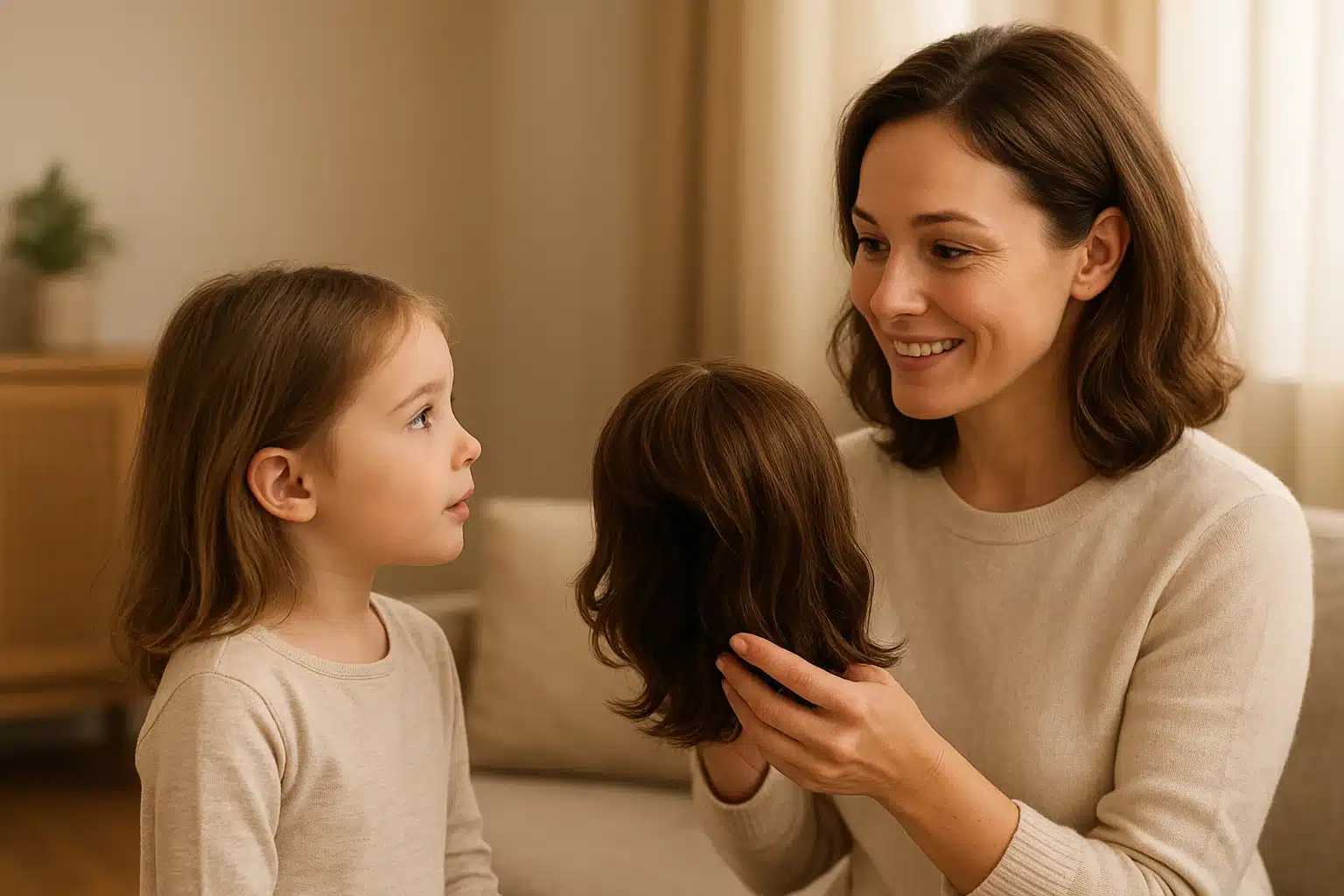
Imagine the scene: you are in front of the mirror, adjusting your wig or preparing to put it on, and your child walks in. Their eyes go wide, and the air fills with a sudden, heavy silence. For many parents and guardians, this is a moment of intense vulnerability. You instinctively want to protect your child from worry, yet you also want to be authentic about what you are going through.
The fear that a wig might confuse or scare a child is incredibly common, but the reality is often much gentler. Children are naturally curious, not judgmental. How they react depends almost entirely on the emotional tone you set. Navigating these sensitive family discussions is a key part of building strong support systems for wig wearers, ensuring everyone feels understood and accepted. When approached with care, this conversation doesn’t have to be a crisis—it can be a powerful opportunity to teach your children about empathy, adaptability, and self-confidence.
The Conversation You’re Worried About (And Why It’s an Opportunity)
Most parents delay “the talk” because they are managing their own emotions regarding hair loss. Whether your hair loss is due to alopecia, chemotherapy, or natural thinning, there is often a layer of grief involved. We project that grief onto our children, assuming they will feel the same sadness we do.
However, children view the world through a lens of practicality and play. To a child, a wig doesn’t necessarily signal “sickness” or “loss” unless we frame it that way. It can simply be an accessory, like a hat or a pair of shoes. By shifting your mindset from “confessing a secret” to “explaining a tool I use,” you remove the stigma. You are teaching them that bodies change, and there are wonderful ways to manage those changes.
The Foundation: 3 Golden Rules for the Talk
Before we dive into age-specific scripts, there are three universal rules that apply regardless of whether your child is a toddler or a teen.
1. Be Honest (But Age-Appropriate)
Kids are intuitive lie detectors. If you hide your wig or act secretive, they will sense that something is “wrong.” Honesty builds trust. However, honesty doesn’t mean oversharing medical details that might overwhelm them. It means answering the question asked, without adding unnecessary weight.
2. Keep It Simple
We often over-explain when we are nervous. We talk about follicles, medical treatments, and social norms. A child just wants to know: Is that hair? Is it yours? Does it hurt? Use simple, concrete analogies (which we will cover shortly) to bridge the gap.
3. Set a Positive Tone
Your energy leads the conversation. If you present the wig as something you are ashamed of, they will feel shame for you. If you present it as something helpful that makes you feel good—like wearing a favorite outfit—they will accept it as a positive part of your life.
The Heart of the Guide: An Age-by-Age Conversation Playbook
What works for a four-year-old will feel patronizing to a ten-year-old. Here is how to tailor your approach based on developmental stages.
Toddlers (Ages 2–4): Sensory and Simple
At this age, children are focused on what they can see and touch. They don’t need the backstory; they just need to know the object is safe.
- The Approach: Treat it like a game of dress-up. Make it tactile.
- The Script: “Look! Mommy has her ‘sleeping hair’ (bio hair/scalp) and her ‘awake hair’ (the wig). When we go out to play, I put on my awake hair!”
- Pro Tip: If they seem startled, play peek-a-boo with the wig. Let them touch the fibers so they see it’s soft, not scary.
Preschoolers (Ages 4–6): Curiosity and Analogies
Preschoolers are the “Why?” generation. They are trying to make sense of how the world works. This is the best age to use “helper” analogies.
- The Approach: Connect the wig to other tools they recognize.
- The Script: “You know how Grandma wears glasses to help her eyes see better? Well, I wear this wig to help my head feel cozy and to look the way I like. It’s like a special hat that looks just like real hair.”
- The “Why”: This normalizes the wig as a utility, not a scary medical device.
School-Aged Kids (Ages 7–11): Facts and Social Fears
Children in elementary school are becoming socially aware. Their concerns shift from what is it? to what will my friends think? They need reassurance about normalcy and rules.
- The Approach: Be factual and address the social aspect directly.
- The Script: “My hair stopped growing the way it used to, and that’s okay. I chose this wig because I love the style and it makes me feel confident. It’s just like how some people wear braces on their teeth.”
- Crucial Follow-up: Ask them, “Are you worried about what your friends might say?” If they are, give them a line to use: “My mom wears a wig, and it’s actually really cool—she can change her hair whenever she wants.”
Teenagers (12+): Identity and Privacy
Teens are dealing with their own body image issues and may feel embarrassed easily. They understand the concept of hair loss, but they need to feel their privacy is respected.
- The Approach: Treat them like adults. acknowledge their feelings.
- The Script: “I know this is a big change. I’m wearing a wig now because of [reason]. I want you to know so it’s not a surprise. How do you feel about it?”
- The Boundary: Discuss who knows. If you are open about it, let them know. If you prefer to keep it private, ask them to respect that circle of trust.
The “Aha” Moment: Visualizing the Experience
Sometimes words aren’t enough. The most successful “aha” moments for children often come from comparing the wig to things they already love or understand.
- The Super-Suit: For kids who love superheroes, explain that the wig is part of your “super-suit” that helps you get ready to face the day.
- The Accessory Box: Compare it to shoes. We don’t wear the same shoes for running, sleeping, and going to a party. Sometimes you wear a wig, sometimes a hat, sometimes a scarf. It’s just a choice from the accessory box.
Mastery: Your FAQ for Tough Questions
Even with a perfect script, kids ask wild questions. Here is how to handle the curveballs without panicking.
Q: “Are you sick?”
- A: If you are undergoing medical treatment, be honest but reassuring. “I am taking medicine to get better, and the medicine made my hair fall out for a while. The wig helps me feel like myself while I heal.” If it is alopecia or natural thinning: “No, I’m not sick! My body is healthy, it just decided it didn’t want to grow hair on my head anymore.”
Q: “Does it hurt?”
- A: “Not at all! It feels just like wearing a beanie or a baseball cap. Sometimes it can get a little warm, but it never hurts.”
Q: “Can I try it on?”
- A: This depends on the cost and delicacy of your piece. If it’s a durable synthetic wig, letting them try it on can demystify it instantly. If it’s a delicate human hair piece, say: “This one is very special and fragile, so only I can wear it. But we can find a dress-up wig for you if you want!”
Q: “Will your hair grow back?”
- A: Manage expectations. “We aren’t sure yet. Whatever happens, I’m happy that I have my wig so I can have hair whenever I want it.”
Beyond the Talk: Normalizing Your New Look
The initial conversation is just the door opener. The goal is to make wig-wearing a boring, normal part of your household routine.
One of the best ways to do this is to involve your children in the maintenance (if appropriate). Let them watch you wash it or help you choose between two different styles for a dinner out. When you treat your wig with care and confidence, you are modeling self-care.
Remember, children look to you to gauge how they should react to the world. By embracing your wig as a positive, empowering tool, you aren’t just explaining a hairpiece—you are teaching them that they have the strength to handle whatever changes life brings their way.