We’ve all been there: you step out the door feeling fabulous, but by noon, you’re experiencing that familiar, creeping sensation of your wig sliding back. Your immediate instinct is probably to take it off, find the adjustable straps at the neckline, and yank them as tight as they can possibly go. It seems logical—if something is slipping, tighten it. But if you’ve tried this, you already know it rarely works, and it usually creates an uncomfortable squeeze that gives you a headache.
The problem is that a wig cap is not a belt; it is a three-dimensional architectural foundation. Before diving into micro-adjustments, users must first understand the foundation of sizing. Effective customization starts with mastering wig fit through accurate head measurements and cap sizing, which provides the necessary baseline for using adjustable features effectively. Once you have the right canvas, true security comes not from squeezing the circumference, but from intelligently contouring the cap to the unique topography of your head.
The Psychology and Physics of the Perfect Fit
For many wig wearers, the pursuit of a secure fit is shadowed by the fear of their hair shifting in public. This often leads to a reliance on messy glues, heavy adhesives, or painfully tight adjustments. But when you understand the mechanics of your wig, you transition from seeking “security through glue” to achieving “security through architecture.”
A professional-level fit relies on the 3-Point Anchor System:
- The Nape (The Anchor): Provides vertical stability by hooking under the curve of your skull.
- The Ear Tabs (Lateral Stability): Prevents side-to-side shifting and keeps the hairline flush.
- The Straps (Circumference Tension): Secures the overall perimeter without bearing the entire weight of the wig.
When these three points work in harmony, they create a gentle, suction-like fit that holds your wig perfectly in place—all without restricting blood flow or causing tension headaches.
The Nape Anchor: Your Built-In Security System
If you run your hand down the back of your head, you’ll feel a distinct curve just above your neckline. This is the occipital bone, and it is the single most important anatomical feature for keeping your wig secure.
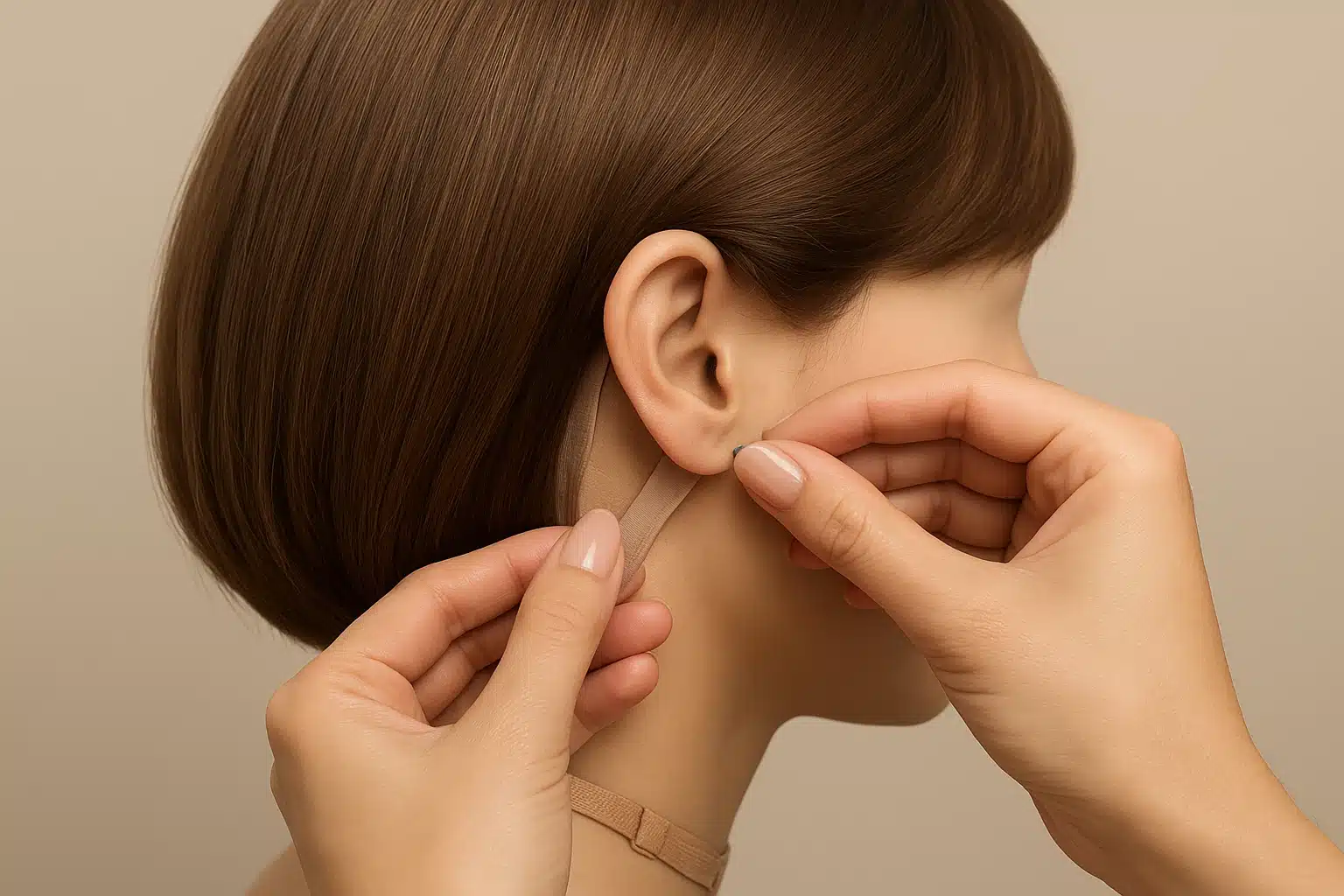
The nape of your wig is designed to cup slightly under this bone. Most beginners simply pull the nape adjusters (whether they are velcro or hook-and-loop) as tightly as possible. However, over-hooking the nape adjusters actually ruins the silhouette of the wig cap. It creates a bulk of bunched fabric at the back of your neck, which can cause the wig to ride up when you tilt your head.
The Pro Technique: Instead of pulling the straps straight across to the tightest notch, adjust them just enough so the elastic sits flush against the skin, allowing the bottom edge of the cap to comfortably cradle the underside of your occipital bone.
The “Strap Trap” and the Infamous Pop-Up Effect
Have you ever tightened your wig at the nape, only to find that the front hairline suddenly lifts off your forehead? This is a highly common phenomenon known as the “Pop-Up Paradox.”
Because a wig cap is a continuous dome of tension, over-tightening the back actually pulls the entire structure backward. The energy has to go somewhere, so the front of the wig lifts up. If your wig is popping up in the front, your first instinct shouldn’t be to glue it down. Instead, loosen the back straps. Often, releasing that excessive tension allows the front of the cap to relax and lay beautifully flat against your forehead.
Ear Tab Articulation: The “Metal Stay” Secret
If you’ve ever complained about the “ear flap struggle”—where the sides of your wig flare outward, leaving a visible gap above your ears—you are not alone. Ear tabs are meant to provide coverage and lateral stability, but many wearers don’t realize they contain a brilliant hidden feature: the metal stay.
Inside each ear tab is a small, bendable wire. Most people just pull the wig on and leave the tabs hovering however they fall. But these stays are meant to be articulated.
The “Bend and Stay” Technique: Once your wig is positioned correctly, place your fingers on the outside of the ear tabs. Gently but firmly bend the metal stays inward, curving them toward your cheekbones and temples. You are contouring the wire to follow the hollows of your face. This simple micro-adjustment transforms a floating piece of fabric into a custom-contoured anchor, creating a flush, natural-looking hairline that won’t shift when the wind blows.
Advanced Scenarios: Glasses, Ponytails, and Active Days
Customizing your fit isn’t just about standard daily wear; it’s about making the wig work for your specific lifestyle.
The Glasses Hack
Over 60% of people wear corrective lenses or sunglasses, yet mixing frames and wigs is a massive friction point. If you experience pressure behind your ears, the interplay between your ear tabs and your glasses is likely the culprit.
- The Adjustment: Instead of bending the ear tab inward, try bending the stay outward by about 10 to 15 degrees right where the arm of your glasses sits.
- Placement: Decide whether your frames should go under or over the ear tabs. Placing the arms under the tabs (against your skin) offers more stability for the glasses, while resting them over the tabs prevents the wig from being pushed upward. Finding what works best for you is a crucial part of your daily routine when wearing a wig with glasses.
Tension-Free Stability
If you have a perfectly sized cap but still want absolute reassurance during a workout or a windy day, you don’t need to over-tighten your straps. Using a velvet wig grip utilizes the directional friction of the fabric to comfortably lock your wig in place without adding stress to your hair follicles or scalp.
Professional Tailoring
Sometimes, no amount of strap adjusting will fix a cap that simply doesn’t match your unique head shape—like if you have a beautifully petite forehead but an average-sized crown. When micro-adjustments aren’t enough, professional customization services for wig fit and style can structurally alter the cap, taking in excess fabric exactly where you need it for a flawless, bespoke fit.
The Wig Fit Troubleshooting Matrix
Next time your wig feels off, use this symptom-and-solution map to identify the mechanical fix:
- Symptom: The front hairline is lifting or “popping up.”
- Solution: You’ve fallen into the strap trap. Loosen the nape adjusters by one or two notches to release the backward tension.
- Symptom: There’s a visible gap between the wig and your temples.
- Solution: Articulate the ear tabs. Locate the metal stays and bend them inward to contour against your face.
- Symptom: The wig is slowly sliding backward throughout the day.
- Solution: Check your nape anchor. Ensure the back of the wig is pulled down far enough to cup underneath your occipital bone, not resting on top of it.
- Symptom: Aching pressure behind the ears.
- Solution: The ear tabs are either sitting too low or the stays are bent too sharply inward. Bend the stays outward slightly, or check if your cap size is too deep for your head measurements.
Frequently Asked Questions (FAQ)
How should a properly adjusted wig actually feel?
A well-fitted wig should feel like a gentle, reassuring hug around the perimeter of your head. It should feel “locked in” securely at the nape and temples, but you should not feel throbbing, tightness, or restriction of blood flow. If you have a headache after an hour, your straps are too tight.
Can I stretch out my wig cap if I adjust the straps incorrectly?
Yes. Relying entirely on overly tightened straps places immense stress on the elastic and the delicate lace materials of the cap. Over time, this constant high tension will permanently stretch out the cap. Utilizing the 3-point anchor system distributes tension evenly, greatly increasing the longevity of your wig.
Are nape adjusters supposed to crisscross?
Generally, no. If you find yourself needing to crisscross the velcro straps or pull the hook adjusters all the way to the opposite side to feel secure, the wig cap itself is likely too large for your head circumference.
Next Steps on Your Wig Journey
Mastering the micro-adjustments of your wig cap is a game-changer. It shifts the power back into your hands, allowing you to transform a standard wig into a custom-tailored hairpiece that feels like an extension of yourself.
Remember, achieving the perfect fit is a blend of accurate foundation sizing and intuitive 3D contouring. Take the time to sit in front of a mirror, locate your nape anchor, articulate those ear tabs, and find the perfect balance of tension. By understanding the beautiful mechanics behind your cap, you ensure every day is a secure, comfortable, and confident hair day.