Imagine investing in a beautiful, high-quality wig, carefully taking it out of the box, and placing it on your head—only to feel like you are wearing a helmet. Or perhaps you experience the opposite frustration: a hairline that steadily creeps backward throughout the day, no matter how many pins or clips you use. If you are nodding your head right now, you are not alone. For many navigating the emotional journey of hair loss, achieving a truly seamless, natural-looking hairline is the biggest hurdle.
The problem usually isn’t the wig itself, and it certainly isn’t you. The issue often lies in how we are taught to measure our heads. While mastering wig fit through standard head measurements and cap sizing is an essential starting point, most guides stop at circumference. But your head isn’t a two-dimensional circle. It has contours, slopes, and distinct vertical proportions. Today, we are going to explore the critical 3D relationship between your wig’s cap depth and your unique forehead height, empowering you to find a fit that feels secure, looks incredibly natural, and helps you reclaim your confidence.
Moving Beyond the “Circumference Trap”
One of the most common pitfalls for beginners is falling into what we call the “Circumference Trap.” Here is how it happens: you measure around your head and find you are a solid size “Average.” You buy an Average wig, but when you put it on, the front feels unbearably tight or sits far too high on your forehead. Thinking the wig is too small, you exchange it for a “Large.” Now, the wig swallows your head, bunching at the nape of your neck.
Why did this happen? Because the circumference was right, but the depth was wrong.
Circumference only tells you how wide the wig needs to be. It doesn’t tell you how far the wig needs to travel from the front of your hairline, over the crown of your head, to the nape of your neck. Understanding the nuances of wig cap construction helps, but realizing that cap depth dictates the vertical “rest” of your hairline is the real game-changer.
The Anatomy of Fit: Cap Depth vs. Forehead Height
To achieve the Proportional Balance Rule—the sweet spot where your wig aligns perfectly with your facial geometry—you need to understand two critical measurements:
1. Cap Depth (Front-to-Nape): This is the distance from the front edge of the wig cap, over the top of the head, to the back edge at the nape. If a cap is too shallow, the wig will inevitably sit too far back. If it’s too deep, it will hang over your brow or bunch at the crown.
2. Forehead Height: This is the distance from your eyebrows to where your natural hairline begins (or used to begin).
Even the highest quality realistic hairline wigs will look artificial if the cap depth pushes the lace an inch too low or pulls it an inch too high. A beautifully crafted wig placed just one centimeter off its intended mark can drastically alter your facial proportions.
Forehead Archetypes: Finding Your Proportional Balance
Every forehead is wonderfully unique, but they generally fall into one of four archetypes. Knowing yours is the secret to unlocking a flawless fit.
The Average Forehead
Typically, an average forehead allows for standard cap depths to sit naturally. You can usually place the wig exactly where the cap wants to settle, and it will align perfectly with your facial framing.
The Low Forehead
If you have a lower forehead, a standard wig cap might feel like it’s resting too close to your eyebrows, creating a “helmet” effect.
- The Fix: You may need a petite-depth cap, or you can utilize the “Ear Tab Pivot.” By shifting the ear tabs slightly forward and tilting the wig back a fraction of an inch, you can raise the front hairline without sacrificing security.
The High Forehead
Those with high foreheads often struggle with the “sliding hairline.” The cap simply isn’t deep enough to reach your natural front hairline while still covering your nape.
- The Fix: You need a wig with a deeper front-to-back profile. Trying to force a shallow cap forward will only result in the wig creeping back over time. Learning how to keep wig from slipping starts with ensuring the depth matches your forehead height.
The Sloped or Receding Forehead
If your forehead slopes backward rather than sitting vertically flat, standard lace fronts can sometimes wrinkle or gap.
- The Fix: Focus on the tension at the ear tabs. The ear tabs act as an anchor point. Properly securing them helps pull the front lace taut against a sloped forehead, ensuring a flush, invisible melt against your skin.
The 4-Finger Benchmark: Your Biological Ruler
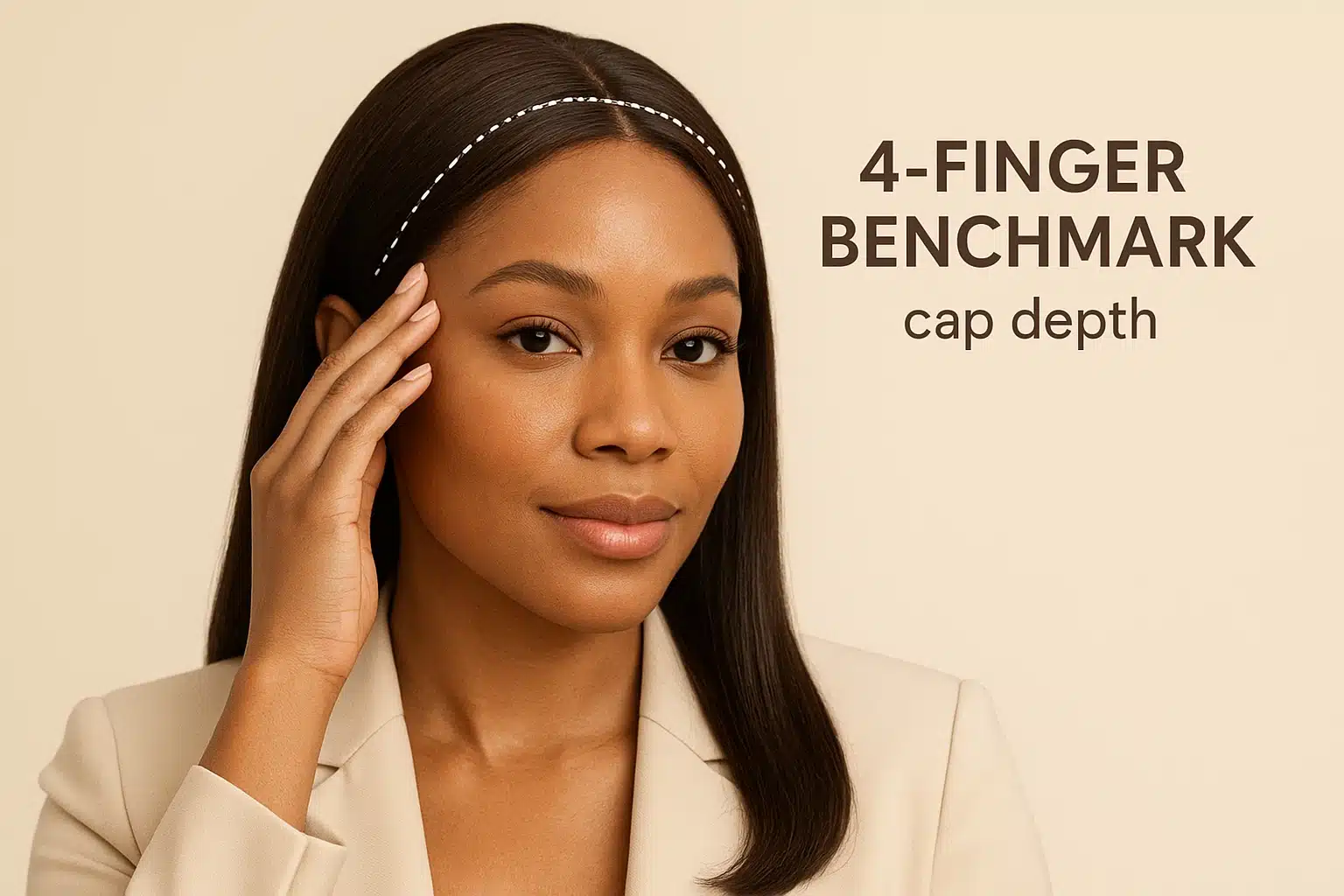
So, how do you know exactly where the wig should sit? Before you reach for a tape measure, try the “4-Finger Benchmark.” This is a stylist-favorite trick used worldwide.
- Hold your hand flat, keeping your fingers together.
- Place your index finger horizontally resting just above your eyebrow bone.
- The top edge of your fourth finger (your pinky, depending on hand orientation, or the top of your index finger if measuring up from the pinky on the brow) is approximately where your natural hairline should begin.
This biological ruler provides an instant “aha moment.” For most adults, the natural hairline begins about 2.5 to 3 inches above the eyebrows. If you place your wig using this benchmark and find the ear tabs are suddenly sitting above your ears, or the back is riding up your neck, you instantly know your cap depth is too shallow!
Troubleshooting Common Fit Frustrations
When cap depth and forehead height are mismatched, a few common issues arise. Here is how to diagnose them:
The “Helmet Look” (Deep Cap + Low Forehead)
If the wig feels heavy, sits too low, and creates excess bulk at the top of your head, perform the Pinch Test. Pinch the hair at the very crown of your head. If you can grab a handful of empty cap fabric, the depth is too long for your head shape.
The “Sliding Hairline” (Shallow Cap + High Forehead)
If you constantly have to pull your wig forward, the cap depth is too short. Often, wearers blame their adhesives and try to troubleshoot wig adhesion problems when the real issue is structural tension. Glue cannot fight the physics of a cap that is physically too short to reach your hairline.
Whether you are investing in a premium human hair piece or exploring high-quality natural looking wigs, getting the 3D geometry right will make any piece look significantly more expensive and customized to your face.
Frequently Asked Questions (FAQ)
How do I measure my front-to-back cap depth accurately?
Place the start of your measuring tape at the center of your natural front hairline (using the 4-Finger Benchmark if you are unsure where that is). Run the tape over the very top center of your head, down to the nape of your neck where your skull meets your neck muscles.
Can I adjust a wig if the cap is just a little too deep?
Yes! If you have minor gapping, using a velvet wig grip can add just enough circumference and friction to absorb that extra depth. Additionally, professional customization services can discreetly tailor the cap to reduce depth without ruining the style.
Does proper placement affect how the wig is styled?
Absolutely. Proper wig maintenance and styling rely entirely on the foundation of a good fit. If a wig is pulled too far forward, layers meant to frame your cheekbones will end up falling into your eyes. If it sits too far back, volume meant for your crown will look flat and unnatural.
Next Steps in Your Hair Journey
Experiencing hair loss can feel overwhelming, but finding the right wig should feel like a sigh of relief. By shifting your focus from a simple circumference measurement to understanding the beautiful, 3D proportions of your cap depth and forehead height, you take back control of your look.
Take a few moments today to try the 4-Finger Benchmark in the mirror. Assess where your current wigs naturally want to sit. Armed with this new understanding of proportion and balance, you are perfectly equipped to find a hairpiece that doesn’t just fit your head, but truly fits you.