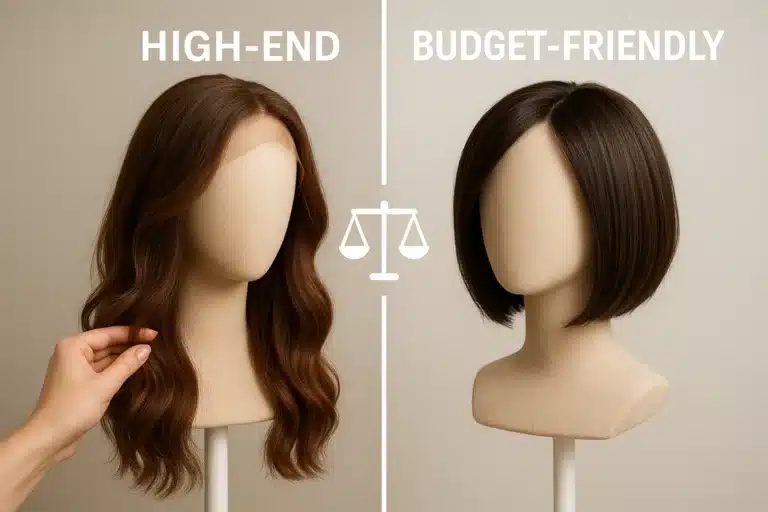
When you first begin browsing for high-quality wigs, the price range can be startling. You might see a synthetic piece for $200 sitting virtually next to a human hair design priced at $2,500. For many first-time buyers, especially those navigating hair loss, the instinct is to look strictly at the sticker price. However, experienced wearers know a secret that changes everything: the initial purchase price is often only about 60% of the true cost of ownership.
To truly understand what you are paying for, you have to shift your mindset from “shopper” to “investor.” Just like buying a vehicle, the initial cost is just the entry fee; the real value is determined by how long it lasts, how well it performs, and what it costs to keep it running smoothly. By learning how to calculate and maximize your wig ROI (Return on Investment), you can make a financial decision that saves you money in the long run, rather than just an emotional one based on the number on the tag.
Beyond the Sticker Price: The Total Cost of Ownership (TCO)
Total Cost of Ownership (TCO) is a business concept, but it applies perfectly to wearing hair. If you buy a “budget” wig that tangles in three weeks and needs replacing, it is actually far more expensive than a premium wig that lasts two years.
To calculate the true cost, we have to look at three distinct buckets:
- The Acquisition Cost: The price of the wig itself.
- The “Invisible” Product Stack: The chemistry and tools required to maintain the fiber.
- The Service Lifecycle: Professional styling, resizing, or deep conditioning over time.
The “Invisible” Product Stack
One of the most common mistakes beginners make is budgeting for the hair but forgetting the hardware. Standard drugstore products are the quickest way to destroy a wig’s investment value. The chemicals in standard shampoos (sulfates and parabens) strip the moisture from human hair wigs (which don’t receive natural oils from your scalp) and can degrade synthetic fibers.
To protect your asset, you need to factor in a “Starter Kit,” which generally costs around $100–$150 initially. This includes:
- Sulfate-free Shampoo & Conditioner: Specialized formulations to retain moisture.
- Wide-tooth Comb & Detangling Spray: To prevent mechanical damage and shedding.
- Mannequin Head or Wig Stand: Essential for drying and storage to maintain the cap’s shape.
- Thermal Protectant: Vital for heat-friendly synthetic or human hair.
Identifying the best wig care products isn’t just about styling; it is an insurance policy for the hair. Spending $50 on high-quality care items can prevent hundreds of dollars in premature repair or replacement costs.
The Mathematics of Longevity: Calculating Cost Per Wear (CPW)
The most accurate way to judge the price of a wig is not the total dollar amount, but the Cost Per Wear (CPW). This formula helps level the playing field between a $300 synthetic wig and a $3,000 human hair wig.
The Formula:(Purchase Price + Annual Maintenance Costs) ÷ Days Worn Per Year = Cost Per Wear
Scenario A: The “Budget” Synthetic
Let’s say you buy a standard synthetic wig for $250. It looks great, but because you wear it daily (approx. 12 hours a day), the fibers begin to friction-frizz at the nape of the neck by month three. You replace it four times a year.
- Annual Cost: $1,000 ($250 x 4)
- Annual Maintenance: $100 (shampoo/spray)
- Total: $1,100
- CPW: ~$3.01 per day.
Scenario B: The “Investment” Human Hair
You purchase a high-quality Remy human hair wig for $2,000. With proper care, this piece lasts two years.
- Two-Year Cost: $2,000
- Two-Year Maintenance: $400 (specialized products + one professional refresh)
- Total: $2,400 ÷ 2 years = $1,200 per year.
- CPW: ~$3.28 per day.
The Aha Moment: The daily difference between a “cheap” solution and a “luxury” solution is often less than the price of a cup of coffee. While the upfront cash flow is different, the long-term financial impact is remarkably similar—but the experience, confidence, and realism of the human hair wig are often superior.
The Hidden Cost of Professional Maintenance
Just as a car needs an oil change, a high-end wig requires occasional professional attention. This is a variable often left out of online conversations.
For human hair wigs, you should budget for a professional “refresh” every 9 to 12 months. This might involve:
- Deep Conditioning Treatments: To restore moisture and bounce.
- Knot Sealing: To prevent shedding at the cap.
- Lace Trimming or Repair: If the front hairline has frayed.
These services usually range from $75 to $200 per session. While this adds to the cost, it resets the clock on the wig’s lifespan. Ignoring wig maintenance accelerates depreciation, forcing you to buy a new unit sooner.
The Break-Even Point: When to Upgrade?
Understanding the “Break-Even Point” helps you decide which type of hair is right for your lifestyle.
If you are an occasional wearer (weekends or special events only), a synthetic wig is almost always the better financial ROI. A synthetic wig worn 20 times a year will last for years, keeping your CPW incredibly low.
However, if you are a daily wearer (due to medical hair loss or alopecia), the friction of daily life destroys synthetic fibers quickly. In this scenario, the break-even point—where a human hair wig becomes cheaper than buying repeated synthetic replacements—usually happens around month 14 to 18.
Protecting Your Asset: Avoiding “Investment Killers”
You can ruin your ROI in a single afternoon if you aren’t careful. The fastest way to lose money on a wig isn’t buying the wrong one; it’s treating the right one poorly.
- The Heat Trap: Using standard hot tools on non-heat-friendly synthetic fiber will melt it instantly. It is unfixable.
- The Kitchen Beautician: Attempting to color or bleach a human hair wig yourself can chemically burn the hair, leading to severe shedding.
- The Sleeping Hazard: Sleeping in your wig without a silk bonnet or pillowcase causes friction (matting) that can cut a wig’s lifespan in half.
Learning how to care for human hair wig fibers specifically—versus how you treat bio hair—is the final piece of the financial puzzle.
Frequently Asked Questions
Is a human hair wig always a better investment than synthetic?
Not always. It depends entirely on frequency of wear. If you only wear wigs occasionally to change up your style, synthetic offers a much better ROI because the fiber doesn’t degrade while sitting in a box. Human hair requires maintenance (styling/hydration) even when not worn frequently.
Can I use regular grocery store shampoo to save money?
This is the most common “penny wise, pound foolish” mistake. Regular shampoos contain sulfates designed to strip oil from a living scalp. Since wigs do not produce oil, these shampoos strip the hair’s only moisture source, turning a $2,000 soft wig into a brittle, tangling mess in just a few washes.
How much should I budget for annual maintenance?
For a daily wearer of human hair, a safe annual budget for products (shampoo, conditioner, oils, hold sprays) and one professional service is approximately $200–$300. For synthetic wearers, the annual maintenance cost is lower, usually around $100–$150.
Does the cap construction affect the price and lifespan?
Yes. Monofilament and hand-tied caps are more expensive because they are labor-intensive (hairs are tied individually). However, they also allow the hair to move more naturally, which can actually reduce tangling and shedding compared to cheaper machine-wefted caps, potentially offering a longer lifespan if treated gently.
Next Steps for the Smart Investor
Now that you understand the true cost of ownership, you can browse with confidence. Look past the sticker price and ask yourself: “What is my cost per wear?” Whether you choose the ease of synthetic or the longevity of human hair, you are now equipped to make a choice that fits both your style and your financial goals.