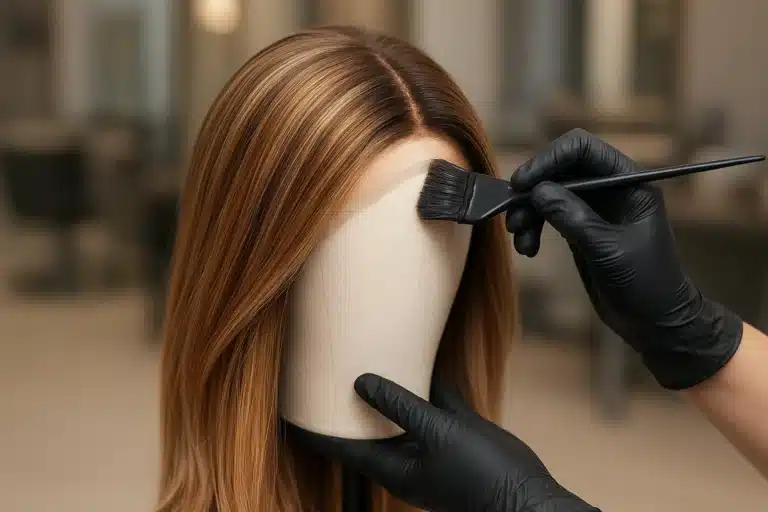
Imagine walking into a boutique. You see a wig on a display head. You instinctively reach out to touch it, running your fingers through the strands to test its softness. You check the hairline up close, holding it against your skin. You feel the weight of the cap in your hands. This tactile experience provides immediate, undeniable proof of quality.
Now, shift to the digital world. You are staring at a high-resolution image on a screen. The model looks stunning, the lighting is perfect, and the description promises “luxury.” But you can’t touch it. This creates a distinct tension—the online wig shopping dilemma—where convenience battles with the anxiety of the unknown. Without the ability to physically inspect the hair, how can you be sure you aren’t buying a disappointment?
The secret lies in shifting your mindset from a “shopper” to an “investigator.” While you cannot touch the product, high-quality listings leave digital clues that reveal the truth about a wig’s construction and realism. By learning to decode these visual signals and technical specifications, you can bridge the tactile gap and shop with clinical confidence.
The Visual Audit: Reading Between the Pixels
Most buyers look at the model’s face or the overall style. To verify quality, you must learn to look past the aesthetic and scrutinize the mechanics. Here is how to perform a visual audit on any product listing.
The “Lighting Trap” and Plastic Shine
Studio lighting is designed to make everything look appealing, but it can mask the quality of synthetic fibers. High-quality synthetic hair should mimic the light-reflecting properties of biological hair—a soft, diffused sheen. Lower-quality fibers often reflect light like plastic, creating a high-gloss “doll hair” effect.
What to look for:
- The Crown Burst: Zoom in on the top of the head where the light hits most directly. If you see a blinding white “halo” or sharp, aggressive reflections, the fiber may be too shiny and artificial.
- Blonde Warning Signs: Blonde shades are notoriously difficult to photograph. If a blonde wig looks flat, one-dimensional, or excessively yellow under studio lights, it often lacks the multi-tonal depth required for realism. Look for descriptions mentioning “rooted” colors or “dimensional” shades, which indicate a more natural color gradient.
The “Knot Test”
The illusion of hair growing from a scalp is created by the way fibers are attached to the cap. In higher-end wigs (specifically hand-tied or monofilament), individual hairs are knotted into a mesh material.
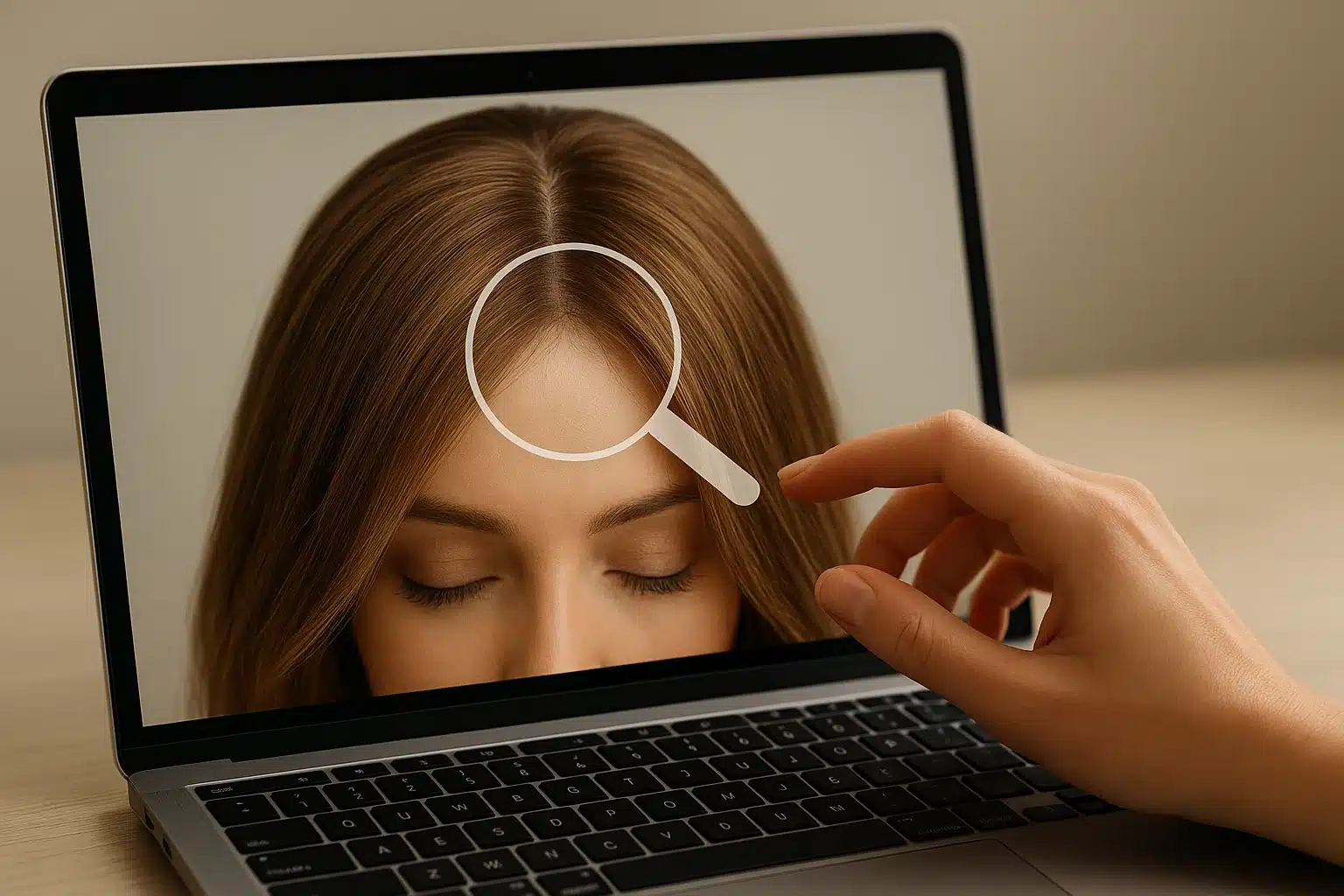
The Zoom Technique:Use the zoom function on the product page to inspect the parting line.
- The Red Flag: If you see prominent black dots at the root of the hair (especially on lighter skin tones), these are visible knots that haven’t been bleached or concealed. This creates a “grid” look that destroys the illusion of natural growth.
- The Quality Indicator: Look for “invisible knots” or descriptions of “monofilament” features. In these constructions, the knots are tiny and the mesh is sheer, allowing your own skin tone to show through, making the hair appear as if it is growing directly from your scalp.
Analyzing “Swing” and Movement
Hair has mass and physics. Biological hair swings and settles; it doesn’t stay stiff. While you can’t shake the wig yourself, you can look for cues in the imagery.
- Video Verification: If the product page includes a video, watch the ends of the hair as the model turns her head. Does the hair move fluidly, or does it move as one solid block? Stiffness suggests heavy coating or low-grade fiber density.
- The Shoulder Resting Point: In static photos, look at where the hair rests on the shoulders. Does it bunch up unnaturally, or does it drape softly? High-quality fiber (both synthetic and human) should possess a natural drape.
Decoding the Specs: From Jargon to Reality
Product descriptions are often filled with industry terminology that can feel like a foreign language. Understanding three key metrics will help you predict how the wig will feel and behave.
Density: The Volume Equation
Density refers to the amount of hair on the cap. A common misconception is that “more is better.” In reality, “more” often looks “wiggy.”
- 130% Density (Standard): This is the industry sweet spot for a natural look. It mimics the density of an average head of biological hair.
- 150%-180% Density (Heavy): While popular for glamorous, stylized looks, high density can look unnatural for everyday wear, especially if you are experiencing hair loss and are used to finer hair. If a listing boasts massive volume but you want realism, proceed with caution.
Cap Construction Hierarchy
The inside of the wig matters more than the outside for comfort and realism.
- Basic/Wefted Cap: Durable and affordable, but the hair is sewn in rows (wefts). You generally cannot change the part.
- Lace Front: Features a sheer mesh strip along the hairline. This is the gold standard for off-the-face styling. If the listing doesn’t specify “Lace Front,” the wig will likely have a hard, abrupt hairline that requires bangs to conceal.
- Monofilament Top: The entire top section is sheer mesh. This allows you to part the hair in any direction and gives the most realistic “scalp” appearance.
Fiber Technology
- Synthetic: Holds its style through rain and humidity. “Shake and go” convenience.
- Heat-Friendly Synthetic: Allows for heat styling (curling/straightening) but requires more maintenance to prevent friction frizz.
- Human Hair (Remy vs. Non-Remy): “Remy” means the cuticles are kept intact and aligned in one direction. This prevents tangling and ensures longevity. If a listing says “100% Human Hair” but omits “Remy,” the hair has likely been chemically stripped, which can lead to matting after a few washes.
The Social Proof Filter
When you can’t verify the product yourself, you must rely on the verification of others. However, not all reviews are created equal.
How to Read Reviews Like a Pro:
- Seek User Photos: Skip the text and look for customer-uploaded photos. These are usually taken in bathroom mirrors or natural light—the “truth serum” for wig quality.
- The “Wig Check” Consensus: Look for recurring comments about specific pain points. If three different people mention “it sheds a lot” or “the cap runs small,” it is a pattern, not a fluke.
- Video Reviews: Search YouTube or TikTok for the specific wig name. Influencers often do “unboxing” videos where they show the wig straight out of the box, before any professional styling. This reveals the “baseline” reality of the product.
Frequently Asked Questions
Q: Can I trust the color I see on my screen?
A: Monitors vary, so color is rarely 100% accurate. To verify, look for the color code (e.g., 12FS8) and search for that specific color code on different websites or video reviews to see how it looks in various lighting conditions.
Q: How do I know if a wig will fit without trying it on?
A: 95% of women fit into an “Average” cap size. However, knowing your circumference is vital. Measure your head with a flexible tape measure. If you are between 21.25″ and 22.5″, you are an Average. Listings should always have a size chart; if they don’t, that is a red flag.
Q: What is the “Burn Test” I hear about?
A: This is a post-purchase test to verify human hair. You take a few strands and burn them. Human hair burns to ash and smells like singing hair. Synthetic fiber melts into a hard plastic ball and smells like chemicals. This is the ultimate scientific proof of authenticity.
Q: Is “HD Lace” necessary for a natural look?
A: HD (High Definition) lace is thinner and more invisible than standard Swiss lace, making it excellent for close-up scrutiny. However, it is also more fragile. For daily wear, standard Swiss lace is often durable enough and still very realistic.
Moving Forward with Confidence
The transition to wearing wigs is a journey of self-discovery, and the online landscape offers an abundance of options that a local shop simply cannot match. By analyzing the hairline, checking the knotting, understanding density, and filtering through social proof, you strip away the mystery.
You don’t need to touch a wig to know its worth. you just need to know where to look. As you continue your search, remember that quality is an investment in your confidence. Armed with these insights, you are no longer just browsing; you are curating the version of yourself you want to present to the world.