You aren’t just looking for a wig; you are looking for your hair. The difference between a standard hairpiece and a look that feels undeniably authentic often comes down to one factor: dimension.
While the human hair wig market is projected to reach staggering heights—exceeding $4.5 billion by 2033—the real story isn’t about sales volume. It is about the shift toward customization. The days of flat, monochromatic colors are behind us. Today, discerning wearers demand the depth of balayage, the transition of ombre, and the sun-kissed lift of highlights.
However, coloring a wig is fundamentally different from coloring growing hair. You don’t have the benefit of body heat to process color, and there is no “regrowth” to correct mistakes. This is a high-stakes customization on a premium investment.
Whether you are evaluating a pre-colored piece or considering customizing a virgin human hair wig, this guide serves as your strategic framework for achieving professional, natural-looking results without compromising the integrity of the hair.
The Canvas Matters: Assessing Human Hair Quality
Before you even look at a color chart, you must audit the hair itself. Not all human hair wigs react to chemical processing in the same way, and mistaking one type for another is the most common cause of coloring disasters.
Virgin vs. Processed Hair
This is your primary evaluation metric. Virgin hair has never been chemically processed. Its cuticles are intact and aligned, making it the ideal canvas for bleaching and lifting. It behaves predictably.
Processed human hair, however, has likely been dyed, texturized, or stripped to achieve a specific look before it reached you. Attempting to bleach processed hair can lead to catastrophic dryness or “gumminess” because the structural integrity has already been compromised. If you plan to lift color (go lighter), you almost strictly require a high-quality virgin base.
Understanding Porosity
Porosity determines how your wig absorbs and retains moisture and color.
- High Porosity: Absorbs color instantly but fades quickly. Common in curly textures or heavily processed hair.
- Low Porosity: Resists color absorption; processing takes longer. Common in healthy, virgin straight hair.
Knowing the porosity allows you to adjust your processing time and saves you from a patchy, uneven result.
The Chemistry of Color: Selecting the Right Products
When modifying a premium wig, off-the-shelf box dyes are rarely the answer. You need formulations that respect the lack of natural oils in wig hair.
Semi-Permanent vs. Demi-Permanent vs. Permanent
- Semi-Permanent: These deposit color without lifting the cuticle. They are the safest option for darkening a wig or adding a gloss. Because they don’t penetrate the shaft deeply, they will fade over 6-8 washes, making them low-risk for testing tones.
- Demi-Permanent: Using a low-volume developer (usually 10 vol), these deposit color more deeply than semi-permanents but still do not lift pigment. This is the industry standard for refreshing faded color or toning highlights without damaging the hair.
- Permanent: Necessary only when you need to lift color or cover stubborn grays. However, frequent use on wigs can degrade the hair fiber lifespan, as wigs do not regenerate keratin.
Advanced Techniques: Balayage, Ombre, and Highlighting
The current market data suggests a massive surge in demand for “lived-in” color. Achieving this requires specific application techniques that differ significantly from salon methods used on biological hair.
The Balayage Approach
Balayage is freehand painting. On a wig, this technique creates the most natural finish because it avoids hard demarcation lines.
- Technique: The dye is swept onto the surface of the hair, usually starting mid-length and getting heavier toward the ends.
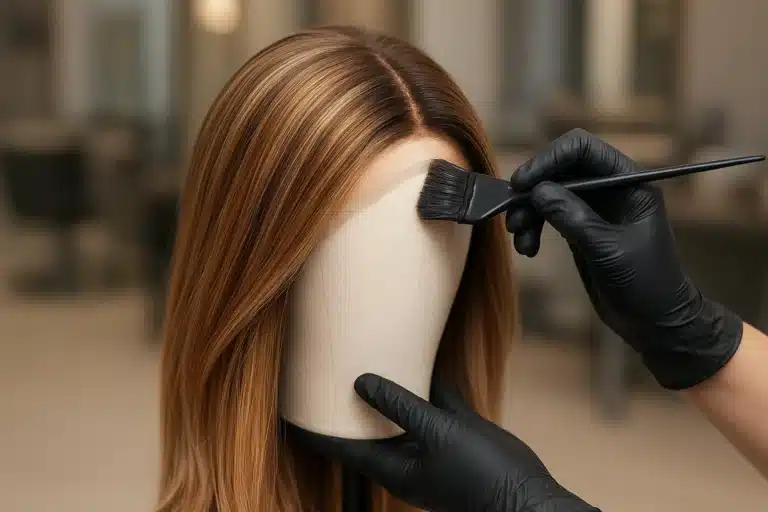
- The Wig Difference: When performing balayage on a wig, you must secure the wig to a canvas block head. Unlike a human head, the wig won’t move, giving you total control. However, you must be hyper-vigilant about keeping bleach away from the lace knotting, as bleach will weaken the knots and cause shedding.
Ombre Mechanics
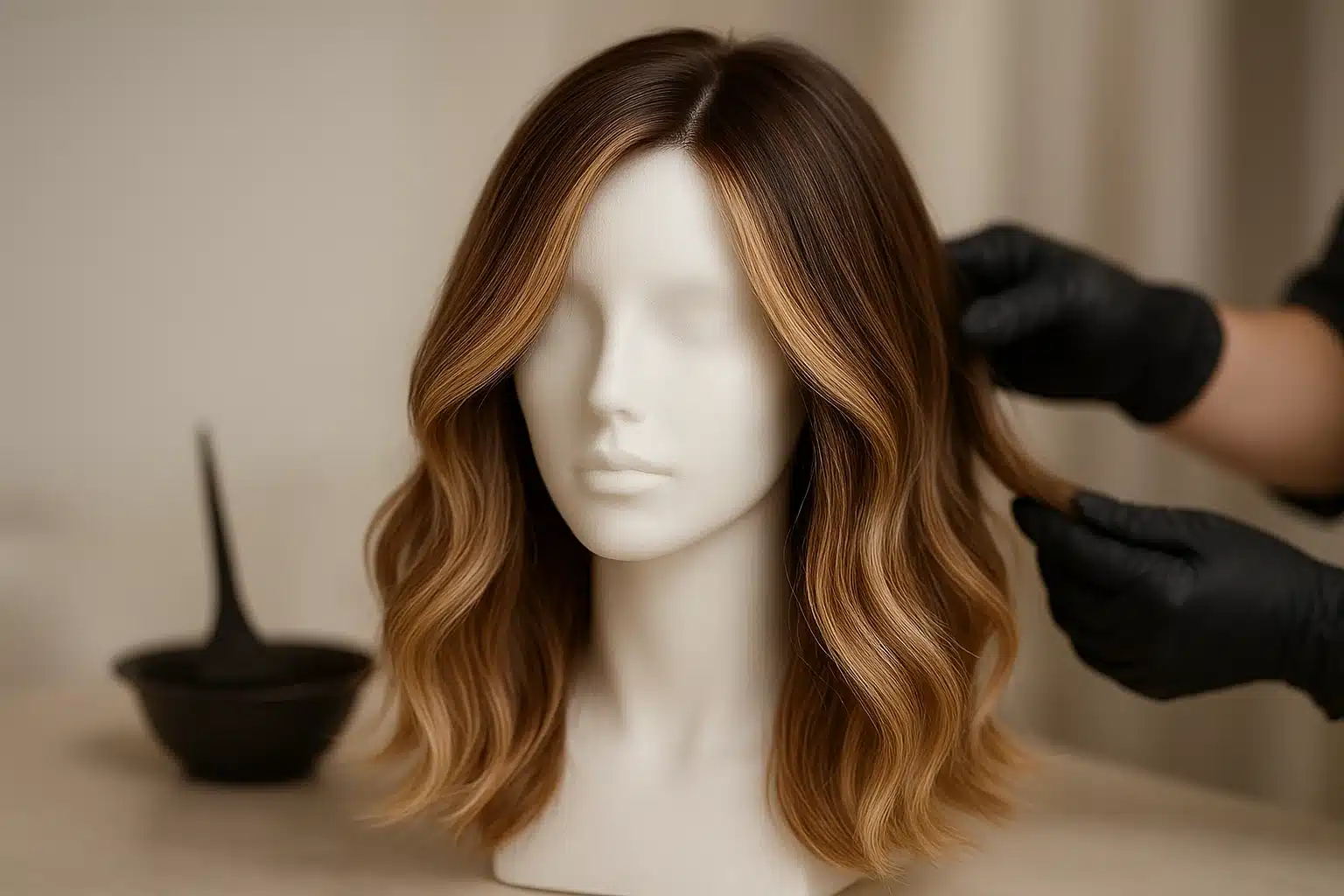
Ombre creates a horizontal graduation from dark roots to light ends.
- Technique: This often involves a “teasing” method where hair is backcombed before applying bleach to ensure a soft transition rather than a stark line.
- Best For: Lower maintenance. Since the roots remain dark, you don’t have to worry about the “growth” line looking fake against the lace.
Traditional Highlights (Foiling)
Foiling provides precise, high-contrast lift.
- The Risk: The heat generated inside a foil packet can process very quickly on a wig.
- The Strategy: Use a lower volume developer (20 vol maximum) and check the foils frequently. “Lowlights” can also be woven in using this method to add depth to a wig that looks too flat or solid.
Execution: A Strategic Framework for Application
To ensure safety and vibrancy, follow this protocol. This reduces the variables that lead to errors.
1. Preparation and Lace Protection
This is the step most amateurs skip. Protect the lace. If dye touches the lace material, it will stain permanently, ruining the illusion of a natural scalp.
- Pro Tip: Apply a thick layer of styling gel or a barrier cream to the inside of the lace cap and the hair knots before coloring. Dry it down. This creates a seal that prevents dye from bleeding through to the lace.
2. The Watercolor Method vs. Brush Application
For solid colors or fashion tones (pinks, blues, silvers), the Watercolor Method is superior.
- Process: Dissolve semi-permanent dye in a basin of hot water. Dip the wig in.
- Why it works: It ensures even saturation instantly, eliminating the risk of missed spots that happen with brush application.
For highlights or dimensional color, you must use the Brush Application on a canvas block head to isolate specific sections.
3. Processing and Rinsing
Wigs process color differently because there is no body heat.
- Cold Processing: You may need to let the color sit longer than the box instructions suggest, or use a hooded dryer on a low setting to mimic body heat.
- Rinsing: Rinse with cool water. Warm water opens the cuticle and rinses the money (color) right down the drain. Always wash the hair flowing in one direction to prevent tangling.
Troubleshooting and Color Correction
Even with the best planning, variables can shift the outcome. Here is how to handle common issues without panicking.
The Issue: Hot Roots (Roots lighter than ends)
- The Fix: This usually happens because the hair at the root is newer (on the donor) or reacted faster. Apply a root smudge using a demi-permanent dye one shade darker than your target color to deepen the base and melt it into the length.
The Issue: Brassy or Orange Tones
- The Fix: This is simple color theory. Blue neutralizes orange; violet neutralizes yellow. Use a high-quality toning shampoo or a toner with the correct base pigment to cool down the warmth. Do not bleach again immediately.
The Issue: Uneven or Patchy Color
- The Fix: This often indicates uneven porosity. Use a colored gloss treatment. It acts as a topcoat, filling in the lighter patches and unifying the overall tone while adding shine.
Preserving Your Investment: Maintenance Protocols
You have invested in a high-quality human hair wig and customized it. The goal now is longevity. The $2.5 billion market growth is driven by consumers who view these wigs as long-term assets, not disposable items.
- UV Protection: Sunlight is the enemy of hair color. It oxidizes pigment, turning brunettes red and blondes brassy. Use UV-protectant sprays if you are outdoors for extended periods.
- Sulfate-Free Chemistry: Sulfates strip color. Ensure every shampoo and conditioner in your arsenal is sulfate-free and color-safe.
- Thermal Regulation: Heat styling tools fade color rapidly. Always use a heat protectant and keep tools below 350°F (175°C).
- Deep Conditioning: Since the wig receives no natural oils from the scalp, you must manually replenish moisture. A weekly mask keeps the cuticle flat, which locks the color molecule inside the hair shaft.
FAQ: Common Obstacles in Wig Coloration
Can I dye a synthetic wig using these methods?No. Synthetic fibers are plastic and do not absorb standard hair dye. They require fabric dyes and heat setting, which is a completely different (and riskier) chemical process. The techniques above are exclusively for human hair.
Will coloring my wig shorten its lifespan?Chemical processing always impacts the integrity of hair. However, if you stick to depositing color (going darker) rather than lifting (bleaching), the damage is minimal. Bleaching requires aggressive hydration maintenance to keep the hair soft.
Should I wash the wig before coloring it?Yes. Wigs often come with a factory coating or silicone finish that makes them shiny but blocks dye absorption. Wash the wig with a clarifying shampoo to strip this residue before applying any color.
Why did my color turn out darker than the box said?Wig hair is often more porous than growing hair. Porous hair drinks up color like a sponge, often resulting in a darker or cooler tone than expected. Always perform a strand test on a small section at the nape of the neck before committing to the whole head.
Conclusion
Mastering the art of wig coloration allows you to transcend the standard “off-the-rack” look, moving into a space of true personalization and confidence. Whether you are executing a subtle balayage or a complete color transformation, the secret lies in respecting the canvas—starting with high-quality human hair [] and applying patience and color science in equal measure.
By understanding the unique properties of wig hair and following a safety-first protocol, you ensure that your investment pays dividends in confidence and style for years to come.